Saturday, 9 September 2017

War Thunder Air Battles Review (PC Games for Wargamers)

War Thunder is a WW2-focussed PC game where players can pilot tanks or aircraft (sometimes on the same map) and when I heard they would have a naval aspect focussing on coastal forces - E-boats, MTBs, MGBs and destroyers (possibly my favourite genre of historical warfare, period!) I downloaded it, afire with dreams of piloting a "Dog Boat" against E-boats in the Med.

Well, the naval side of things has not come out of beta yet, but I've had a lot of fun flying air battles.  As a kid I had "Encyclopedia of World War II Aircraft" on near-permanent loan and without exaggeration I could probably name (and give key stats) on pretty much every combat aircraft  of the era (though trainers and transports were a bit more dull to my 12-year-old self).

This review will focus only on air battles - I haven't explored ground forces (tanks) beyond the tutorials.

Aircobras and Kingcobras are some of my favourite planes; good at the low altitude of Arcade mode; solid all-round and packing a 37mm with decent .50 cal backup. Also they look sexy!
 
War Thunder allows me to live out my dream of flying Kittyhawks with shark nose art against Zeroes; Spitfires against 109Es, taking down B-17s with a cannon-festooned 190, flying a Molins armed Mossie against German shipping...

It has a range of difficulty settings: arcade (very much Crimson Skies with simple damage and physics; you usually fly with a mouse) realistic (more realistic physics and damage, logistics) and sim (cockpit only, joystick only, "full real" settings).  I must admit I only play arcade; with small kids I don't have the luxury to spend 30 minutes climbing to altitude like in sim mode and with limited time I like air-spawning straight into the action.

There is a huge range of game modes; you can play 12v12 arena, fighting to capture airfields, bomb targets, fly historical missions or campaigns or even make your own.  You can fly historical lineups or just mix up teams with random planes in multinational lineups; my mate might fly a Hurricane while I back him up in a 109.  There's something for everyone; for the die hard historical buff to the casual dad who wants to jump in and pew-pew in a Spitfire for 5 minutes using merely a keyboard+mouse and the most basic flight controls.

I have focussed primarily on Arcade quick matches; they go for 5-10 minutes, perfect for a busy dad; and you can get away with a minimum of controls (i.e. non-gamers can easily jump in fly about and pew-pew using only a keyboard and mouse).  If you die you can respawn and return to the fight if you desire. Arcade mode is divided into tiers 1 to 5; basically by historical era and performance; tier 1 may include Gladiators, I-16s, 109Bs, A5Ms, CR.42s etc - mostly nimble biplanes with low firepower - I did not enjoy this tier as much due to the frustration of peppering a biplane with dozens of non-vital MG hits.  Also, it's very dogfight-y with aircraft tailchasing in circles a lot.  I really enjoyed tier 2 play, early war craft like 109Es, Spits, P40s, Wildcats, Yaks, Zeroes and Hurricanes. I prefer energy fighting in the vertical and I did well at this tier against opponents who still only wanted to "turn and burn" low.  I'm at tier 3 now (Corsairs, Hellcats, later 109s, Spits and Zeroes, Mustangs, La5/7s, P47s, P38s etc).  Tier 4 is late war super-props like La11s, Bearcats, Do335s and Ta152s and Tier 5 is jets up to the Korean War (including my favourite quirky jet, the DH Vampire).
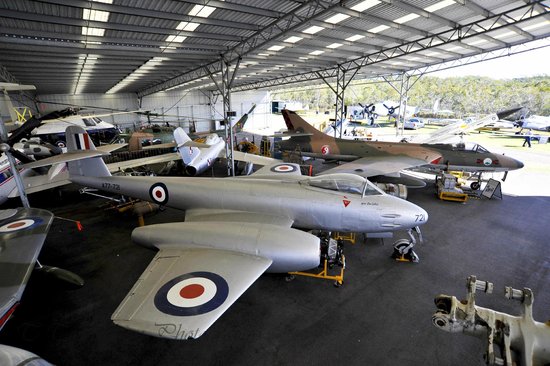
The Korean War jets reminded me to visit Caloundra's  Air Museum for a day trip. They have a great selection of 1950s jets, including some quirky planes like Fairey Gannets.

Gameplay wise; it's hard to review as War Thunder varies wildly between game modes - in Arcade mode I've noticed that as ground targets are often the objective, bombers tend to determine the win unless the fighters actively hunt them and don't get tempted into the nearest furball.   I've had a lot of fun brushing up on air combat maneuvers; whilst I already "got" simpler stuff like Immelmans, Split-S, scissors and yo-yos, I'm learning to spiral climb and perform hammerhead turns.  I found this WarThunder-specific  Youtube channel handy (he's also an Aussie).  Playing with friends is fun; having a wingman to clear your tail is pretty handy and I like dragging enemies out with climbing turns to bleed them of energy, leaving them hanging as easy targets for allies to kill.  If dogfighting isn't your thing, bombers have a big influence on the battle.

The planes seemed reasonably balanced (unlike games like World of Tanks where a tank can find itself unable to damage a "better" tank) and it can be fun to frustrate faster "superior" planes in a slow but agile lower-tier plane like an I-15 biplane which can pretty much spin on its own axis.  A good pilot or an altitude advantage is more important than the plane model.  If you have a rough grasp of energy tactics and fight in the vertical where possible, you'll be above-average at lower tiers where things tend to often dissolve into low level turning fights.
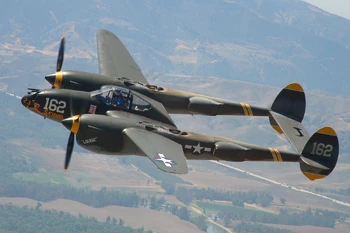
The P-38 is my other favourite ride; surprisingly agile, a good climber, with firepower concentrated in the nose. Also, it has quirky good looks.

It's not perfect: there's a lot of target fixation and a fair bit of accidental ramming; "allies" often "shoot through" you to try to secure a kill; I hate getting sniped out the cockpit by .303s at 500m (always seems to happen to me, but the MGs seem dammed ineffective when I use them). Also, arcade mode is rather  "Air Quake" at times but that's not really a negative (after all, there's realistic and sim modes for those who want to spend 30 minutes stalking a single plane or performing complex engine start routines).

Also, all planes are not automatically available; you have to "earn" your way to higher tiers by gathering XP - through winning, kills and mission objectives.  If all you want to play is 1950s jets (tier 5) I recommend you get IL:1946 where 400+ planes are available instantly; getting to jets in War Thunder is the "end game" achieved after months of gameplay.   If you just want to try all the planes, it's not an issue: I'm lingering at lower tiers learning to fly properly and unlocking all the interesting looking planes (rather than racing to the "endgame" tier; too often players assume because they've got a good plane it means they are good players).

I found I had to switch around some controls (elevator for throttle) and make the "look around" key and combat flaps buttons easier to access; but I didn't have to spend an hour setting up my controls like some games.  In Arcade, a mouse > joystick due to more precise aim (heresay, I know!) but after all there are joystick-only modes so it's a bit of a non-issue. Flying can be as simple (i.e. WASD + mouse) or complex as you want it.
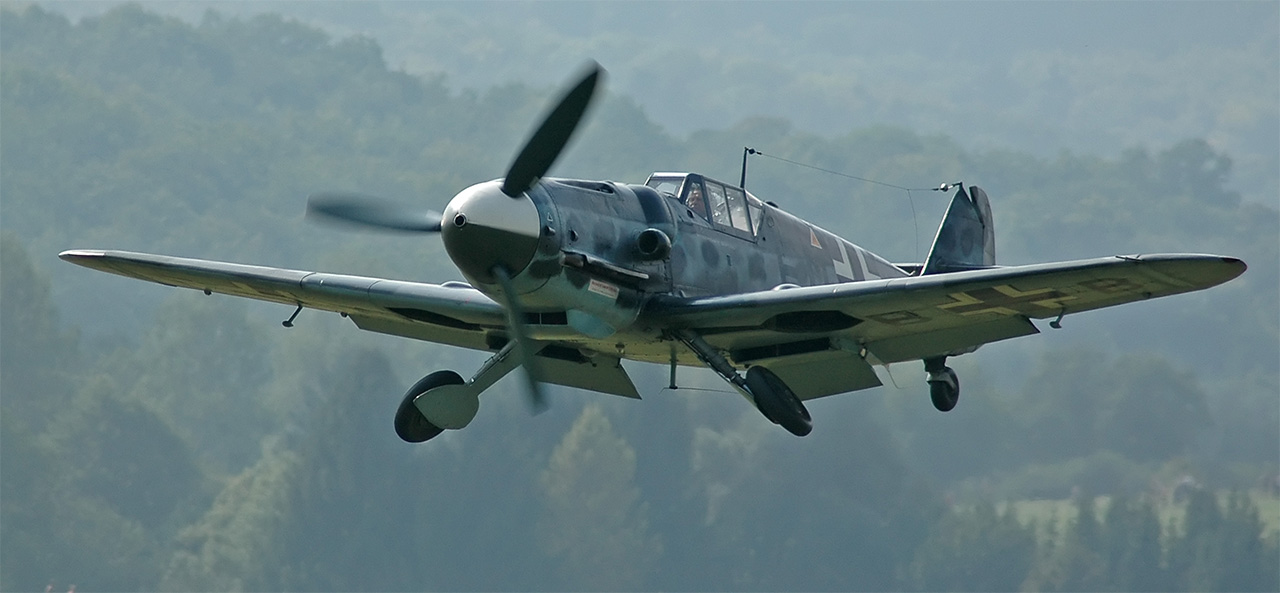
I like 109s (my favourite to fly in IL-2:1946) but have struggled with the elevator/high speed control issues in War Thunder, compared to the better high speed controls of many American planes.

In summary: War Thunder (air battles) is a free-to-play game which does not force you to spend, which has a game mode for everyone; be it historical campaigns, homebrew missions with friends, or arcade mode "air quake" with multinational fantasy lineups.  It can be as simple or complex as you wish; from mouse aim to joystick full-real settings; from instant dogfight air-starts to complex engine management and takeoffs - from 5 minute "quick matches" to long campaigns.  Whilst it is not as "hardcore" as the DCS series, it caters for a wider range of modes and styles; for the first time I feel like I might finally uninstall IL-1946 (the greatest combat flight sim, ever!) as War Thunder gives me similar options, but is more user friendly and exponentially easier to play multiplayer or with friends.  Probably the major downside is that all planes are not automatically unlocked but you have to "earn" them (though you can test-fly them solo.)  Oh there's also tanks and (upcoming) naval forces included in the game you download.

Recommended:  Yep. If you like WW2 props or Korean jets, there's something here for you, whatever your interests or level of ability.  It's free - so there's no reason not to try it; you don't even need a joystick.

Friday, 8 September 2017

Game Design #73: Willpower and Morale as a Resource

A few people I know hate wargame morale tests of any kind.  They say it slows the game down and takes away from the pew-pewing.  I can't argue with what someone regards as fun; others like systems with complex morale systems

Morale (in most cases) is usually a test against a morale stat; perhaps if a unit loses xy amount of troops in a single turn, or maybe each casualty if an entire army or unit drops below 50% numbers; perhaps if faced with a terrifying enemy or weapon (flamethrowers ftw). 

Other systems (especially in the age of firearms) deal with "suppression" - units accumulate markers, perhaps "pinning" them in place or routing them off the table entirely.

Fleeing troops can often be "rallied" by a successful roll (perhaps by a command or hero unit), or perhaps by breaking line of sight or getting in cover.

Pretty standard.

But there is pretty good evidence that "willpower" or morale is a finite resource.  We have finite mental energy. (This would be as applicable to certain magic or psychic systems).  I enjoy the "You are not so Smart" website; so I'll summarise a few interesting points from this article.

Researchers did some experiments to test if willpower was finite: like tell people they were awesome/worthless, then get them to count cookies (yes, as expected the "rejects" gorged themselves, having already suffered a blow to morale they couldn't resist delicious cookies); or putting participants in a room with cookies and radishes; one group was told to only eat radishes, others were told to eat cookies; a third group wasn't shown the food.  All three groups were then given an impossible puzzle.  Two groups lasted ~20 minutes; the poor radish group lasted only 8 minutes.  Resisting the cookies and forcing themselves to eat radishes caused some psychic cost.  But it isn't always negative uses of willpower; it can be any choice or complex process; for example finding every "e" in a nonsense sentence is easier than searching this paragraph to find each "e" that is two letters distant from another vowel....  Subjects who had the more difficult initial task or decision tended to give up faster on a subsequent task.  Conscious choices or exercises of willpower come at a cost; though it is easy to coast on autopilot (like showering and driving to work), manual "executive decisions" come at a cost. Although what is being depleted may just be glucose...

Anyway, this got me thinking to morale systems where morale or willpower is a resource than can be managed, or depleted.  I remember AE:WW2 having a "Drive" value that is gradually eroded (or restored) by various actions.  Once the Drive score got to zero, the unit routed.

Morale is arguably a much larger determining factor in battle than... pretty much everything; fights seldom go to the "last man" and most usually end with one side pulling back (or fleeing outright).  It's much easier to scare the pants off someone than kill them.  I think the overall casualty rate in Iraq was around 2% (albeit massively skewed in favour of the Coalition) and Antietam from the ACW was similar.  Saratoga was also about 2%.  Overwhelming force seems to be a factor; the more evenly matched the force, the longer the contest; the more casualties; casualties also are much higher if the loser is unable to easily retreat.  Agincourt was around 25% casualties; Normandy was about 18%.  Yom Kippur was about 1%.  I'm sure I'll get some nerd in comments correcting my numbers to the nearest decimal; but point is, there was seldom a fight to the last man. Even in battles where one side was pretty much surrounded and slaughtered (Cannae?, WW1 "boodbaths" marching into MG nests) casualty rates seldom exceeded 40%.   In short, forces should be testing for morale well before 50% casualties - probably more like at 2%.

Interestingly, I remember reading only 1 in 3 soldiers ever fired their weapon in combat in WW2; and only 15% actually fired at an enemy; in Vietnam 8 out of 10 did; nonetheless a significant proportion of soldiers in shooting combat are not actually... shooting.  Combat ranges are also interesting: in Vietnam, only 30% of those who fired, ever fired at under 100m; only 15% fired at under 50m... perhaps a topic for another post)

Anyway back on topic. So morale and willpower are finite resources; someone under stress or making decisions will struggle to make decisions or use willpower on subsequent occasions - which points to morale being a "resource" that can be steadily eroded.  Some systems allow morale to be increased due to actions of leaders, but should morale ever improve beyond the rested, pre-battle level, even if sarge is yelling?    So tracking morale/willpower as a resource makes sense, albeit perhaps a bit messy (perhaps a micro d6 next to a unit, for example?).

Secondly, traditional wargaming "break tests" at 50%+, while easy to keep track of, seem nonsense; forces will break and retreat well before that; 50% casaulty rates tend to only occur if a army is unable to retreat (ambushed/surrounded) or if forces are evenly matched and the battle goes for a protracted period. 

As usual, I'm not advocating a "best method" or even forcing folk to use morale tests at all (I can sympathize with people who want to "fight to the last man" as I myself dislike rules that stop me activating all my soldiers in a turn - even though it would be quite reasonable to have poorly trained troops paralysed/indecisive compared to better trained troops with more initiative).

I'd just like to shine a spotlight on morale; I feel it is often ignored in favour of cool mechanics and "tacked on" as an afterthought - should it be more central to rules than they usually are?  After all, breaking morale and forcing the enemy to flee tends to be how battles are won; killing is just a means to that end.  Many rules spend a lot of effort on a new mechanic to resolve shooting, or melee - but ignore perhaps the key aspect of warfare. 

Thursday, 7 September 2017

Dreadnought vs Fractured Space (PC spaceship game faceoff)

Space games have seen a bit of a revival lately. With the perhaps-never-to-be-completed sims Star Citizen and Elite: Dangerous (more on Elite in later post) leading the charge, there are also a few more casual space games for those who want to spend more time pew-pewing in their spaceship rather than travelling about.  I dismissed Star Conflict as a typical Russian "freemium" and so tested two arena-style space shooters: Fractured Space and Dreadnought.

Fractured Space has potential on a tactical level, but it's ultimately boring steering your blimp spaceship around and pew-pewing; it's a reskinned ARPG.
Fractured Space
It's also a "free-to-play" game, but this is not my main objection. It's that it's boring.  For some reason most space games treat spaceships with the flight model of blimps, ignoring vector movement and Fractured Space is no different. There technically IS 3 dimensions of maneuver; but as all objectives are on the same plane it's not terribly relevant. It has an interesting tactical level; where 5v5 you can contest 3 "objectives" to collect resources, levelling up your ship before attacking the enemy base.  Sadly it's slow moving and about as engaging as an ARRPG; park alongside, click on targets and spam the occasional special attack.  Whilst the tactical level was interesting (which cap to attack, when to warp out, etc) the actual ship combat was dull and the ships felt generic and similar. You could replace the ship with a fantasy hero and it would be similar to games like Diablo. It seems well balanced and fair, but it's basically a slow, generic RPG-esque game with a space "skin." I can see there is room for tactical skill, but ultimately it's slow and dull, and does not feel very "space-y".   
Not recommended. 

 
 Here's someone else's opinion of Dreadnought, with gameplay. Ultimately just a very slow paced shooter, lacking depth.

Dreadnought
Another "free-to-play" game, Dreadnought was a tad less boring to play, but tactically shallow.  The massive scale of motherships-duelling-in-atmosphere in the trailer was lost due to poorly scaled terrain.  The "star destroyer" size ships reminded me more of flying submarines rather than gigantic motherships; like Mechwarrior Online the buildings and terrain are too large; making the ships feel small.  You need tiny trees, cars and aircraft buzzing around, skyscrapers SMALLER than the spaceships. If you make terrain gigantic to match your gigantic unit...  ... the unit doesn't seem so gigantic anymore. The gameplay is more engaging. There's more to do; ships move faster, you can channel power to shields, lasers or thrusters with a wider range of weapons and modules; the ship classes are more distinct; lumbering dreadnoughts, support (healer) or sniper cruisers, all-rounder destroyers or speedy ambusher stealth frigates.  The classes again seem inspired more from traditional ground shooters/RPGs but they do give a distinct feel.  Seems less balanced and it's progression system is not optimal. Also 5v5, in contrast to Fractured Space, the tactical side of things is boring; pretty much straight deathmatches which get old fast; leaving Dreadnought as slow, dull shooter where concentrating fire and blobbing targets seemed the order of the day.   
Not recommended either.

So the search for a casual multiplayer space game continues. There are RTS style games (Homeworld has been upgraded graphically, and Sins of a Solar Empire is a competent 4X-meets-RTS) but there's not much about where you can fly a spaceship with or against your mates.  Singleplayer, I can recommend Space Pirates and Zombies for top down vector maneuver, and Rebel Galaxy (channeling Firefly) for 2D Freelancer-esque play; the X-3 series (aka EvE Offline) seems so promising but isn't worth the learning curve; I keep trying to play it and tend to quickly lose interest. 

Tuesday, 5 September 2017

To Infinity and Beyond! Reviving the Cold Navy

I'm following my rule of "no new minis until I've painted all the others of similar type" (this does not preclude starting new genres and scales...  ..heh) and as I'm eyeing off some Dropfleet Commander ships I decided to see what spaceships needs be painted first to "clear the decks".

These are very old (5+year old)Terran Cold Navy resins; a bit dodgily cast, with lots of mold lines and bits of miscast resin to be sliced off.  However the designs are lovely.

I call this the "Bunnings Fleet" (Australian readers will get this joke) due to the colour scheme; I wanted to use orange (after realizing I had 2-year-old bottle of orange I'd never opened, let alone used) and as a contrast colour I briefly considered purple before deciding it was too 'High Elf' and settling on an aqua-ey blue.

I use my normal 15mm-and-smaller paint method; I call it "reverse drybrush"; basically I paint the ship; wash it to make it darker; then fully re-paint all the "open spaces" leaving the cracks dark. It tends to look ugly up close but "pops" really impressively at table-top range (i.e. usual 2-3ft away). 

In hindsight I don't know why I didn't get more escorts; my task force seems a bit "heavy" without enough screening ships and scouts. 

If you click and zoom in you can see how ick the paintjobs look up close; but this paint style is my favourite for "small things" when on the tabletop.

The "Delta Vector" blog got its start with a focus on space games; it's been a while since I revisited this genre (though I sporadically experiment with homebrew rules inspired by the Lost Fleet series; books whose somewhat cheesey plotting and writing is compensated by some excellent space battles where relativity/time-space distortion and velocity play huge roles).

Not sure what colour to paint the thrusters; my usual red and light blues won't pop well against the current paint scheme. Maybe violet thrusters?

Anyway while digging these up I found some Cold Navy Mauridians as well as demoralising myself when seeing just how many unpainted LoTR I have (for some reason; few dwarves - they were never popular locally and always seemed overpriced on eBay).

Thursday, 29 June 2017

Car Battles - Death Race/Car Wars/Mad Max/Carmageddon Games

This is a topic on the DV google group that has seen a lot of differing opinions on what makes a good car battle games, in terms of realism, recording, etc.  There's a few pretty nifty ideas as well.  Shoutout to the prolific inventor Eric Farrington who has since published his "flick mechanic" game.

For me, I'm interested in a campaign game allowing 6+ cars per side to be used, with a driving "feel" without aiming for hyper realism.  I'd prefer not to have uber detailed recording or fancy templates - i.e. keep a low barrier to entry - "pick up some Hot Wheels, some dice and play."

Anyway, I stole some of my 1-year-olds more muscle-car-y Hot Wheels (in my defence, he left them scattered messily around in my work shed) and gave them a quick spray with some normal beige gloss spray. A touch of black and metallic grey later, and they are now a blank canvas awaiting some 15mm weapon add-ons.  (I think my Sherman tanks may surrender their pivot mount .50cals... I'm sure there's a Sherman variant that didn't use them anyways...)

I was supposed to be cleaning my hobby shed; at least I go those pesky Hot Wheels out from underfoot...

As you can see, I put a lot of effort into the paint jobs... ...not!

I'll have a dig through my 15mm spares box. Weapons will be added...

I'm probably going to use a impulse-style of movement (i.e. cars move only 3-4 "CUs" or Carlength Units" per impulse) so they don't teleport past each other or zoom off the table.  Turns might use a 45 or 60d arc, with rolls to skid etc if going to fast for the angle of turn.  Weapon ranges and accuracy will be kept really low to emphasize maneuver.   I'll probably use a d6 hit location system depending on the angle of fire to the car, for example:

End on: 1-2 boot or engine; 3-4 wheels, 5-6 passenger compartment
Side on: 1 engine, 2 wheels, 3-4 passenger compartment, 5 wheels, 6 boot

Perhaps each car can have a simple card with hit locations on it.  Anyway, I've got a few old draft rules, and I'll dig them out over the next few days and have a playtest....

Tabletop Wargames - PC RTS style?

I recently bought the PC RTS  Impossible Creatures to play with my daughter.  Besides marvelling at the inventiveness of old school games (I mean, mad scientists battling using mutated mixes of animals - crocodile lobsters, giraffe eels, bull ants...  ..build your own unit at its finest) and making me shake my fist at the sequel-itis that infects the gaming industry (are we up to the 12th version of CoD?).. ..it got me thinking about how wargames look similar to traditional PC RTS (like Command and Conquer and Starcraft) but few actually share the same traits.

Let's look at some features of the PC RTS and how they would apply to tabletop wargames.

This post was inspired by "Impossible Creatures" - an old school RTS where you can create hybrid animals to attack armies of mutated enemy animals...

"Clicks per Minute"
The ability to micromanage units with relatively few sitting idle is a RTS skill.  This could be simulated by having a set amount of activations; i.e. you get say 6 "actions" per turn; an action can be used to move a single unit or group of units which are bunched together. I guess the word "limited actions" kinda covers it.

Resource Collecting
This could be collecting crystals, gas, or whatever unobtanium.  Often there are two resource types - a general resource (mass, such as steel to make tanks), and a rare resource for producing high tech units (unobtanium, to power fusion reactors or tesla cannons etc).

I like the resource collecting aspect; as interdicting resource collectors (harvesters) and escorting them can provide a source of small clashes and a kind of alternate victory condition - deny the enemy the resources to build or replace combat losses. 

Another sort of resource is "control points" as seen in THQ's Dawn of War and Company of Heroes series; dozens of control points that can be captured and provide a stream of resources and an incentive for constant raids.

The resource management puts another layer on top of the game; and allows for base building and unit building meta-games; you basically can "build your army" during the battle, not just before it (a feature of games like Warhammer 40K). 

A further thought is that resource management must be kept simple, perhaps being tracked by tokens of different colours.  

Tech Levels and Research
I think researching new tech would be outside the scope of a tabletop game, but many RTS have several "tech levels" of base - for example tech 1 could be simple grunts and engineer units; tech 2 light vehicles, tech 3 advanced vehicles, and tech 4 mammoth tanks and super weapons or advanced stealth fighters etc.  This "teching up" might cost resources; so you might have the choice between remaining tech 1 and making a cheap "horde" army to attack early; or sitting tight and advancing as fast as you can to tech 4 to beat the enemy down with superweapons. So "research" in a tabletop game might be simple; merely deciding which of several tech levels to stop on.

Bases & Base Building
There are usually a main "command building" which once knocked out, removes the ability to build new buildings (kinda of an "assassination" target); usually a resource-gathering centre, plus production centres for ground and air units.  Sometimes there is power generators (knocking these out is another way to cripple production capacity) and base defences.  There should be a balance; do you try to nibble your way through enemy defences or try to deep strike past them aiming for critical buildings and generators?  Again there is a level of choice - what do you spend your resources on? Base defences? Advanced buildings? Do you eschew aerial units in order to make an overwhelming ground force?

Unit Building Metagame
Units usually have a faint paper-scissors-rock feel; a light minigun tank might easily be gunned down by a heavy assault tank; but the assault tank loses to a sniper tank destroyer which can easily be swarmed by the minigun tank...

Choosing how many of each unit should be an important part of the game.  As min-maxing armies is popular out of battle (a quick google will reveal a zillion army lists for "best practice" in games like Warmachine and Warhammer; creating optimal lists is a popular pastime.)


Unit Levelling + Recon/Fog of War
RTS games sometimes have the ability to level-up units (often hero units or heavy units) which gain accuracy buffs etc as they get kills on enemy units.  Another, more common feature is "fog of war" - anything not in LoS of a unit (or within their "view radius") are blacked out by the "fog of war."  In games like Wargame: European Escalation recon is vital; sneaky infantry recon units can call down indirect fire while remaining hidden, or allow units into ambush range of their RPGs. They can protect valuable units from being interdicted by their counters - i.e. spot SAM batteries to protect valuable gunships, or spot hidden tank units allowing ATGMs to be wheeled into place to take them out. Having good recon should, in the least, allow you to best counter their scissors with your rock, while keeping your paper out of the way.

I'm sure there's more key points to cover here, but my wife has returned from a seminar by author Mem Fox (does anyone know Possum Magic or is it purely an iconic Aussie-only children's book?) so I'll wrap up this post and join her watching Preacher (an awesome show, btw, though not particularly similar to the comics.)

So... where is this post going?
Well, the RTS-meets-tabletop wargame is something I'm going to explore more.  I'm sure there are boardgames that do something similar, but it's wargames that interest me.  I know Brent Spivey did OP4S years back as a RTS homage - but it does not seem to have gotten out of beta (I did a brief review way back in 2011).  I'll dig it out again - I could do another test play as I've pretty much forgotten it apart from it having a nifty activation system. 

In the Delta Vector google group we looked at landships/motherships/megavehicles a few months back (you know, Ogre, or a Cylon basestar, or an Avengers heli carrier) and I'm now a proud owner of a Landcruiser Ratte in 15mm. I keep looking at it and thinking it would make a good giant mobile base factory/landship/landcarrier for 6mm mecha, and I've attached tracks to some WW2 1:700 aircraft carriers to make them into landcarriers...

I've gone with 15mm for my tank project, leaving me with many 6mm sci fi vehicles unused. I feel 6mm tanks are too small to be "main characters" but they make an affordable horde to be spawned from larger "landships" which could be the heroic units which level up.

I also think RTS might be fun with a focus on a different aspect of sci fi than usual - perhaps with nanomachines or similar.

Sunday, 25 June 2017

Domina and Needless Busywork: What is a game's core focus?


A dozen battles into the awesomely violent pixel gladiator game Domina, I received a humourous message to the effect my avatar (the lanista) had died of thirst, thus ending the game.

My response: "Wtf?!"

The aim of the game is to run your own ludus, to become the best ludus in the land and have champion gladiators. In short: the core gasmelay is to a manage gladiators. Giving your lanista a drink is something one would assume would be abstracted; given you can't walk around with her or anything and she's just an icon on the screen.  Keeping track of finances and, say, overall food supplies for your ludus makes sense; micromanaging every glass of water does not. 

Before you race to comment: I later found that water was a resource to be managed (it linked to gladiator training)...   ...but the point was stuck in my head...

While googling my water dilemma, I then noticed the biggest gripe from players is how the research skill "Mind Control" - which allows you to directly steer a gladiator - make the game too easy to win.  Again, by allowing you to control a gladiator, the game is stepping outside its core gameplay - managing a ludus. It's be like if a football management game allowed you to control a single player allowing you to wtfbbqpwn Real Madrid with Luton Town's reserve striker who works at Woolworths.

These musing have applications for game design:
What is the focus of the game? What can be abstracted? What can be micromanaged and what should NOT be micromanaged?  

A lot of games fall into the trap; the general can control each individual sniper or aim each cannon.  A tank commander should be able to designate individual targets; but should a division commander be able to do the same?


 Domina is hilarious pixel violence as you control your own ludus (gladiator school). I found myself shouting "tis but a flesh wound!" as a pixellated trident-and-net dude hopped around clutching an amputated leg...

Why people are failing to make the next Mordheim
I've often discussed how the skirmish campaign genre lacks a torchbearer since Mordheim/Necromunda.  Funnily enough, there are many skirmish games with much better tactics and mechanics already.  I actually think the real reason most have failed as the core of these games IS a ridiculously deep and complex campaign system.   Most games since then have focussed on improving gameplay while tacking on a "simple" and "elegant" campaign/advancement systems.  But I think they've missed the point.  Mordheim was pretty basic (and imbalanced at times) in terms of gameplay, but the nostalgia lingers.  Why? Tellingly, the most successful imitator (Frostgrave) has rather meh, bland gameplay but has a deep magic system and plenty of meat on its campaign mechanics.  Along with an appeal to nostalgia (a searching a ruined city for artifacts...) I think Frostgrave has successfully indentified what makes a skirmish campaign successful - the campaign/advancement/skills/base building part.   I always liked LOTR:SBG, and it's Battle Companies campaign system elegant and simple...   ..and you'd think I'd love it...  ...but it's too simple; as it does not hold the depth of play of its GW predecessors. 

Busywork - aka meaningless grind or activity
Besides the focus of the game, Domina reminded me of "busywork" - contrived or added work/grind in a game for the sake of it.  A good example is found in open world survival games - ARK - an awesome (but terribly optimized game) where you can build bases, ride dinosaurs, and fight other people while riding said dinos.  A key "feature" is how you need to constantly eat or die; you need to scarf down berries every 5 minutes, or your HP steadily and quickly drains until you die.  It's busywork.  Grind for the sake of grind.  It doesn't even make it feel realistic. It's LESS realistic. A few hours without a meal shouldn't kill you. There can be a penalty - reduce stamina, or XP gain, or -1 to all stats or something...   but you shouldn't be constantly hunting berries. That's not realistic survival - it's busywork. 

Does a game track something that can be abstracted or ignored? Are there dice rolls or extra actions that are "tacked on" to a game?  Has each element of the game been looked at; and asked the question "Does this add enough to the game to be worth the extra time/complexity/recording?"


I fail to see much difference between Diablo and clicker games... What is a clicker game?

Perhaps a little off topic (although this is mostly a rambling train-of-consciousness post anyways). Talking about core game design and what the main point of your game; I've always wondered:

What is the point of ARPGs? (PC games like Diablo)
Talking about core gameplay - what is the point of top-down Diablo-ish games (ARPGs?) I call them dungeon cleaners.  It's just cleaning dungeons of coin and skeletons by clicking on them. My level 20 broom cleans your level 15 poop off the walls.  Unless there is dodge/roll mechanics, or specific aim (like Alien Swarm)they're a bit too akin to those clicker games which reward you for how fast you can click.  I try to like them (because I know folk who do) but... ..what is the ultimate point?  What is the core gameplay?  Levelling your character? Because you can level characters in other, more fun game styles that involve more depth and skill than clicking on stuff...