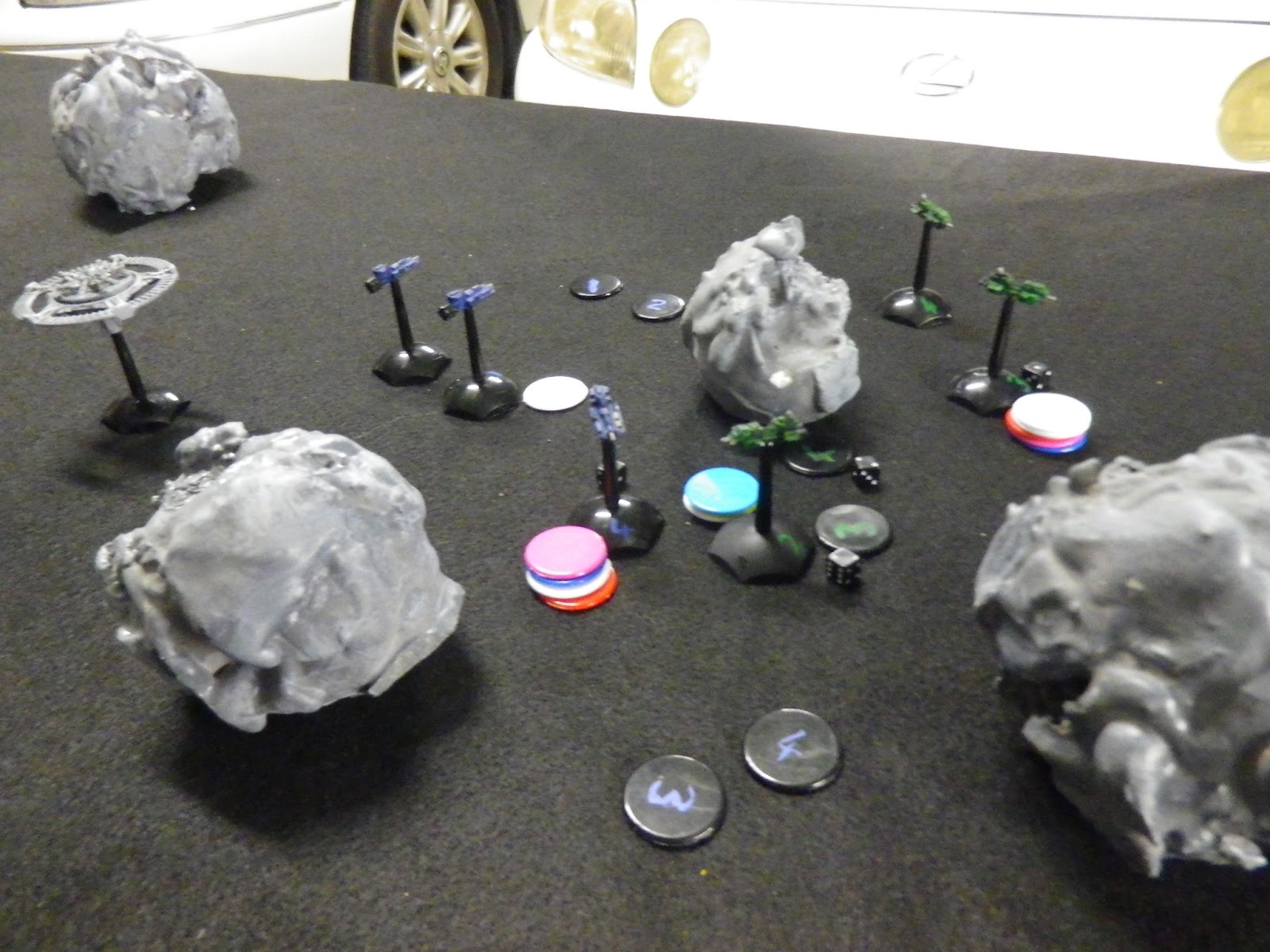
Sunday, 20 January 2013

Airships & Sky Pirates Rules Review

I really like the Brigade aeronef models but the "official" rules are pretty bland and minimalist. If "beer" is the ring left on the coaster, and the "pretzel" is half a low fat pretzel you found behind the sofa cushions, you could charitably call it a "beer and pretzel" game.

The models from Brigade are fun to paint. Sadly the official rules give the term "beer and pretzels" a bad name.

(Wessex Gaming) Aeronef Rules Review
I'm doing this as this game got an inexplicable 5 stars at the wargames vault. (Admittedly from three reviewers - I'm presuming they must have deleted all the negative ones). I've made a bet to myself I can explain the entire rules in a single paragraph. Ok, go!


Your "Nef" has hitboxes (2, 4, 8, 16, 24, 32 depending on size); and each ship has gun dice = half the total hit boxes. Speed ranges from 8-22", smaller class= faster.  Ships must move 1 hex between turns. Small ships can make more turns in a move. For each gun dice roll a d6. Only '6's hit.  As you take 25, 50 and 75% damage, reduce speed and gun dice by 25, 50 & 75%.

There, I explained the entire rules without pausing for breath! Oh, and besides all those hitboxes, you have to write down speed changes. Missed mentioning the altitude rules, you say? Ah, that's because there isn't any....

....so naturally, I am interested in any alternative in this rather niche field. Cue Airships and Sky Pirates, stage left.

Airships & Sky Pirates 
(A Supplement to "When the Navy Walked")
by the Armchair General

The art isn't that crash hot, but if you get a pdf you can't expect too many bells (or even whistles)

The Shiny
B&W except for the cover. There is a nice clear table of contents, and the quick-reference pages which I always look. The art is somewhat home-made and the font a little small, but it is serviceable.  Preview available here.  Fine for a $10 pdf. Actually, while I think of that - can I also make the disclaimer this is not a standalone product.  If, like me, you have no interested in VSF mass ground battles you still need to pony up an additional $10 for the core land rules "When the Navy Walked". So you're effectively paying $20 for two pdfs.  I'd like to see enough of the core rules added to make A&SP "standalone."   Note: Both pdfs are also available as $30 hard copy rulebooks but I wasn't shelling out $60 to test a ruleset...


Mechanics
Command points are important. You get 1d6 every 2 units, plus any leaders'  Leadership scores. They are a resource which are spent by giving units orders, and do not carry over from turn to turn.

Leaders in command range give orders, to move, shoot etc.  You are supposed to secretly record (ugh, recording = writing stuff down, innit?) who you give shooting orders to. Any "unallocated" units without orders may "react" after taking fire by shooting back, but only after they have taken the effect of any hits.  I'm not a fan of writing down the shooting targets, but otherwise this is a good idea which adds a good layer of tactics/resource management, without much complexity

Movement in atmosphere (flying craft) requires units to move half speed.  This and the 45d turns reminds me of the stately movement of Battlefleet Gothic.  In the aether ships can hover - they also can retain speed from turn to turn (vector movement) which you will need to track (more recording!), and gun ranges are doubled. Aetherships with solar sails use sailing rules. In atmosphere, there are 6 elevations you can conveniently mark with a micro d6.   Aetherships can break orbit and go "into the black beyond."

A&SP uses the tried and true "Full Thrust" damage system - i.e. 4,5,6 hit on a d6, with the '6' counting as double.  You tally the hits and compare them to your foe's Threshold rating. This is kinda like their armour/hull strength and shows how many hits a ship can take before it has hull damage.    I.e your 3d6 firepower ship rolled a 1, 4, 6 = 3 hits against a Threshold 3 opponent. The three hits reaches the Threshold level and scores a hull hit. Four hits against a Threshold 2 ship would do 2 hull hits, etc.

Any hits in a salvo that exceed the "Threshold" do damage.  There is a typical 2d6 "special damage" chart which can cause hits to weapons, optics, engines, and the usual "golden BB" on a roll of 12 which means "kaboom!"  Units may attempt repairs to systems. Much as I dislike any record-keeping,  there's probably a little less hitboxes & stuff than most space/wet navy games, to be honest.

Free cards for recording ship hits and internals are available at the Wargames Vault. 

The Sylvana from "The Last Exile" - a anime with typical annoying squeaky Japanese teens but also awesome aerial dreadnaught battles

A&SP covers boarding, grappling, boarding, ramming and collisions, as well as air to ground and ground to air fire. You can even scuttle your ship if you want. There are also wind rules which work for "solar winds" and aetherships as well as conventional sail ships.

There are rules for small flying craft, sailing ships and aetherships.  I like the small craft rules which allow you to make "maneuvers" such as Immelman, dogfight, roll, and corkscrew which add different benefits if you can pass a command check. If they fail, they stall and might crash.

An interesting idea is Tesla "Broadcast" fighters. The electricity is generated on the carrier and transferred to the fighter via "Tesla wave" - making them effectively drones that are restricted to a certain radius from the mothership.  There is also a random table for aetheric flora and fauna, turbulence etc. Kinda like "the warp" from 40K.

Leaders can "sabotage" enemy units which is resisted with their "Espionage" roll.   A successful roll can cause an internal hit.

There are rules for fleets, squadrons, recon and chain of command.  There are rules for formations like line ahead and line abreast, each of which has its inherent advantages and disadvantages.

Scenarios, Skills & Perks
There are six sample scenarios including hunting pirates in asteroids and fighting a giant space squid. 
There are additional "special rules" specific to A&SP which add to those already in WTNW such as incidiary bombs, chain shot, special bombsights, rams, improved agility- they can also include flaws like being flammable, reckless, or having poorly rigged sails.

Army Lists
There are sample army lists. Ships have stats in
Shoot range (usually around 12")
Shoot damage (2d6 destroyer, 3d6 for a cruiser, to a 6d6 dreadnought)
Melee damage (usually 2d6)
Command Range 8-14"
Morale 6-8
Espionage 2-4d6
(ability to block "sabotage" by enemy leaders; a bit of a random idea IMO)

TL:DR
Having to switch back and forth between WTNW and A&SP was annoying and at times confusing. A&SP should be a standalone product.  The fact "firepower" is the same for all ships, with no real differentiation between weapon types (where's my Martian heat rays, eh?) or even calibres means its only mild step up from Aeronef's "roll lots of sixes."  Damage at least is more interesting and the fact there is altitude (fancy that, altitude in a game involving airships *cough* Aeronef *cough*) is a plus - it's even easy to track. Speaking of tracking, I really dislike writing down/recording anything in a wargame (bad SFB experiences scarred me) but most space and naval gamers won't balk at recording special internal hits or writing down orders for shooting in A&SP.

EDIT: The Armchair General notes in the comments section below that a card deck will be available to eliminate written record-keeping. His post contains ideas for using counters or poker chips to track activation. 

On the flip side, the basic mechanics are sensible, and the command system adds a layer of resource management (that could be easily recorded with a handful of tokens).  The "perks and flaws" are flavourful and A&SP covers a wide range of content (aetherships, airships, ironclads, sailing ships, sky galleons, biplanes/ornithopters etc).

I particularly like the small craft rules which are both simple and flavourful (I also like the idea of Tesla-wave fighters buzzing around in the aether) and the fact it shares mechanics with WTNW means integrating land and air battles will be seamless.

EDIT: Also of interest - The Armchair General says there is an upcoming miniature line.  As there is no such thing as "enough" VSF goodness, I personally am pretty stoked!

Recommend? Yes. I'd prefer it if Airships & Sky Pirates was standalone with all the rules in the one location, but overall a definite step up from Aeronef, offering easy ground-air-space integration.

Wednesday, 16 January 2013

Rippers: The Horror Wars Rules Review (Savage Worlds)

So far I have tried (and reviewed) Strange Aeons, Chaos in Carpathia, Witchfinder General, Empire of the Dead and Solomon Kane and Helldorado. The next addition to my rules library is Rippers: The Horror Wars.  Using the same Savage Worlds game engine as Solomon Kane and the weird west game Deadlands, I am interested to see what this slim 80-page volume has to offer.

The Shiny
One of the smaller rulebooks I have read lately, Rippers has colour cover and spread of colour plates in the centre. I always like pictures of the game "in action" and there are plenty of miniatures to look at.  The rest is b&w but has a pleasantly sized text which is comfortable to read, with clear headings. It has more content and substance than you realise at first glance.

 Rippers has their own box sets. Old Glory sell warband boxes of 11 minis for $25. Apparently made by West Wind but I can't find any info in their shop. I'm wondering if they are rebadged "Gothic: Vampire Wars" minis

The Fluff
The "backstory" is that the "Rippers" are Victorian-era monster slayers like Van Helsing who have modified themselves with body part implants "ripped" from the very monsters they hunt.  Naturally many of the have gone "dark side" as the implants have corrupted and warped their minds.  These have formed the "Cabal" the necromancer-cackling scientist-werebeast conglomerate.

The Game Mechanics
Rippers uses the Showdown system (available for free download here) seen in many other Savage Worlds games such as Deadlands.  A deck of normal playing cards and various dice (d4, d6, d8, d10, d12, d20) are employed. 

Each turn, each unit or hero is dealt a card, and this determines move order (i.e. Joker, Ace, King, Queen, and so on, with Two moving last).  A unit can go on "hold" so it can act later in the turn. It must make an opposed roll using Agility to move before an opponent it is "interrupting."

For skills and abilities, the higher the dice, the better - you roll the dice and need to pass 4 or more to succeed.  You can take more than one action, but you have to -2 off any rolls for a second action, -4 for a third action, etc.  There is an "exploding dice" mechanic where any maximum throw (say a 8 on a d8) earns a re-roll.  Every 4 points you exceed your target roll gives you a "raise" - say you needed a 4 on a d12 and rolled a 9 - then you would succeed and get a "raise." This adds bonuses, like an extra damage in an attack.

Heroes (or"Wild Cards") can roll an extra d6 in addition to their usual roll, and choose the best result.
You also get three "Bennies" (free re-rolls) to spend each game, and an additional two for each Wild Card (hero) which adds an element of resource management.

Rippers uses the same combat system as the popular miniatures game and RPG "Deadlands" 
Combat
Shooting and close combat is simply passing the 4+ (shooting) or the opponent's Parry (melee), with additional ranged penalties for long range and cover where appropriate.

The attack then uses the strength of the wielder (melee) or weapon (ranged) and if it beats the opponent's toughness, the target is Shaken (can take no actions, can move only half speed - characters can attempt a recover roll next turn). If the attack if it beats toughness with a raise (+4) the target is Wounded (which kills non-hero characters). Heroes can usually take 3 wounds.

There are rules for area attacks (scatter) and ways to target specific areas (i.e. shoot the eyeslits of a robot, or a tentacle off a monster). Players can also "defend" which adds to their Parry score. Players can dual wield, suppress with automatic weapons, go prone and make "all out attacks" which reduces their defence in favour of attacking bonuses.

Units must make guts checks if they lost 25% of their force - also when facing opponents who cause "Fear."

Magic is simple and follows the combat mechanics but you have to track how many "power points" worth of spells you have spent.

Jack the Ripper. Surgeon, royal - or mad scientist who implanted too many vampire body parts?

 Powers
There are about 13 powers which I though was surprisingly small.  Most games have 20-30 powers but it has the benefit of being easy to remember.  There are about 18 generic weapons which also was quite a modest number.  It did cover all the main weapon types, so this isn't a problem.

Scenarios and Missions
This is the "guts" of the game as the rest you could download for free or read on the blurb of the game.  There are rules for innocent bystanders, and bonuses for evil creatures at night.  However there are only four basic missions.  There are 11 scenarios which extend these with a few extra rules, adding a bit more "fluff".  They are specific but characterful -  bringing to life a Frankenstein monster, fighting Old Ones in a defiled church, rescuing a loved one from cultists, etc.

Terrain
There is a terrain generator which is a nice idea and allows you to have some input over the arrangement of terrain whilst keeping things interesting. This is a welcome feature. There are also special terrain features such as haunted houses, graveyards, storm drains, strange ruins, a fountain of blood. etc.

If Borat was a vampire, he'd use this to fight gypsies...
Advancement 
Wounded figures make a roll to patch up wounds and return the next game. Reinforcements can be bought.  Heroes can "level up" any skill  or attribute one level - i.e. d6 to a d8 - and they can add up to 32 special abilities if their base stats are high enough - i.e. a hero needs a d8 level agility before it can take the "Acrobat" ability.

Warbands
There are a few stock warbands - Van Helsing's slayers, the Harker's gypsy/wolf hunter band, the Warriors of St. George (warrior monks and nuns), Puritan witch hunters, the tomb raider/explorer/archeologist faction, dime-novelesque "masked crusaders", as well as freelancers who can work for any faction.


The evil "cabal" warbands tend to have largely interchangable troops, but included werewolves, vampires, mummies and their servants, evil scarecrows and headless horsemen, circus freaks including killer clowns (my particular nightmare, even now!), a witch coven, Dr. Moreau hybrids beast-men, witchdoctors and zombies, Victorian villans a la Jack the Ripper, Invisible Man, Hyde.
All heroes and units have a points system to balance games.

Equipment, Relics and Rippertech
There is about 30 equipment types ranging from mini-crossbows, silver daggers and throwing knives to whips, holy water, wolfsbane and ripper claws.  There are a dozen holy relics such as Bibles and blessed weapons.  "Ripper" implants included gills, cat eyes, demon blood, werewolf claws and vampire fangs.  Evil cabals do not have Rippertech but can upgrade their monsters with "bloodlines" which upgrades particular abilities.

TL:DR
The ubiquitous Savage Worlds system is solid as usual. Unsurprisingly, Rippers has a more Victorian slant than the excellent Solomon Kane (which is more 16th/17th century). In addition, it meshes neatly with the Rippers RPG if you want additional flavour. The terrain system is good, the limited missions are expanded upon, there is managable equipment and special ability lists, and Rippers has its own miniatures line, to boot.

My normal reason not to buy a Savage Worlds game is the bargain "Explorer's Edition" rules contain pretty much the toolkit for any setting you'd want, but Rippers has enough well-focussed content to get the nod. In fact it has a surprising amount of content packed into 80 pages, far more content than you'd expect at first look.

It sits alongside Empire of the Dead and Chaos in Carpathia as a warband-focused competitive system with the Mordhiem-like ability to upgrade and equip warbands in a campaign.  I'll have to do a direct comparison between them one day, but generally I'd say  choosing between them is more a matter of personal preference. Cost-wise,  EotD is a shiny hardback "production" ($40+), CiC is a $10 pdf* and Rippers sits somewhere in between at about $25.  However Rippers (published 2004) seems to be out of print so your best bet is eBay or similar.

Recommended? Simple rules, campaign experience/advancement, and the ability to build and modify diverse warbands? Yes. A solid competitor in the Victorian horror field, with slightly wider scope than its rivals. 
 
*Edit: Blue Moon and OG also have $25 print copies

Delta Vector Playtest Mission: The Station Attack

A simple playtest of the rules.

Both sides have 4 frigates with identical stats:
Thrust 4
Defence 2
Weapons 4 x 1AF d10 Lasers
All crews are CQ 8. 

Blue team has to defend a space satellite. The satellite has stats as follows:
Thrust: 0
Defence 4
Weapons 2 x 1AF d10 Lasers
CQ 6 (civilian)


 Both sides are moving slowly. The distance each "drift marker" is from its ship shows where the ship will move next turn unless thrust is applied.

Turn 1
Initiative isn't too significant as both sides are out of engagement ranges (defined as the CQ of the ship - 8" in the case of all ships). 

The Green forces accelerate towards their objectives. The Blue forces move to block them, accelerating along their vectors too.  The game is playing quite fast.

All ships accelerate.  B1 and B2 loop north to stop G3 & G4 from flanking.

Turn 2
This is where things get interesting.  In the "initiative faceoff" G3 & G4 force the northernmost blues to move first, then using full burn (you can see them facing sideways to their direction of travel) they dodge sideways through the gap in the asteroids.  They open fire at long range. As their squadron  mates were decoyed away B3 & B4 will face all the green forces alone.

The greens win the "opposed roll" and fire first.  G4 has its line of sight blocked by an asteroid, so G3 combines all 4 guns (for a +3 modifier).  He needs a 5 (range) + 1 (small target). He rolls a 3 (+3 for "combined battery" modifier), succeeding in doing 1 damage.  However since 5" is the range of laser falloff, the damage is halved to .5 - it does not even scratch the shields

Now the blue forces fire back.  B4 elects to fire all batteries independently. He also needs a "6" and rolls hits of 6, 6 and 9. Even halved, the "9" is enough to score Light Damage on G3, which also damages its laser batteries  B3 now opens fire.  He also fires independently, scoring hits with a '8' and a '0'. The G3 is now in serious trouble, drifting without power with its engines out, and with its fighting ability compromised.   

G1 and G2 now come blasting between the asteroids. They elect to engage B3 & B4.  As this is well inside the laser "falloff" range I expect the shooting to be pretty murderous.  The Greens win the opposed roll and shoot first.  G1 scores hits with a 5, 3 and 6, crippling the B4, which has its engines knocked out and many weapons offline. G2 chooses to "combine fire" with a single roll. It comes up an "8" and its target, the B3, is vaporised in a fireball. Kaboom, earth-shattering kaboom!
 B4 fires back, but it is -2 due to the repeated attacks and it has had its main batteries damaged by enemy fire.  Its return fire scores only light engine damage on the G2.

The blue centre is giving way, with one ship blown up and another crippled.  It looks like green will push easily through to their objective, the space station.

However, the green frigate's successful attack has brought them in range of the northern frigates B1 & B2.  Blue wins the opposed roll.   It is longer range (4") but B2 scores a 7, 8 and 9 - the successive hits wrecking the G1 and turning it into a debris cloud.    The B1 is less accurate and the G2 deflects most of the fire with its shields. The G2 fires back, but the range means it only "shakes" the crew of the B2 with a non-penetrating hit.

The end of a surprisingly bloody Turn 2.  The counters beside the ships take the place of a SSD - showing hull, weapon, shield and thruster damage.  

Turn 3
At this stage the both sides have 50% combat ineffective (crippled or destroyed) so I decide both sides must pass a CQ check or attempt to withdraw. Both sides pass. In addition, the crippled ships (G3 and B4) test individually - both pass and elect to fight on.

In the repair phase, all ships except B4 pass CQ checks to remove "Shaken" counters.  In addition, G3 (who was drifting) regains power and can use half thrust.

The initiative here is important. G2 wins it and forces the crippled B4 to go first, with the intent of "reacting" to it with all 3 surviving ships.  Ironically, B4 wins the "opposed roll" and fires first, causing severe hull damage and utterly destroying G2's main battery and targeting sensors!  G2 now cannot complete its attack run on the satellite this turn as its weapons are inoperative - neither can it attack the B4, which is drifting away towards the board edge and safety.  However B3 and B4 make an "offensive reaction" and B4 rolls two 9s to reduce the B4 to wreckage.

Now, another vital initiative contest.  Blue wins it this time and move its two surviving ships into the rear arc of G3 and G4.  These ships have their vulnerable rear arcs slewed out as they used full burn last turn, and their primary weapon arcs are faced away.

The two green frigates used their rear thrusters to change heading but exposed their vulnerable rear arcs to enemy fire...

B2 combine-fires at G4 at point blank - a total of 8 vaporises the luckless frigate.  B1 has a weaker target - the already-crippled G3.  B1 scores a 8 and a 0, and the G3 breaks up.

Turn 4
 The last surviving Green frigate, the G2, accelerates past .5 light and whizzes past the station, taking evasive action from the stations guns, and breaks clear. GAME OVER

With all weapons knocked out, the last surviving green frigate repairs its engines and runs for home.  The B1 and B2 reverse course but have no hope of catching it...

Thoughts
The battles were extraordinarily bloody.  I feel this was largely due to the fact that bountiful terrain kept speeds under the .5 light (10") +2 modifier.  The frigates ability to thrust 4" ensured they were usually in their optimum (under 5") range.   And except for at the end, no one used the "evasive action" ability which makes agile ships like frigates almost immune to enemy fire and can add up to a +4" range penalty.
The ship who fired first tended to insta-win - I'm definitely going to have to tweak defence values. For a start, the frigates base DF could be raised to 3.  I am concerned about the triple-power battleship guns one-shotting frigates, and I will probably increase the frigate size modifier  to +2" range penalty to make them still harder to hit.
The battle was over by turn 3 - but it was extremely eventful.  Each turn, a ship would be involved in multiple combats.  The turns lasted much longer than I thought, but both sides were constantly involved. Like Infinity and Tomorrow's War, there was no "down time."

The d10 damage system gives more radical results than the multiple d6s in DP9s "Silhouette" system and an unusual number of 8s 9s and 0s rolled exacerbated this. That said, I do like the fact the to-hit, damage and criticals are lumped into one roll.  I probably rolled as many dice for 8 all ships in one turn, as a single cruiser would in Full Thrust. 

The counter stacks were not too obstrusive and I really liked them instead of having a ship SSD.  The counters you see, and the ship stats at the top of this post, are the entire record-keeping for the game. That I do like. 

I don't particularly like counters, but it beats the alternative...

Ditching IGOUGO for contested initiative between units worked well, and makes controlling the "initiative" a vital component of the game.  CQ will be very important. The opposed roll worked well, but in this game winning the roll was too important as the side that fired first tended to do so much damage they were immune from return fire. 

The game was rather bland, but I want to balance small ships and set a "benchmark."  Too many space games add smaller "escort" or "frigate" size ships as an afterthought. I want to start with them and build up.  
 Tools of the Trade
Here's what I used to play the game:
Different coloured tiddlywinks from EM4 Miniatures ($1.50 for mixed pack of 40)
Blue = Engine Destroyed
L. Blue = Engine Damaged
Pink = Main Armament Damaged
Purple = Main Armament Destroyed
White = Shaken
Yellow = Light Damage
Orange = Heavy Damage
Red = Crippled
Black = drift marker

Black 6mm micro d6 = shows amount of "reactions" taken per turn
Green 6mm micro d6 = shows evasive action thrust (not used)

4x d10 - for laser weapons
2x  d8 - for Crew Quality (CQ) checks and opposed rolls
All in all, under $5 of dice and bits. The GZG frigates are about $1.50 each.  Total cost - under $20.

Friday, 11 January 2013

Delta Vector the Game: Reflection

 Last year I realised I was bored with spaceship games - or more specifically, how even new space games are stuck in the "full Thrust" rut, whilst ground wargames (Tomorrow's War, Infinity, Song of Blades) have shown genuine innovation and tend to focus on gameplay over record keeping. I created a spaceship wargame "manifesto" of what my ideal space game would look like. 

There are about 30 posts in which I outline the movement rules, a range of combat/damage rules, muse on campaign systems and ship design

I have made changes to nearly all the ideas outlined in the posts, although movement remains largely the same. I'm going to "review" the rules as they stand currently:


Initiative
IGOUGO is ditched in favour of an opposed die roll between ships or squadrons (based on crew quality).  The winner either activates first OR can choose an opponent (within a certain radius) to activate first.   Along with the predictable paths ships will take, it allows ships with better crews to better manipulate movement and firing opportunities.

Movement
Basically Triplanetary-style movement, with a "destination counter" removing the need for grease pencils and hexes.  It's a simple, quick and elegant way of showing inertia in space "The vis insita, or innate force of matter, is a power of resisting by which every body, as much as in it lies, endeavours to preserve its present state, whether it be of rest or of moving uniformly forward in a straight line." i.e. spaceships will keep the same course and velocity unless they change it by using their thrusters or something else like gravity.

Terrain
The vector movement means you need to plan ahead to navigate past obstacles. Thus a space mat with lots of terrain will avoid the traditional "everyone fly into the middle, park alongside each other and throw lots of dice" of many space games due to trajectories imposed by avoiding terrain hazards.  Terrain effects add interest and tactics (ships hiding in asteroid field; nebulae degrading lasers; a pulsar messing with sensors and small craft, gravity wells allowing unusual maneuvers, etc).

Reactions
Ships can't just "teleport" unscathed past opponents. Any ship that is fired on or has an opponent act within a set range may make an opposed roll to "react" to them.   If the reacting ship passes the success threshold it can act; and the highest scorer from the opposed roll gets to act first.  Each reaction adds a penalty to future reactions; thus a ship reacting to multiple attacks rapidly has its efficiency degraded - a huge battleship can have its defences overloaded by repeated attacks.

Crew Quality
Unlike 99% of space games, crew ability impacts the game significantly. They have different dice types depending on quality.  Average crew use a d8 for "CQ" rolls and have a 8" reaction range.  An elite, heroic crew (think Enterprise, Battlestar Galactica) might use a d12 for rolls and have a 12" reaction range. Better crew can hold the initiative in movement, react to threats more reliably, repair damage faster.

Weaponry
Direct fire is simple - equal or exceed the range with a single roll of the weapon die.  I.e. a laser turret is d10, and needs a "4" or better to hit at 4 inches range.  Relative velocity, and target size and thrust modify this roll. This means small, agile ships are very hard to target. Frigates now actually have a chance of surviving to the end of the game!  A shot that easily surpasses the number required does exponentially more damage; i.e. a roll of "8" where a "4" was needed would do 4 x more damage.  The system has only a single roll to hit and damage speeds up play (with only a single roll) and avoids "buckets of dice" whilst still providing a wide spectrum of results. Weaponry is pretty generic and includes a modest range of kinetic and energy weapons, as well as missiles, mines, drones and fighters. 

Damage
The "ship data chart" - usually a page of systems and hitboxes - has been done away with in favour of "damage levels" similar to that seen on movies and TV.
"Shaken" - similar to "suppression" in ground wargames - temporary effects which last a turn
"Light Damage" - minor damage that does not significantly impair the ship's fighting ability
"Heavy Damage" - the ship takes major damage to important systems such as engines and weapons
"Crippled" - the ship is missing big chunks of hull and is wracked with explosions
"Kaboom!" - ship either explodes in a cinematic fashion or breaks up into drifting wreckage

Ships do have a "critical hits"; but instead of an extra roll each hit on a special chart or dozens of system rolls, this is incorporated into the initial weapon roll, and can damage either mobility or weapons in a rather broad manner.


...To be completed...

Resource Management
I'd like to add a layer of resource management without complicating matters too much or having to have too many counters messing up the playing surface.  Some ideas:
"Command Points" where you can make extra activations/remove reaction penalties or allow re-rolls
"Orders" like Battlefleet Gothic (crews test to get an extra speed boost, firepower, defence etc)
"Heat Management" a la Battletech (perhaps extra heat = easier to hit/detect like in Lightning Strike)

Detection and Electronic Warfare
I personally don't think you can really "hide" in space, so this has not been a priority area.  However ships would likely be able to decoy or jam their enemies to prevent them from being effectively fired upon.  Besides, "cloaking" has a rich TV and movie heritage.

Campaign Rules
I've outlined a few ideas already, but I want a set of rules that encourages lots of little skirmishes, where going to look for fights is beneficial to the player, rather than everyone "turtling" and building up for a single apocalyptic battle at the end....

Ship Roles, Ship Construction
I want all ships to have specific roles within a fleet. Especially small ships - I don't want them to be simply smaller copies of larger ships (or min-maxed with "glass cannon" builds as "throw away" one-shot weapons). In many space games, escort-sized ships are targeted and quickly wiped out early in the game.

I'd like all ships to have a role - the MMO EvE Online is a great example of this. Large battleships find it almost impossible to catch or engage small, nimble targets.  The smaller ships are not always a direct threat but they might slow them and stop them from escaping, or jam the battleships' weapons. 

I'd also like to avoid "kitchen sink" superships with a million different special abilities, to encourage more medium and small ships who have specific abilities. Perhaps each extra system adds an exponential cost - i.e.a "interdictor beam" might add 10% to the cost of a ship, but a second system (say a "recon sensor pod") might add 20%, and a 3rd sytem 40%, and so on....

In Summary
I feel I have achieved many of my goals, though I would have preferred using only d10s and not multiple dice types, and I think the "broad brush" approach to damage may not appeal to everyone (space gamers, like naval gamers, seem to be inveterate rivet-counters).

I'll have to playtest the initiative system more, but it seems to work, and the movement system is solid and has impeccable heritage.  The reaction system owes a lot to Ambush Alley and Infinity and thus is pretty sound.  recording the "reactions" wih a microdice besides the model adds to the clutter but I think it is worth keeping as it allows "sustained pressure" against a more powerful target.

I'm mostly happy with my new damage/combat system (at last!) - a big battleship might need only a single roll of 5-6 dice to resolve ALL hits, damage and criticals.  Whilst I don't like cluttering up my board with counters, I am determined to get rid of the "ship data sheets" with their typical rows of systems and hitboxes: a single counter besides the ship's base seems a small price to pay. I could probably make special "explosion" counters out of cotton wool to make them more aesthetically pleasing anyway. 

Crew skill is important but impacts ship fighting ability indirectly. Rather than a big firepower boost, for example, good crews can react faster and more reliably, hold up better in sustained combat, and can get back into action quickly after damage. 

Anyway, this is just a reminder of where I am at. I'm aiming to get a set of test rules out sometime in the next month, for people to experiment with.

Sunday, 6 January 2013

Iron Kingdoms RPG Review

I bought this on sale in hopes of finding a use for my respectably sized Warmachine armies.  Now Warmachine itself is a game I have learnt to roundly dislike, due to a plethora of special rules making it more akin to a CCG than a wargame. The short movement and firing ranges and focus on unit synergy and "combos" means the minis could be rather easily replaced with a "deck." I also feel the game is so unbalanced it is balanced - i.e. there are so many sub-rules that victory is determined by the player who can remember the minutiae - memory > tactics).

The rulebook is glossy and well presented... and weighs in at a hefty 358 pages

That does not mean I dislike the Iron Kingdoms setting. Far from it.  The steampunk-and-sorcery is a fun mix - who can dislike stompy steam-powered magic robots?  The miniatures, although typical exaggerated GW-style "heroic" (i.e. misshapen with outsized heads and hands) are pleasant to paint and have plenty of character.

So - will Iron Kingdoms give an excuse to dust off the Warmachine paraphenalia?


 Gun-mages...  awesome concept. In the flesh, the sculpts are actually pretty "meh"

The Shiny
As usual with Privateer Press, the production values are excellent. It is a hefty, hardback, glossy rulebook (358 pages) with plentiful characterful art.  I found it a bit of a slog ("wall of text") at times but that probably was due more to its intimidating size than anything else.  Gaming templates and character charts nestle at the back of the book along with a thorough index.  Overall, an impressive tome and I feel good value for its $60.


Iron Kingdoms has almost as much history as Gibbon's Decline and Fall of the Roman Empire...
Warmachine fanboys, rejoice!

History & Background

Each region's history is detailed, along with religions, in a 106-page chunk.  I'm sure Games Masters will appreciate it but I admit I speedread through it as it was pretty vast in scope - it had rich history and lore containing details like military service, commerce, laws, languages, the "industrial revolution" and its effects. An impressively in-depth primer for the Iron Kingdoms.  A good resource for GMs, and showcases the depth of the world that Privateer has developed over the years.  Trains, steamboats and alchemy, religious fanatics, giant robots "warjacks", magicians and scientists, dragons, undead, monsters and giant beasts... there is a rich lore which is rapidly expanding to match the scale of the 40k/Warhammer canon.

Characters

Character Creation
There are three primary stats, each with two sub-stats:
Physique (toughness): Speed, Strength,
Agility: Poise (ranged attacks), Prowess (initiative),
Intellect: Arcane (magic power), Perception (defence, initiative)

There are also stats derived from the above "primary" stats:
Defence (speed+agility+perception)
Initiative (speed+prowess+perception)
Armour (armour bonus+physique)
Will (physique+intellect) <-----------I found that a weird combination

Characters have a "life spiral" like that found on Warmahordes beasts, with physique, agility and intellect as the three "whorls."

There are racial stats for the seven races of Western Immoren (elves, humans, dwarves, goblins, ogres/trolls - the latter of which are a bit more intelligent than the fantasy standard), and then a character is designated as one of the four archetypes: "Gifted" (magickers) Intellectual (commanders) Mighty (tough fighters) or Skilled (quick, nimble, roguelike)

There are 28 careers which tend to reflect Warmachine roles - stormblades, trenchers, pirates and mage hunters for example stay closely within the scope of the game. Each of those careers has attached abilities, skills and assets and receives its own page, contributing to the 52-page length of this section.  You choose two careers which allows for quite a bit of variety.  The focus. however, is strongly on combat-orientated characters.

Experience, Skills and Abilities
There are simple rules for leveling up (there are 150 experience levels) and you could end up with 38 skills and abilities by level 150, not counting inherent career skills.  I thought Warmachine profiles had a lot of "special rules!". Speaking of which, there are 144 "abilities" to chose on, of which 90% are combat-related.  In addition, there are 39 skills which are more general (i.e. non-combat) and are tied to specific character stats like perception or agility.

TL:DR: Quite a bit of variety in character creation but sticks strictly to the Warmachines-specific roles. An enormous list of 180+ skills and abilities makes Warmachine look restrained. 


The main difference between Warmachine and Iron Kingdoms is the activation sequence
  

The Game

The mechanics themselves are the same as Warmachine - you add the Stat + 2d6. The only additional rule is Iron Kingdoms allows you to add a skill bonus on top of that, and that "Resolution Rolls" can be used against GM-assigned "target numbers" like in most RPGs - i.e.
Moderate = 10-12
Complex = 13-15
Difficult = 16+ etc
Combat resolution is thus pretty much identical to Warmachine, but characters move in order of initiative, not IGOUGO, which changes the whole feel of the game.  Players can also "hold" their activation and interrupt an opponent's move (a kind of "overwatch").

Players can throw, grapple, slam or push opponents like Warmachine jacks and there are "actions" like dismounting, going prone, reloading and pulling the pin on grenades that add detail.  As expected, the RPG has more complex terrain rules as well as rules for interacting with them (climbing, bashing open doors, light and darkness, etc.)

At only 25 pages the combat rules are pretty simple and closely follow the Warmachine rules.

Magic 
This is resolved by spending focus points and adding 2d6 + ARC (Arcane) to target the spell. 
There are different "schools" of magic each with a range of 30-40 spells ranging from 1 to 4 focus cost to cast.  The categories are: Arcane Mechanik, Arvcanist, Gun Mage, Priest, and Sorcerer.  I'd estimate there are at least 180+ spells to choose from - again, they are 99% combat related. 

TL:DR:  Pretty much Warmachine, but a different activation sequence changes the game significantly. A bit of extra "grit" is thrown in and the magic selection is mind-bogglingly large.

 Other Stuff...

Gear & Equipment
By now I'm expecting the list to be as enormous and detailed as everything else so far, and I am not wrong.  There are 58 pages of stuff: with 100+ ranged and melee weapons and pages of ammunition, clothing, mounts, food, drink, runes, alchemical ingredients and compounds, mechanika and miscellaneous equipment such as a humble piece of chalk.  Many have detailed profiles.

The Arcanist can actually carry a kitchen sink! There are even rules for sinks with and without plugs in the equipment list... (this may be a slight exaggeration)

Steamjacks
The stars of Warmachine have their own section, and in addition to their usual profiles they have "stats" like the RPG characters.  They in turn have their own equipment and weapon lists, gear and upgrades.  They also have more complex damage tables, repair rules, and rules for their own  "development" i.e. gaining skills due to an improved bond with the warcaster.

Game Master Stuff
There are tips for rewarding players and player development, creating and balancing NPCs and encounters, and scenario settings.  These tend to be generalised guidelines rather than specific examples and are very "light on". There is also a very small bestiary (burrow-mawg, dregg, farrow, thrall and thrullg) that is specific to Immoren. I was surprised how sketchy this section was compared to the elaborate detail of the other parts of the book. A lot like Lord of the Rings - Iron Kingdoms presents an immensely detailed world, without much of a plot to go with it.  Perhaps you could use old Iron Kingdoms sourcebooks such as the Witchfire Trilogy but it is optimized for a completely different system (d20 D&D 3.5e).

TL:DR  An exhaustive equipment list (I think the kitchen sink was included) and steamjacks also had extra rules tacked on. The Game Master chapter was surprisingly vague and contained no concrete gameplay examples.

So, to Summarise...

Iron Kingdoms is an impressive production, with 100+ pages of background and "fluff" and quality presentation.  The mechanics of gameplay are lifted directly from Warmachine but alternate unit activation alters the gameplay from the synergies and combos of IGOUGO.

Weapons, equipment, abilities and spells are given in mind-numbing impressive numbers and detail, and are tied very specifically to the Warmachine universe.   Given the game machnics themselves and the games master/scenario section are rather sketchily presented in contrast, I am left with the feeling that Privateer Press had a whole lot of unused art and "background" material leftover from other projects and decided to make a book out of it, tacking on a rough modification of the Warmachine rules as justification. That it does use familiar Warmachine mechanics may be a positive to some, and it is certainly simpler than the D&D 3.5e of the earlier Iron Kingdoms books.

Recommended: If you can't get enough Warmachine fluff, then your prayers have been answered.  To me, it feels like a vanity project by Privateer.   Though it has a strong combat/miniature focus, I'd argue that the Savage Worlds engine would make a better RPG and wargame....  

Iron Kingdoms admires its own "fluff"

Privateer Press Guy #1: "Should a steamjack heavy battle blade cost 250 gold pieces?"
Privateer Press Guy #2: "Well, since Cygnar is the primary manufacturing base for 'jacks, and the Menoth war has caused 8.9% inflation - say.... 275 would be better."
Privateer Press Guy #1: Thanks. You need to get this stuff right. 
Privateer Press Guy #3: "So, ummm....   what are we doing for rules for this RPG?"
Privateer Press Guy #2: "Oh, just copy and paste Warmachine and make it more complicated so's people know its a RPG and shit."

Thursday, 3 January 2013

Tohaa Unboxing & Pig Iron Ferals

The Paradiso supplement's most exciting inclusion (the campaign rules were a bit "meh") was the new race, the Tohaa.  At the time I labelled them a rather lazy space-elf "Eldar" ripoff, and that is pretty much on the money.  On closer inspection, their facial features look a tad vampiric so they may have a touch of "Dark Elf" in them - their wheel-lock style weapons have a bit of a space pirate vibe to boot...


This model seems a "paint by the numbers" standard exotic dancer. Rather unimaginative...

Provocative but Pointless...
Anyway I am really unimpressed with the Tohaa Diplomat model. Yes, it is used for a campaign scenario but it reminds me of the Nomad "catgirl" sculpt. I don't mind provocative sculpts, but I dislike pointless ones.  If she had been toting a weapon of some sort, fine, but she is simply a bland alien exotic dancer a la Mos Eisley Cantina...

She probably appeals to anime fanboys, but the Daktari catgirl seems jarringly out of place in a battlefield... I think Corvus Belli actually does themselves no favours by so overtly pushing the anime theme as a lot of people have told me they have avoided Infinity because of it....
 
Further proof Corvus Belli has been drinking Games Workshop Kool-Aid is given by this sculpt - they seem to be channelling a Kroot vibe with the parrot headgear.  

Infinity - Jumped the Shark?
I once held Infinity models up as the epitome of mini sculptor's art, but I seem to be getting more and more flash and mold lines requiring clean up. Half the time the models have chunks of sprue attached.   Cleaning them up is a laborious and fiddly job - not to mention that the fine details, besides being a nightmare to paint, show up any small blemish in an unforgiving light.

Not to mention two packets I got lately were missing parts (and one had the arm from a different model!).  Corvus Belli has had excellent customer service replacing them - but quality control seems to be slipping. This is not some guy's backyard business - I kinda expect top quality when I am paying $11 for a 28mm model.

The mess of bits in the middle is supposed to be the parts to make 2 models....

Multi-Part = Not Better
Whilst I do like posable/swappable heads, what I do NOT like is models with ridiculous amounts of separate parts.  This is a 28mm figure, not a 1:48 Tamiya kit.  I already do enough "modelling" removing flash and mold lines, thank you very much, let alone assembling every individual arm and leg.

I'm not saying Corvus Belli do, but some companies portray this as a positive -  claiming multi part models are easier to "pose" or "convert."  That's fine, but most multi-part models can only be assembled one way anyway, unless you want the model to look like he is deformed or has a dislocated shoulder.  This is particularly true of Infinity - where parts have a particular way to fit into a socket, and the only way to get "bitz" is to cannibalise another $11 metal model. 

In short - the line troops are cast in one piece, and look good - so why does Corvus Belli need 6 pieces to make a single 28mm figure?  They already have a truckload of mold lines and flash - now they want me to fill in joins as well? (Admittedly Infinity models usually fit together pretty neatly)

Perhaps they think if I get more "bits" in my mini blister I will feel I am getting my $11 worth....

Another Tohaa sampling.  I actually liked the "standard" light infantry best...

Pig Iron - A Blast from the Past
I got a "trial packet" of Pig Iron Ferals.  Kinda the polar opposite of Infinity.  No mold or flash these are remarkably clean sculpts with no multi-part assembly bar a range of posable heads (10 heads in a pack of 5 troopers).  They are going to be sooo pleasant to paint, with simple design and nice deep bold lines that will take well to washes and drybrushing. 

Basically, they're perfect for me to paint... but....

"Heroic" scale just looks stupid....

...sadly for me, along side more "normal" finer models like Infinity, the "heroic scale" chunky Ferals just look like static, deformed dwarves with outsized heads and hands.  D'oh! I've spent too much time lately with Infinity and the lovely Empress moderns, and now the "normal" heroic 40K-style models look weird to me....

The Ferals have a "Tusken Raider" vibe about them and would be right at home in any post-apocalyptic game...

Wednesday, 2 January 2013

A Tale of Two Game Mats

I've been waiting for a space mat so I can continue with Delta Vector the Game (my modernisation of space rules.   I currently prefer 1.5" hexes as your "normal" GZG spaceship or Silent Death fighter tends to fit inside it without much (if any) overlap, and having more, smaller hexes = more maneuver room for your game.

Hotz Mats
I had 6x4 mat used for ground games and I was impressed by the sensible pricing and good quality finish.  Delivery was about a month and a bit which is par for the course Down Under, and considering it is hand-made on request, quite decent too. So when I needed a space mat to trial a hex variant of DvTG, there was only one supplier in my mind...

however

unfortunately this coincided with shifting house.  The Hotz order was one of the things caught in the "overlap" and the real estate laziness (I asked them for onforward any mail for the period).  A few emails from me were replied to, confirming it had been returned to them, but could not be located in the warehouse.  Then, radio silence for 3 months....

The MKP mat looks a lot better without the rather chunky hexes printed on it...

Monday Knight Productions
A little tired of waiting I sent an order, and had an email reply saying it could be dispatched the same day. MKP then re-advised they needed to get stock in. A day later, I got a Paypal invoice and email saying the stock was ready to ship.  I then received an email saying the product had been shipped, as well as a refund on postage.  I was not surprised at their efficiency, initiative or customer service, as previously I had wished to get a set of their Galactic Knights rules and they suggested they burn it to a CD to save me postage.  The mat does not have the treated "finish" of a Hotz mat and the dots that make up the hexes are a little large, but a game mat in the hand is worth two in the bush, as they say...

So the matchup:


Hotz Mats
Communication: 2/10  Erratic responses to emails, none for months
Delivery: 0/10 Pending (ordered 9 months ago in March)
Quality: 8/10 (going from my last mat, great finish, bulletproof, good quality materials, good price) 

=VS=

Monday Knight Productions
Communication: 10/10  Impressive.  A stream of friendly emails letting me know exactly where my order was at.
Delivery: 10/10  2 weeks, plus $4 P&P refunded due to costs being lower than quoted
Quality: 6/10 (solid but lacking the "finish" of Hotz Mat)

I recall playing on a vinyl Chessex mat but they seem mostly out of print now...

There is also Corsec Engineering who have a reputation as a "top of the range" mat, and also Terrain Mat who I know have some great coastline and land mats as well, but at $150+ vs $68 for the Hotz and $58 the MKP, I'll pass...

Oh, and some people are tempted to make a home-made mat. There are quite a few techniques out there on the interwebs, and even a hex stencil from Litko. I've tried a few, including the stencil, and I must say DON'T DO IT if you value your sanity. You're better off waiting 9 months for a mat....

Off to dig out DvTG and put a bit of work into it. I'll try to have downloadable "test" rules up soon.