Friday, 9 December 2022

Revisiting Jet Wargames 2022 #4: Actions, Reactions, Stress

 Small Chunks of Time

Now I'm starting to think about Activation and Initiative.  Normally this is #1 for me when designing a wargame (how and when you act) but streamlining movement seemed more urgent in this instance as this is where air wargames tend to bog in excessive detail.  

An aerial wargame is very chaotic and fluid. You might be able to co-ordinate a wingman but there is no grand strategy.  Is a pilot better? Is he undetected? Does he have more energy? These should convey a big advantage, as all 3 link with my initial manifesto dot points; but there should be a random element.

I'm really quite split on how to do this. A big issue is how much it bogs the game down. It can't be slower than a skirmish game. I.e. the complexity and time required to determine initiative, movement and resolve any detection and firing cannot be slower or more complex than a game like Infinity or Mordhiem.

Reactions or No Reactions

Now all this talk of skirmish wargaming has me thinking of Infinity - do I want a reaction mechanic? They can bog a game down (bad), but can add fluidity (good).

We need to divided the game into very small segments of time; especially if we have no reactions. A very real danger is if planes can always get on each other's tail each move, do to much, or maneuver too freely.

Example A: Plane can move 24", move freely and face in any direction, and fire 4 missiles and kill 4 different targets, while other planes sit motionless and just 'suck it up'. Having your 'turn' is too powerful. You can do whatever you want...

As we don't have real-time/simultaneous moves, planes are pretty much teleporting while the rest of the planes on board are motionless. So we want the move to be short; it is a tiny sliver of action. Seconds of real time. (Note: I don't tie myself to a scale, as I don't want to shackle myself to the alter of 'realism')

Example B: Plane can move 4" into front 180d arc only in a straight line from its origin point, and fire ONE missile. IF they move into rear 180d they must pass a Pilot Test to fire (so only elite pilots can reliably Immelman and pull off a missile shot at a target behind them). This turn is much more limited and forces more player decisions. 

A further reaction mechanic option to Example B is to allow other planes to react if the plane moved into their 'threat zone' say 8" like Infinity (or equal to the Pilot Skill in inches i.e. Pilot 6 = has 6" radius). This further takes away the 'power' of the moving player and removes the sense of planes hovering motionless in the sky awaiting their turn. It also allows both players to be involved in all aspects of play. Downside: more complication, slowing the game down.

Some implications:

In my rules, I have based normal movement on thrust/weight: i.e. if a plane exceeds 1.0 thrust/weight it moves 6", if it is 0.8-1.0 t/w it moves 5", if 0.5-0.7 = 4", 0.4 or less = 3". This is kinda to line up with infantry movement (you know, typical W40K 6" move, 24" shoot).

Sprint (top speed) has limited maneuvers due to Gs (it's also like a 'run' move in a skirmish game) and is based on maximum Mach, i.e. Mach 2.3+ 12", Mach 2+ 10", Mach 1.7+ 8", Mach 1.3 6", Mach 1.0+ 5" or something similar.  Subsonic planes have no Sprint capability.

Obviously these are just rough guidelines; but with reactions we can allow longer move distances, and without reactions we may need to reduce distances moved even more, so planes can't teleport past each other.

Would you still respect me if I admitted I haven't seen Top Gun: Maverick yet?

Actions

Using "action points" is very 1990s - you know, remember the RPGs where heroes could take 4-5 actions, regulars 3 actions, and rookies 1-2 actions?  .....I also recall those games usually being pretty fiddly. We do, however, want to show that veteran pilots can coolly plan out moves while rookies are panicking, not knowing what is going on.

But remember we are not micro-managing each plane; if you have 4-12 planes per side, you are a flight or squadron leader, able to give directions, but not precisely micromanaging each twitch of the joystick or throttle input: merely giving pilots general instructions which we can presume they will carry out. Instructions like "break left"  "split S" are fine; precisely setting each plane's speed and altitude to the nearest kph or metre or degree of AoA is not. Our scale is deliberately vague and fits this; 1-2" is "dogfight range" and could be several kilometres; our only angles are "front 180" and "back 180"; each 1" is 2-5km where missiles and radar are concerned....

For example, it seems silly to spend action points/actions or whatever just to make a pilot turn his plane; it's presume a trained pilot could rather easily bank his plane without much concentration. If I do "actions" it will be for complex actions requiring sustained concentration; perhaps like performing an Immelman,  a 'scissors'  to lose a pursuer, or guiding a semi-active radar missile in.

So we'll probably give all pilots a single complex action, with a chance (perhaps pass a pilot roll) at performing a second action. This is actually pretty common in a lot of skirmish games where I am heavily drawing my inspiration from. So a rookie pilot could perform an Immelman, but would find it hard to Immelman and then immediately lock and fire a Sidewinder, which may be quite easy for a skilled ace.

Stress aka Suppression

OK, I'm now borrowing a second concept from skirmish games - "suppression."  In most Dirtside/Ambush Alley-style games suppression is when a fire team cops incoming fire and can't advance or do much. Well, I'm renaming it pilot Stress but the idea is the same; a pilot can't do much when he is being locked onto by a beeping missile or is trying to evade a foe at treetop height; he is panicked and not seeing the big picture; he is likely to mess up something he can easily do in practice.

"Stress" is kinda like suppression; it's an intermediate stage where things are going wrong, but not deadly yet; but it's more psychological than physical. For example, a pilot may attempt to perform a complex maneuver like a Split-S and makes a pilot test.

If he fails the first time, he is merely Stressed. This is because most trained pilots can easily perform an Immelman under normal conditions, 99 out of 100 times. 

Only if he is already Stressed is there a negative consequence; a loss of control (spin) which might see him lose energy and face a random direction; or even crash if he is already low energy or on the deck.

This represents how a pilot could Split S flawlessly in training, but misjudge and crash into the ground when freaking out being chased by an enemy bogie.

Stress could also be removed; merely by the pilot  'collecting himself' maybe by spending a complex action (or rather, forfeiting the opportunity to do so).

There will be a range of things that may cause Stress; attempting complex maneuvers or trying to do "too much at once"; being fired at, losing dogfights, etc. I'd presume none would automatically cause stress; you'd probably only be Stressed if you fail a Pilot Roll triggered by the event.

Ugh. Another counter. 

So far we have a counter for,,,,

(a) energy status (high or low energy only; regular energy = no counter)

(b) tracked/locked/detection (to be specifically determined later)

(c) if "on the deck" <- rare?

(d) if damaged <- rare?

(e) Stress aka suppression

,,,,Eww. That's very messy. A energy token could be placed under the clear base of a plane, but there could be 2-3 others beside it. I'm thinking the counter situation may be spiralling out of control...

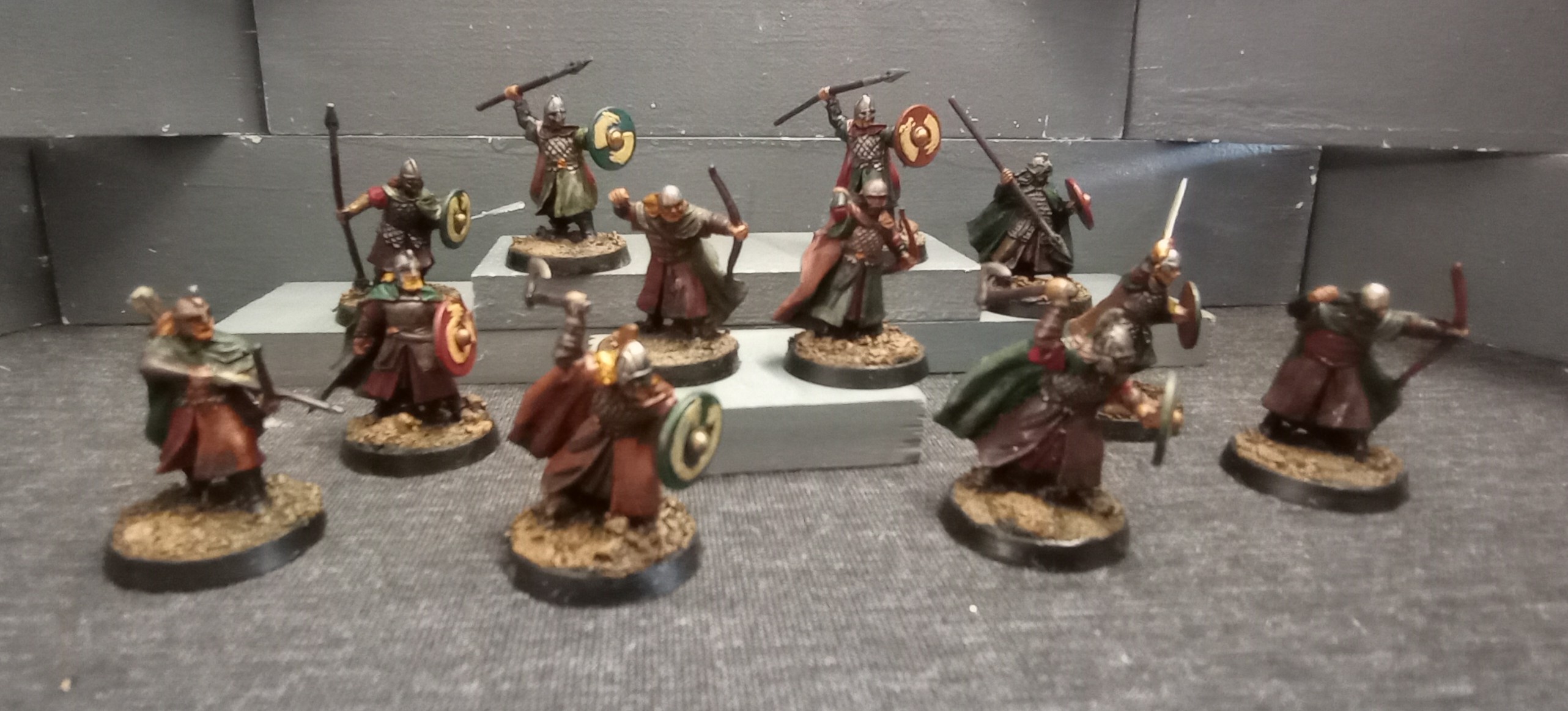
I've said all this about actions and reactions, but haven't even stated the "how you take turns" and "who goes first" which is is kinda the core of initiative system...  I'll have to save this for another post as my kids want to play Sea of Thieves (co-op pirate PC game) and I have some new LoTR to paint...

Saturday, 3 December 2022

Revisiting Jet Wargames 2022 #3: Missiles, Lethality, "To Hit"

 I'm still avoiding activation/initiative as I'm paralyzed by indecision about a few key factors (reactions, etc). So I'm going to do 'shooting' as it's pretty simple and logical.

I'm still mulling over detection; my current rules (from the last post) may be replaced by a different set of rules. I'm replacing the word 'detected' with 'tracked' - showing it's more about clearly locating/acquiring the enemy rather than the enemy 'uncloaking' in case I am not clear enough in my description.

Version #2: Aircraft can only "track" 1, maybe 2 planes at a time (using similar 180d front/rear rules to detection. Again, it's either/or, front/back; a pilot can either be looking at his radar screen or over his shoulder; not both. "Untracked" planes get an initiative advantage and a bonus to dogfights, + missiles cannot be as easily evaded etc.

Missiles = Simple as 40K Shooting?

As a more relaxing focus, I'm going to look at missiles aka "shooting" in a skirmish wargame. If dogfights are melee, then missiles are going to parallel the rifle shooting phase. They need to be about as simple as shooting in a game like Infinity, while 'feeling' a bit different. Angle and status of the firer/target will matter instead of cover.

I don't really care about mechanics or dice that much so long as the methods are consistent and simple, it's the % chance for success that ultimately matters.  

In a normal 40K-style game, 50% chance to hit, and 50% chance to kill is usual. Which means each shot has a 25% chance of being lethal. Obviously, cover/saving rolls can reduce this further; perhaps ultimately to about 12.5% lethality. This gives us a ballpark for what is 'normal.'

Without getting bogged in ultra-realism and rivet counting, for Vietnam/70s Cold war, I think I recall AIM-9s had a 20% 'to hit' and AIM-7s had around 15% 'to hit'; with about 50% or so actually being lethal. I.e. 7-10% = remarkably similar to the 40K-esque numbers above. I could have a missile roll 4+ on d6 to hit, then 4+ on d6 to kill, and give sat a 4+ saving throw for flares/dodge and get the same end effect...!

Obviously missiles are more lethal now; in the 90s-on - in the 60-70-80% range; but that's pretty un-fun so I may artificially nerf them a bit.

No Rivet Counting

I obviously want some variation in missiles, but again, it should mirror the complexity of a skirmish wargame at most. I'll lump them into dogfight (usual infa-red) and med/long (BVR) range. (usually radar/SARH). Percentages are just my rough idea and are subject to change. This is an idea of how missiles will be categorized into broad groups:

Dogfight (~4-8km range)

Rear-Only (1st, 2nd Gen i.e. AIM-9B, K-13/AA-2). Must be fired into enemy rear 180. Not very accurate (30%?).  Earliest ones can't be used in combination with wild maneuvers. (Later AIM 9 G/H, R-13M/AA-2C/D can...)

All-Aspect (3rd gen; AIM-9L). Can be fired into any angle, but better chance of success to rear (50%) than front on (20%).

Thrust-Vector (4th gen, AIM-9X, R-73). Can be fired from any angle, but very agile, often cued by helmet sights. Say 40% front, 80% rear. Better resistance to ECM/flares. May have electro-optics. Better kill %.

BVR (Medium/Long ~20-50km range)

Early SARH (AIM-7E, AA-7/K-23). Can be fired from any angle, but needs a moment to line up so cannot combine with crazy maneuvers. Say 40% rear 20% front.

SARH (AIM-7M, AA-10/R-27)  More accurate, longer ranged, reduced chance of being decoyed. Say 70% rear, 50% front.

F&F 4th Gen (AIM-120, Meteor, MICA RF). Modern, accurate, use multiple tracking methods. 80%/50%. Very hard to decoy.

Hypersonic Long Range (active radar - AIM54, R-37).  Superfast long range, fitted to interceptors like MiG25/31, F-14 for interdicting supersonic bombers, AWACs etc. Unlimited range on table. Etc etc....

...anyway, you get the idea. While this is fun, it's not really important and it's a bit of a waste of time until I work out all the mechanics surrounding them. How can we make missiles in this game seem like missiles and not just rifles?


I really like Tumbling Dice's chunky 1:600s - easy to paint, sturdy gaming pieces

Lock & Hit? Well, you can only engage a target that is being tracked.  In addition, most missiles will require a "lock" as well as a roll to hit? You could roll two different coloured dice together; one to lock, the second to hit. SARH missiles roll against the plane's Radar stat to lock, whereas heat seekers probably have their own Lock stat (based on search angle and seeker system quality).  Pilot skill modifies this a bit. Modifiers would be the same as radar detection/tracking in the last post, for simplicity sake.

Range will vary, but if our jets are moving 4-8"like 40K infantry, let's say our BVR missiles will average 24"(40K rifle) and dogfight missiles 6-12" (like 40K pistols and SMGs); at least to start with. We can reduce this after playtesting; but we'll start with these familiar distances for balance purposes.

If 'dogfights' and gun range are melee (1-2") = a few km; and 'visual' range is say 6-8" or so - 12-16km or so, then we can adapt missile stats easily enough, always bearing in mind realism is always trumped by fun/playability.

Let's say 1" missile range every ~5km of 'factory spec' range; this would give an AIM-9 3-4"range, an AIM-7E 6" range, and an AIM-7M 14". Seems a little low, but we can get range bonuses depending on the firer's energy/height and the target aspect.

Closing time: Head-on missile targets (fired into target front arc) get +100% range, but are easier to spot/dodge with maneuvers.

High energy launch: Maybe high energy fighters get extra +50% range, low energy lose -50%?

So an AIM-9 could actually fire 10" in optimal conditions = 4" (base) +4" (closing), +2" (max energy)

Evasion (Dodge/Evade Save): Allow some sort of opposed roll or penalty to-hit; if target is facing missile launch it gets a bonus. Radar Warning Receivers (RWR) increase this bonus. Based on pilot skill.

Countermeasures (Cover Save): Allow some sort of opposed roll or penalty to hit; maybe can combine with Dodge Save. Again, a RWR makes it more effective.

Hmm. I really need to make a decision on whether I allow reaction mechanics. I usually build a game using initiative mechanics first, and it's coming back to bite me now...

Ok, so let's put it all together into a sequence. A F-4 Phantom armed with AIM-7Es (medium energy) can engage enemies at 8-16"; newer-gen AIM-7Ms would cover 14-28". 

It would choose a tracked aircraft in its front arc, within range, and roll 2 dice; a lock dice that must pass it's radar stat (say 60%) AND a to-hit to actually have the missile connect (also, say 40% for a rear-on AIM-&E launch). At the moment, it's 24% lethality presuming the missile is 100% effective and insta-kills every target.

Now, let's presume the missile only gets a kill 60% of the time. Some are duds/near misses. Now it has 14% lethality. 

OK, but what about flares/chaff/evasive maneuvers? Let's say it's based on the mid-level agility of a MiG-21; it probably could be a contested roll but for the sake of simplicity let's say it's 50%.

So... in the final wash out, our AIM-7 has a 7% chance to actually kill.   That's actually close to my 40K-style 4+ on a d6 to hit, 4+ to kill, 4+ saving throw... ..and not far off the historical 9% from Wikipedia.

This is a useful design concept to ponder; "how" you get there is mostly flavour; the ultimate success % is the actual effect. So while the process of 'how' may add a sense of realism and involvement, I could technically just skip it all, roll a d10 for each Aim-7, and remove an enemy jet each '1' that was rolled. Effect would be almost identical. But it wouldn't be as satisfying for the players.

It's why I am never too attached to dice mechanics; whether it is buckets of d6 or d20 contested rolls, it's the end result that matters.

I'm not too wedded to the above missile mechanics, but as it is it's no more complex than any skirmish/40K game - merely necessitating an extra 'lock' dice to be thrown alongside the 'to hit' dice -  I'm going to label it 'good enough for now' and move on.

I'm going to review the missile ranges with an eye to linking with radar/detection ranges (which I haven't set in stone, but I'm going visual range as 6-8" and radar may as well be the same as missiles. If missile range is 5km/"  (actually 2.5km/" when you count closing bonuses); then radar range will fall somewhere in there. An F-4 AWG-10 radar has around 100km range, so 20-40" seems fair.  Again, scale is not precise it's more about gameplay feel, and how weapons and radars work relative to each other.

Tuesday, 29 November 2022

Revisiting Jet Wargames 2022 #2 (Detection)

 In Part #2 of revisiting aerial wargames, I'd like to make sure I stay focussed on my manifesto:

-Energy management (potential vs kinetic vs position to foe) 

-Detection  

- Pilot skill 

-Aircraft Performance

The game should be fast, with no token clutter and recording. It should be about zooming planes around the table and tossing dice to pew pew, not plotting turns or consulting movement templates or special custom dials. I want all my toys on the table in a cool spectacle, not just a 1v1 duel. Skirmish wargames seem to manage this, so we will borrow from them. It should look more like Infinity or Mordhiem than a rehash of some 1970s Blue Max air rules or something X-Wing-y with special move rulers or dials.

Currently the movement rules play like a melee game where you spend stamina to melee, change direction or boost speed, with some sort of involved melee mechanics.

Tidying Up...

I feel there is quite a bit to tidy up from last post, unanswered questions like..

How do you regain an energy level? Perhaps if you are making a normal move, roll equal or below your Thrust on a d10 i.e. if your Thrust is 6"; you regain an energy level on a 6 or below.

What if there are multiple planes in a dogfight? I.e. 2v1, 3v1? Maybe just a +2 bonus each extra plane; but only one plane can attack. Planes pair off where possible. This will need a bit of playtesting.

Can planes lose control /spin? Probably only a very stressed pilot doing complex/tricky maneuvers (reversals. dogfights etc), so not a test to do frequently (we want to minimise needless dice rolls), but it should probably be possible.

Any other glaring questions I've missed? Obviously activation, detection and pilot skills have not really been addressed.

F-100 and MiG21 mercenary aces buzz a drilling rig...

Detection (ok, finally to the topic)

This is important in air warfare; but I don't want it to be the main focus. 

I'm not going to faff around with 'blinds' and tokens and hidden movement like this is some sort of submarine game. Neither do I want constantly rolling for detection to interrupt the flow of the game - the movement and pew-pew. We're here to dogfight, pew-pew and shoot missiles, and we can assume ground control have made either or both sides at least aware of the possibility of hostiles. I.e. surprise should be an important advantage - a "first shot"/ambush bonus, or activation/initiative advantage - but it's not the "main game."

So to minimize unecessary dice rolling, we'll set out a few simple rules. (I kinda have Infinity in mind here). You can use visual OR radar, but not both. (Unless maybe two seaters?) You need to choose if you are peering at the radar screen or scanning the sky around you.

Also, in my campaign against extra measuring or special dials, I want to make it so you can eyeball most situations, so I'm going to have just 2 'arcs' - the front (180) and the back (180). You can look to the front or the back, but not both.

Yes, radars, guns and missiles might have much narrower arcs, but remember - simplicity - and we can presume the pilot can move the nose of the plane around and make commonsense adjustments. In Infinity facing matters, so 180 arcs should be good enough for us and dispense with the need for special protractor-ish devices.

VISUAL SPOTTING

Now I'm not exactly sure what max air-to-air visibility is, but I'm going to ballpark ~10km or so. I don't have (or want!) a precise scale, but I want to have a rough idea vs weapon ranges. If dogfight range is 1-2", then I'm going to say visibility is 6-10" or so.  Perhaps it is equal to pilot skill - a 6 skill pilot sees 6"? 

This would fit with my 'pilot skill matters' key concept. The ranges can be tweaked after playtesting. Remember movement is like a 40K or skirmish melee game - in the 4-8" range.

Maybe a pilot makes a single roll for EVERYTHING in either the front or rear (not both) and if he passes he spots EVERYTHING in that 180.  A bit crude - but we want it to be fast. Rolling for each target would be unbearably fiddly.

A few logical modifiers; poor visibility or night would halve the maximum range, and targets in the rear 180 may have a penalty of -2 to the spotting roll (or -4 if poor rearward visibility like a MiG-23), maybe +1/-1 for big/small planes.

RADAR SPOTTING

While radar arcs vary, we'll say radar works for everything in the front 180 only. Just like visual spotting, you make a single roll (this time, vs a radar stat rather than pilot skill?) and anything that passes is spotted.  

Again, a very few logical modifiers; +1/-1 for big and small, -4 for targets which are 'on the deck', and maybe -1/-2/-3 for varying levels of stealth or hostile EW.

K.I.S.S. - are the detection simple/minimal/unobtrusive enough?

+ We use just 2 arcs, front and rear, which can just be 'eyeballed'

+ A single roll is made for each plane (of a single type - radar OR visual) in a single arc

+ Anything outside visual range in rear 180 arc can be ignored

+ Few modifiers and things to remember

- We'll probably need a token (table clutter) to denote undetected aircraft

I've introduced two new stats here - Pilot Skill and Radar. Radar will be a number and a range i.e. Radar 5/24". So a plane might be Thrust 6", Sprint 10", Agility 7 with a Radar of 5/36." These are core stats. It's no worse than a unit from a 40K army list. I think it's still simple enough. I don't want it to bog down with 101 stats and rolls. Basically, my benchmark is: would this rule/level of detail be fine in a Necromunda/Infinity level skirmish game? Can I play a game with 6-12 aircraft per side in an hour?

BENEFITS OF BEING UNDETECTED

Now, what benefit does being undetected be? How do we track it? 

Ugh, probably will need a token - a Black Token next to an undetected jet. Which hopefully means we can remove them once the shooting starts. Token/table clutter is a concern. I'm looking at you, X-Wing.

Probably undetected jets get a significant 'to hit bonus' - i.e. +2-3 to initial Dogfight rolls etc. Like a charge bonus in an infantry wargame, or an unopposed action in Infinity. Maybe also include some sort of activation or initiative advantage; undetected models can move out of sequence before/after detected models. So undetected aircraft, if not truly invisible on the tabletop, can 'dictate the fight' to a degree.

We seem to be heading into discussing initiative (and activation/actions/reactions) which are probably food for another post, and probably need to consider weapon range vs detection range vs movement range which may be yet another topic.

Monday, 10 October 2022

Revisiting Jet Wargames - 2022 #1 (Movement)

 I've generally been discontented with aerial wargames; generally decrying excessive complexity, slow play, recording, and old fashioned mechanics. I made a manifesto identifying factors like energy management (potential vs kinetic vs position to foe), detection, pilot skill and aircraft performance as key elements.

I kinda identified an aim to move away from traditional mechanics, such as movement templates, pre-plotting, special movement rulers or cards etc in favour of simplified movement. But I don't think I went far enough.

At the core, the issue is air combat is relatively complex, and it is always harder to abstract and simplify than it is to add in extra detail. In addition, unless you play a 1 v1 duel between two aircraft, the game will have an issue with micromanagement; say you control 4, 6 or as dozen planes - you are a flight or squadron leader; and as such should not be micromanaging the exact throttle and stick inputs of every jet, even if it was feasible. It should give the broad 'feel' and 'decisions' of air combat, but stay simple.

Instead of looking at flying wargames for inspiration, I'm looking at skirmish wargames - games like Mordhiem, Malifaux, Infinity. I'm trying to divorce myself from the temptation to piggyback existing air wargame rules. I want a fun, fast game to play with my 1:600 jets!

Tumbling Dice 1:600 are fun to paint and characterful playing pieces.

MOVEMENT & MANEUVER (aka Positioning relative to foes)

Movement is a key area to abstract. It cannot be much trickier than a skirmish wargame. There should be no charts or anything that needs memorizing. Minimal recording and token litter.

I'm going to have a few speed levels - "Thrust" representing subsonic maneuvering, mostly based on power-to-weight, and "Sprint" representing sustained straight line speed (loosely based on maximum Mach) a bit like "walk" and "run" speeds in skirmish games.

Normal move = plane can pivot up to 90d and move up to "Thrust"(fairly high-G maneuvers). This would be a 4-8" move for the average jet.

Reversal = plane can pivot 90-180d and move up to half "Thrust" (Split S, Immelman)

I'll probably give planes a minimum movement of 1" to give a sense of momentum. The reversal probably needs some sort of penalty or dice roll to pass to stop planes pivoting on the spot too freely.

Sprint = plane moves Sprint distance; maybe can make a 90d turn after half the move; G forces means it cannot turn too sharply. This is a shallow dive, or afterburn with only shallow turns. This would be a 6-12" move for the average jet. Movement distances are similar to 28mm '40K' style traditional wargames.

Planes can freely move between these two moves without any tokens or recording. As you can see, you could explain it to someone and they could remember it without referring to a chart or rulebook; no fancy movement rulers are needed.

I may add to this, but I'm trying to resist the urge to complicate matters. We are squadron or flight leaders giving general instructions - "break left!" "evade!" - not micromanaging each plane with precise inputs.

Actually an "Evade" move seems a reasonable addition. For simplicity, it is like a normal move (90d+Thrust), but there is some sort of penalty to perform it and it gives defence bonuses. This represents barrel rolls and scissors etc.

Hmm, so far this is somewhat similar to my 2019 efforts, albeit a bit simpler.

Now for a bit of a deviation.

Now, I'm going to go into RPG and skirmish wargame territory. We're going to abstact height and speed into a single resource "Energy" aka a Stamina bar. I'm actually thinking of adding "Suppression" aka Pilot Focus or Stress - representing a pilot's multi-tasking, coolness, awareness. Some games might have Action Points or a dice pool for this, but I'm toying with the idea of a "Suppressed/Pinned" state from land wargames, where the pilot is stressed out of his brain and can't cope; only able to evade or do basic stuff. More on that later.

ENERGY MANAGEMENT (aka Height vs Speed vs Positioning)

Okay, here's our first token or recording. A counter placed under the base; Red is low energy (low and slow), Blue is high energy (high and fast). Normal energy, the default, has no token at all, hopefully reducing the tokens. We're not recording height and speed separately - we're combining them.

I wouldn't do this for a WW1 biplane game, but with the climb rates and thrust/weight of jets, I feel the granularity can be sacrificed. The idea is energy is a resource you can 'spend' to gain better position.

Let's make some maneuvers cost energy.

A high speed Sprint will cost energy. A Reversal will cost energy. You need to 'spend' energy to go faster or change facing radically. You drop a level - from high to normal, from normal to low. A low energy fighter has limited maneuvers. 

I'm toying with the idea of splitting the Reversal into two; making the normal Reversal "free" (yoyo, Immelman) which costs no energy, and a "energy" Reversal which allows you to move your full thrust after pivoting 90-180d (split S, diving turn) but costs an energy level; basically trading height to retain speed. Too complex?

Well, so far we have only 1 token beside the plane (in many cases, for normal energy, none at all). No recording. I've covered the effect of most basic fighter maneuvers.

I'm a bit sad to abstract height away completely, maybe I'll add another token (green?) "On the Deck" for planes who are skimming low to avoid radar. This could make them hard to detect and attack, but make any accident/loss of control fatal? Risk vs reward... Not sure if I want another token possibly cluttering things as I'm trying so hard to avoid them - is it worth it?

By abstracting the rules, we can handle 4-12 planes at a time, rather than a 1 v1 duel best suited to a PC game... Aka we can play with more toys on the table!

DOGFIGHTS & SCALE (Melee?!)

I haven't mentioned any scale. Some rules say 1 hex or 2" or whatever is exactly 500m, and vertical levels are 250m, and each turn is 3 seconds... I can't afford that sort of precision. We're assuming pretty broad movements; the pilot is steering the plane, you the wargamer are not precisely positioning it; rather giving general instructions.We can however assume 1-2" or a hex is more kilometres than metres. 

Following my "copy skirmish wargames rather than 1970s air wargames" I'm going to treat dogfights as a melee!

Once a jet moves within 2"/hex/base length of another jet, a dogfight (melee) is triggered. As soon as this happens, movement is paused (a bit like minis having a "zone of control.")

The player who moved into melee dogfight declares if he wishes to attack or evade, then the non-active player declares if he wants to attack or evade. (Not sure which order atm).

Both players make a contested roll. (Dice + 'agility' stat of some sort)

Both Evade = active player can then continue its move unless it would bring either jet into each other's front arc. If this is the case, see "Evader beats Attacker" below.

Evader beats Attacker = loser pivots randomly, evader is faced 2" away anywhere in its 180 rear arc, facing away. Critical success = Evader chooses Attascker's facing first.

Attacker beats Evader = Evader pivots randomly, attacker is placed anywhere it chooses within 2" of its front 180d arc, facing the target. Critical success = Attacker is placed anywhere 2" within it's rear 180d arc, facing the target (Tailing).

Attacker 1 beats Attacker 2 = Loser pivots randomly, winner is placed anywhere it chooses within 2" of the loser's front 180 arc, facing the target. Loser can shoot back after winner, but at a penalty.  Critical success = Winner is placed anywhere in loser's rear 180d arc, facing the target (tailing). 

Okay, this is a bit jumbled and needs fleshing out/adjusting, but you get the idea. It's kinda a melee "dodge" or "pushback" that represents the winner of the wild maneuvers choosing its facing/relative position, and a critical success gives an optimum position. There's a bit of decision making in the dogfight.

How the 'pivot facing' random facing will work? - on a hex, it's easy with 1d6 giving the hex facings, but otherwise my jets have hex bases so I can go off that.

The dogfight is a swirling series of sharp, violent maneuvers. It obviously would cost energy, and there would be some sort of penalty invoked.

Obviously there would be a bonus for having higher energy than the opponent, and also a bonus if it approached from the opponent's rear hemisphere or if undetected. A low energy plane would be at a significant disadvantage. We'll do modifiers to the contested roll; a -20% or +20% or so to taste. So your state before entering the dogfight matters - high energy, undetected aircraft will dominate regardless of base aircraft performance.

Well, looking at it we've pretty much got skirmish wargame movement (a la Mordhiem, Infinity) where it costs stamina to run, melee, or move to your rear, and a characterful melee system.

The upside: for a jet game, there is no recording, little token clutter, and easy-to-remember and fast paced action that could easily handle 6-12 minis, instead of charts, fancy rulers and writing down moves. We have 3 stats to remember; Thrust, Sprint, and Dogfight. But is it too simple?

From our initial aim: We've got some energy management (potential vs kinetic vs position to foe) and aircraft performance (Sprint, Thrust and Dogfight stats) in our rules so far. But we need to add and tie in detection (through activation, modifiers?), and pilot skill (through modifiers, 'focus'/multitasking - dice pool/action points/suppression, activation).

Tuesday, 4 October 2022

Back in the Shed

 Well, school holidays allowed me some time back in the man-cave. The COVID-enabled frantic painting output has died off (I've mostly been experimenting with homebrew rules and PC gaming with my son). My kids are sharing tenancy of the shed now; daughter mostly reading Harry Potter and son playing both RISK and an invented-by-7-year-old-wargame with plastic ant tribes - combat is mostly a dice each, loser dies, but he adds in extra rules "these are fire ants so if they get less than 4 it counts as 4, unless they are fire ant enemies who are immune to fire." He seems to have the grasp of wargames already!

19 more LoTR take my total to 335 for the year. This is a mix of Mordor uruk-hai and engineers, Castellans of Dol Guldor and foot Rohirrim. (I really dislike mounted minis so 6 more Rohirrim on horseback await me reproachfully on my bench.)  Next up, some more colourful Easterlings - my favourite minis - it's got 'dad-bod' Abrakhan Guards and pirates.

This was a random mix of minis - a feral uruk (broken sword replaced by decapitated head), an orc leader(?) and some what I presume are siege troops, sans catapult (I think I had some ladders in a box). I bought my LoTR minis cheap in 'job lots' in the lull between movies, working on a 50c-per-plastic, $2-5AUD per metal or mounted ratio, so I have lots of double-up heroes and random metals.

Dried up paints and dull colours made these a bit of a slog - I'm out of practice. These were Mordor Uruks which I discovered after a bit of googling. Haven't tidied up the bases and probably should re-do the highlighting.

I bought these Castellans this year - I've actually had very few wargame purchases in the last 5 years. It's just not very good value as a hobby - I just shifted a rulebook cupboard with 150 rulebooks to my shed. At say ~$30 each that's $4500 of books, of which I only regularly use 10 or so... eeek. At least the LoTr minis have appreciated in value!


I've also got some Rohirrim mounted, many heroes and some of their elite guard. I'm not sure how I'm going to go about painting their armour - rewatching LoTR with my daughter, there is a lot of reddish-leather chestpieces and chunks where you'd assume metal on the minis. 

I'm going to count this as mini #336 as I did paint it (inspired by watching Pirates of the Caribbean with my daughter). For those concerned I'm going to maim myself, I always helmet, pad up or wear slide gloves+jeans. Only crash was 2 years ago when my 5-year-old veered into me and I hit a seed pod while evading, but thanks to my gear I yielded only a small blood sacrifice to Skatan. As a hobby, longboarding has a lot of similarities with wargaming - collecting and customising boards (aka minis), often more looked at than used!

In other news, I've been experimenting with homebrew mecha rules thanks to reviving my interest in Mechwarrior: Online (actually pretty good as a 'dad' game where reflexes are not a premium). I enjoy min-maxing mech loadouts and I reckon for every hour I spend pew-pewing I spend two in the mechlab. It's still playing the game, technically!  It's a PvP shooter, but slow paced and full of lore nerds, so I can recommend. I've also dug out my cowboy minis thanks to the PC aRPG "Weird West" which has Deadlands vibes; my digital gaming has influenced my analogue gaming for sure!  I've also done another pass at my modern jet rules - I've never played a fighter wargame that wasn't either slow or bogged in the 70s. I'm allowed another article with my experimenting - the last was in 2019...

Tuesday, 12 April 2022

300 in 3 Months

 Admittedly it's April, but these were finished in March. I've finally got into my Rohirrim horsemen (12) with another ~8 or so to come. These 27 minis bring my total to 316 so far this year.


What is this? Well, I did paint it, so I reckon it should count. ^^^Not really a mini I suppose....

Yes, I finally painted some Rohirrim on horseback. Not my finest work but gets them table-ready.

Another 10 Easterling foot, a commander and banner. 
Some Rangers of the North.
Repaired and painted some Gondor cavalry. Though spear still is shonky...
 

The longboard deck I painted above alludes to another interest - riding around on planks with wheels. There's a bit of overlap; I've been playing with my 6-year-old son's Tech Decks (toy finger-skateboards at 1:12 scale) and bought my own toy board. He and his sister were offended when I declared mine was cooler than theirs, and retaliated by buying themselves a 5-pack each. Finally, they had a toy collection bigger than Dad!...

...which prompted me to build a real skateboard identical to the Tech Deck toy, proving it's hard to outdo Dad in the toy department... 
 
Painting output has been low in April. I've got Dropfleet Commander PHR & USC boxes semi-assembled. Man, the models are amazing - they fit together so well you can click them together with friction and they stay in place. Some of the most precise work I've seen. Only downside was I've damaged a few when cutting them from the sprues and the castings are so fine you notice the blemishes.
 
Also sitting on my hobby bench is an Imperialis Aeronautica starter box which I've eyed off but not even attempted. The hex maneuver rules are a bit confusing and I haven't been in the mood to decipher them. Exacerbating this, the models - whilst nice - come in 101 pieces. It just seems like GW wants to justify their prices by making it feel like you bought a model kit. Taking an hour to assemble a single small mini isn't my idea of a good time. Don't expect a rules review or completed model pics anytime soon.
 
I've also been playing a few  PC games with my kids. Warframe (robot space ninja Jedi) which has given me ideas for a co-op wargame using simple AI, Hunter Call of the Wild - the family that shoots animals together, stays together - and Star Wars Battlefront II (2005 version, of course) being the most popular, although my young son surprisingly prefers slow paced tactical shooters like ARMA3 and Ghost Recon. All are actually pretty decent "Dad" games where old age and cunning tends to outweigh young reflexes, so I'm OK with that!

I have continued to experiment with homebrew skirmish rules; I've simplified The Forgotten by stripping away most of the reaction and activation mechanics. While good rules in themselves, creating lots of interesting decisions, it drew the focus onto positioning and firing lanes, rather than supernatural sci fi horror shenanigans. It was good meaningful decisions, but in the wrong places. As it was, it would have made a good modern spec ops shooter but I wanted faster play, and fewer position decisions in order to focus players on morale and magic management. Currently it's a bit like a super simple Savage Worlds with many shared dice mechanics - which has the benefit of allowing me to port in spells and abilities with minimal playtesting. 

Wednesday, 2 March 2022

LoTR:SBG - Easterlings, Ringwraiths, Army of the Dead

My 1000-page journey with my daughter through the LoTR books is at an end, and likewise my LOTR painting run is drawing to a close.

This month my work ramped up again, and I only managed to paint these 31 models, giving me a total of 289 painted in two months of 2022 - mostly due to being flooded in. It's currently another huge flood where I live, and Day #5 stranded, without coffee. Yep let that sink in.

I've now done the bulk of my Middle Earth forces. Now it's just 'tidying up' random models. My aim was to have 50-60+ strong warbands for each main LoTR faction and this has been largely achieved. 

The army of the dead were most interesting to paint.  I painted them roughly in brown base colours, then went over the top in grey then white drybrushes, with the odd wash in between. 

You can see the leather and armour peaking through, which I based on this picture. They aren't pure greeny-white which is the most common paint style. I found the success confidence boosting and I may attempt some glow and fire effects based on what I learned. I was surprised how fast and easy it was.

I only have 7 ringwraiths - remember I ordered random job lots from eBay - which I painted rather boldly rather than drybushing to make them 'pop' more from a distance. Two had broken weapons and were customised out of my bitz box.

The Easterlings with their pleasingly uniform paint scheme was another 'low hanging fruit' to chalk up a few more minis before the month ended. They could probably do with more highlighting but I'm on a schedule. 

The only  'must do' LoTR remaining is some 12-16 Rohirrim on horseback and some 5-6 random heroes; the rest is just me trying to trim down spare plastics - i.e. I have only painted 40 or so Mordor orcs I needed, but there is still 100 or so of them in a box, staring accusingly at me. 

Now it's all ready to play - naaah - time to switch to a new project! Imperialis Aeronautica is looking increasingly good - I just found a random Thunderbolt model in one of my 'bulk buy' LoTR boxes and I really like it. It must be a sign!

But.... ....my daughter and I are now reading Mortal Engines. Perhaps its time for some mega tanks and humongous landships....