Sunday, 16 June 2024

Victrix Vikings & Dreadball Musings

I bought a pack of Victrix Vikings, intended either (a) to proxy as Dunlendings or (b) fight zombies in a medieval post apocalyptic ice age.


Well, they are amazing. GW-level detail, at $80AUD (~$50USD) for 60 minis. They are a tad big to go with my MESBG but after I priced up the official Dunlendings, I don't care.

So with my single packet I managed to make...

Thrydan Wolfsbane (foot only) = $25

Igrinna/Oathmaker/Gorulf = $78

Chieftain + Banner + 12 Dunland warriors = $137

Wildmen of Dunland (16 not 12) = $101

Huscarls (4) = $57

...so my Victrix pack allows me to duplicate about $400AUD worth of stuff as per GW Australia. And I've still got about twenty vikings left to make a zombie fighting expedition for my own skirmish homebrew rules...

I'll add some 3D printed Crebain (crow flock) and maybe a few hill ponies and I'm good to go. It's pretty much a single packet = an entire Dunland army.

Why are these displayed unpainted, you ask? Well, here's the negative...

Unlike say Perry plastics which are pretty casual in mix-and-match, the combinations are quite complicated. It took forever to assemble them (hours and hours). Not quite Wargames Factory samurai level annoying, but much slower than I expected. 


Dreadball

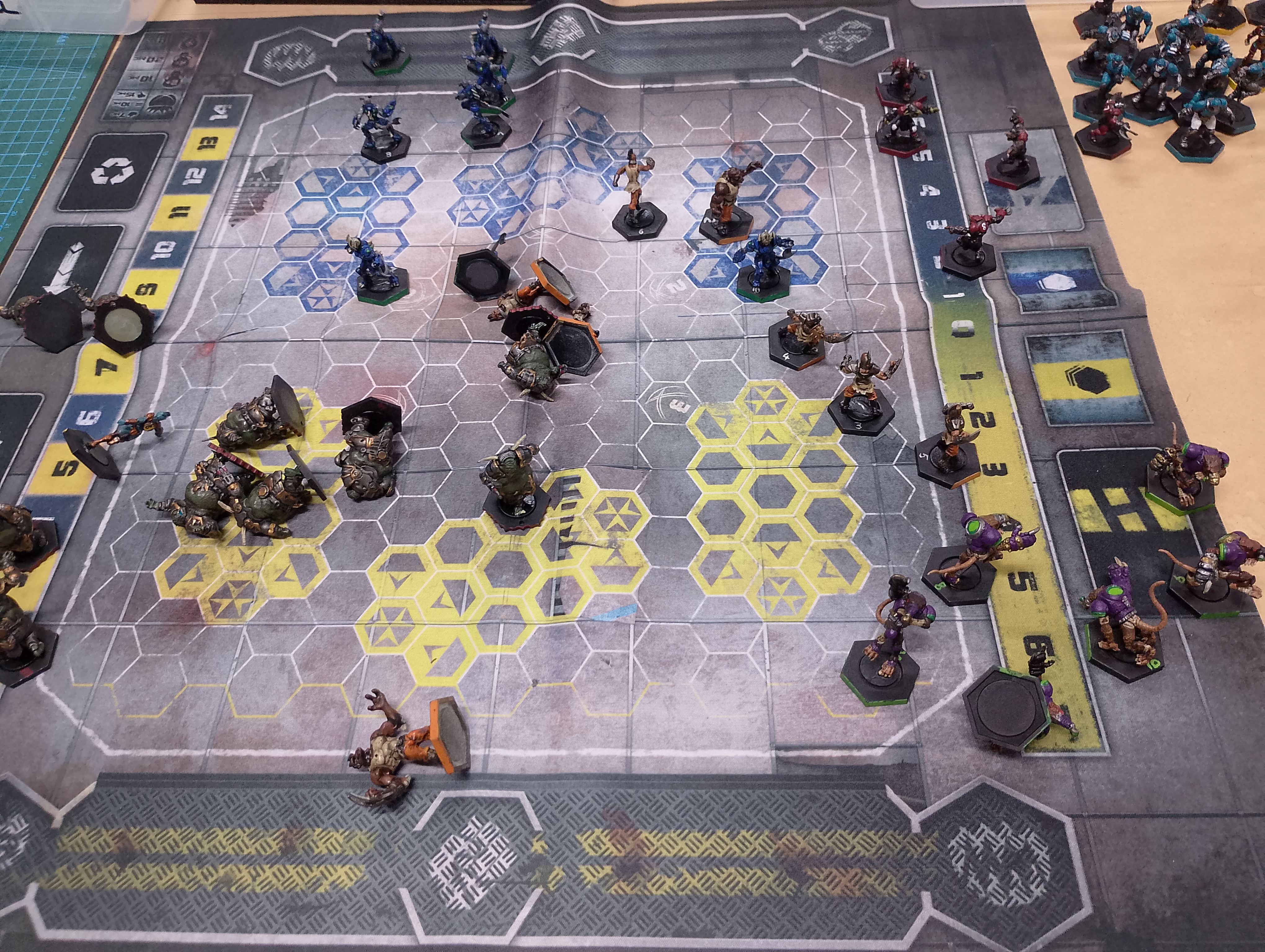
My son has expressed an interest so I've grabbed these out again for a playtest. In my teen years I loved Bloodbowl and technically this is a sleeker, faster playing game of similar ilk. Well, it's not exactly the same (more akin to basketball/hockey/some sort of 90s speedball arcade game) but you can tell BB was in the back of the designers mind when they made it. There's some good design choices here but I'm strangely unenthusiastic.

No setup/kickoff. Once you score the game just keeps going. It's a massive time saving compared to BB and you can actually think ahead beyond when you score. Cool.

Resource Management vs Risk Mitigation. You have 5 actions to spend in various ways; it's more managing your resources than slowly setting up a play, avoiding being f---d by the dice like BB.You can pass multiple times in a turn. Play also alternates faster. You can try riskier shots for more points.

Less meaningless turns/one sided games. Goals can be worth 1-4pts and can be scored almost any time; you never get far behind (there's a 7pt mercy rule); there's no feeling of playing out meaningless turns in an unwinnable game. From my limited experimenting, there seems to be more balance. Stats don't differ much between teams.

Consistent Mechanics. The same mechanics (roll a handful of dice; count successes, modifiers subtract and add dice to pool) are used throughout. No weird dice. Also, the results are less 'swingy' and less terrifying than BB.

A lot of these seem like a direct 'fix' for issues with BB. The game just seems better/more modern. Mechanics are better/smoother. Seems pretty balanced. So why am I not so keen to play?

Miniatures. They're just meh. Some are OK, but many are weedy and lame. Others have pretty much the same sculpt for the entire team. Extra teams are the same price as a BB team and they are nowhere near the quality. Bah.

Factions/Fluff. Bloodbowl is iconic and easy to 'get'. Violet gridiron with fantasy teams. Ogres, elves, orcs - you know what to expect - it 'fits.' Now the sci fi fluff of Dreadball is just... it's like they threw a ideas at a dartboard. Teleporting turtles? It feels like a wasted opportunity. Combined with the lackluster minis, there's almost no team I go "cool - I wanna play as these guys!"

Generic Samey Teams. The teams (and players) seem kinda similar. Bloodbowl had more variation within a team than Dreadball has between teams. Perhaps it was for better balance. It may be because the probability curve has been smoothed out (which although it removes some of the harshness of the rolls) makes things feel.. bland? Flavourless? Except...

Guards/Locked positions. For some reason these guys can't pick up the ball at all. There's some B.S. reason in the fluff but even the most hilariously clumsy ogre in BB could at least attempt to pick up the ball. It just seems weird and contrived. In fact, most Dreadball positions are a bit 'locked' compared to BB - where a player can start out one position yet do other jobs - and through skill rolls, can kinda turn into another. Anyone can do anything - even if it isn't a great idea! But in Dreadball, the strikers can't slam at all (act as guards) they can only dodge. There just seems to be more of a 'hard lock' on positions. There's less flavour yet less flexibility. It's a limitation.

Less simple than you'd think. No one I know plays Dreadball - I'm just teaching myself from the book and it isn't as easy as it seems. There's lots of actions and although they share mechanics all are slightly different. I don't find the rulebook easy to use. (And I've read and played it a few years back so I'm not completely unfamiliar)

 Disclaimer: Dreadball has been out for ages and I'm sure there's many more thorough reviews by guys who play leagues etc. This is just my 10c - but it may be relevant if you are, like me, the 'early adopter' or only player in your area and you can't try/learn from someone else. That said, I see starter sets on eBay for ~$60AUD ($40USD) so it's pretty cheap to start if you're curious. Unfortunately for us in Australia, that's also the price of a single extra team - and the quality of some of the models is very iffy.

Tuesday, 11 June 2024

Man Cave v2 Activated

Still some boxes lying around, but the Man Cave (tm) is habitable. I've done a bit of painting and been testing Dreadball rules again (my son likes the idea of it).

I've actually got LESS shed space now (6 bays from 9) but as it's a single large shed not three smaller ones; it seems about the same. Ooh, and I got a shed fridge (allegedly to help my wife with extra room but we really know what it's for) as well as a better shed TV setup. I've forsaken streaming services and have collected ~900 DVDs this year. It sounds a lot but 20c each from the local dump the collection is cheaper than most wargames! There's about ~6 tables of terrain but they stack on top of each other or are hollow so you only see a few tables here. 

The painting gear isn't unpacked but I'm sort of operational.

The wall is mostly wargaming. It goes painted models, books, unpainted models, terrain.

I guess my LoTR count is ~18 for this year? Down a bit on 466 for 2023 but I blame the move...

The dwarves are genuine but the Shelob is a $5 Toys R Us kids toy, the Riders of the Dead are from a Fireforge sprue and the Heralds of the Dead are 3D printed.  In other words, a fraction of what they cost from Gee-Dub. 'Official' Shelob alone is $70AUD. 

I have visitors - Australia's most terrifying predator. The magpie! No, crocodiles and snakes are not what a true Aussie fears (although I do keep the screen door shut to discourage slithering visitors). It's being swooped by a feathered fiend!  I've been appeasing bribing feeding befriending ours so the magpie mafia now appear as soon as they see me in the backyard and tend to come peek into the house and man shed. Yes, I do have kangaroos (lots) in my backyard. No, I have not seen any koalas - although there is a koala reserve on my back fence. Weirdly enough, there is also a lot of ducks.

I was going to discuss some Dreadball thoughts but kids are impatiently awaiting me to read them their nightly book...

Monday, 29 April 2024

Game Design #105: Suppression, Pinning, AoE

Q: What does Generation Kill, Green Zone and Battle for Los Angeles have in common?

 A: They are all movies I have watched recently with my wife, and have prompted thoughts about suppression/AoE in wargames.

Here are a few shower thoughts. I reserve the right to add to/edit this post as I "concrete" my thinking so apologies if this post changes a bit vs what is in the comments. Also all my wargame books are boxed up for my shift so I can't check details.

What does pinned and suppressed even mean? Which is better/worse? Are we using the right terms?

I kinda presumed pinned means "can't move" and suppressed means "can't shoot." But definitions seem vague in wargames. I'd be interested to know what the correct usage is. 

Usually in wargames pinned is a worse result (frozen in place, unable to return fire); but should it be? If a unit is "pinned" in cover it could presumably return fire (maybe at a reduced effectiveness). Something that is "suppressed" is rendered ineffective, right? So... no shooting? And no moving either? Or is it merely "degraded" enemy shooting/observation?  I also read "suppressing fire" "pins down" the enemy and stops them from moving but "covering fire" stops them from shooting and allows you to move. Ugh, confusing.

I'm not sure if this is semantics but do wargames actually treat this the right way? The terms seem to be two different effects in wargames or two "levels" of impact. I'd be interested to know the proper usage. I'm pretty sure my various army rellies used the word "neutralise" but I think it's just the Aussie term for "suppress?"

Are there two stages of suppression? And if so, what effects should they have to best mimic real life?

I'd like a lot more clarity as to the correct terminology... are wargames even using the words right? 

Are wargames too lethal? Is aimed fire too lethal? Does this diminish the value of suppression?

Should you need to suppress first to reliably kill?

I have 0 real world experience, but in milsim PC gaming, the ones getting kills are the ones who are not being suppressed; or the unspotted ones/ambushers with the leisure to aim carefully. When both sides are suppressing each other/spraying fire from cover there is less casualties then if one side has "won" the lead-slinging contest. I'd presume this is even more so when there is real life risk involved. Aimed fire tends to be close range or when there is less risk to the shooter.

Should it almost be a sequence where you have to suppress first / make yourself safe from return fire (can include first turn of an ambush), THEN your chance of getting an actual kill say ...doubles?

Ambush Alley has units "defend" with a pool of dice that represents their active return fire etc; and as a unit takes fire it looses dice from this defensive pool; making it more liable to actually take more losses.

Rolling a 4+ (50%) on a d6 to hit is crazy high, even for a burst of fire. Heck, even 6+ (17%) is high. It almost infers for modern games we need d10, d12 or d20 to allow the low probabilities and allow modifiers.

Should suppression always include the chance to kill?

Quite a few games have "suppression" effect as merely a morale roll. But shouldn't the suppression actually include danger? Having no chance at all to be harmed (however small) seems a bit contradictory.

Should being suppressed/pinned be a choice?

Should units be able to voluntarily "pin" themselves? Maybe units can choose to override the pin at risk of casualties? (risk vs reward) I.e. WW2 USSR troops would probably push through fire that would pin say US troops  - but would certainly take more casualties. (I think Zona Alfa does this?)

Suppression - should it be an AoE marker?

A bullet suppresses ~1m or so; a artillery shell/bomb might suppress to 100x that...

Should suppression be an "area" i.e. a high RoF weapon like a SAW might suppress a 6" diameter circle but an assault rifle a maximum of 3" - representing the volume of fire. (And even then the AR may need to do some sort of reload afterwards). A .50 cal mount on a vehicle might suppress 9-12" due to the bigger rounds...  How long will suppression linger (before cease fire/enemies recover)? Can you place a "suppression" marker as a sorta hazardous terrain token?

I've always liked AoE effects which I've explored more here already...

Squad/Platoon vs Individual Minis - Different Mechanics for Different Scales?

I feel a game that operates on the Bolt Action/40K level (you move clumps/squads of 4-10 men) will probably need very different mechanics to games where you move and fire individual minis (a la Infinity or Necromunda) - i.e. the effect of suppression on a group vs an individual. This would probably also effect the infliction of suppression; 10 squaddies with semiautomatic rifles could probably "suppress" an area or enemy squad; whereas a single guy's semiauto rifle probably would not be viewed as "suppressive" weapon; whereas a single SAW/LMG might...

Suppression/Covering Fire: Should it effect the move sequence?

Wargames nearly always move then shoot; maybe you must shoot (or suppress) then move; or indeed need to suppress to be allowed to move. Can a successful suppression shift the initiative or change unit activation sequences? I.e. the "flow" of battle. 

Gaining fire superiority is often a precursor to maneuver... so shoot, check, THEN move/flank somehow?

Also... should we allow some sort of joint activation, where one unit covers/suppresses a target and the other unit moves in a single action/activation?

Games like Infinity have reactive/suppressive fire that can stop miniatures dead; but it does not interfere with the move sequence. I think Crossfire did swap the initiative when an action was hindered by enemy fire?

It's very late so I'm off to bed; but I'll probably return to expand upon, and add questions.(And hopefully some solutions - I'm just a bit handicapped due to my move not allowing me to experiment. This topic probably links with other posts; on morale/willpower, activation and lethality.

EDIT #1 - Further Thoughts: As you can see from the comments, there isn't a lot of consensus of what a term exactly entails. 

In my googling I realize we may be rehashing a debate from TMP - who also didn't properly define the terms!

-Looking at the AAP6 NATO terms recommended, suppression "degrades" (limited fire and/or move?) as long as the fire lasts*; neutralisation is the next level up; it renders a target temporarily ineffective/unusable (no fire or move?). I kinda like this as the two main "levels" of effect.

-Wikipedia is not ideal but it is a 'common source'  and is suggests "pinned" is a colloquialism like "keeping their heads down" - it's just suppression, rebadged. Relation to cover probably differentiates suppression from pinned; most movement of a suppressed unit is going to be towards cover; once it arrives it'll be 'pinned' there? I'm wondering if pinning = suppressed; and the idea of pinning > suppression or pinning > suppression may be more from our wargaming rulebooks than 'real life.' 

Pinning may just be one aspect of being suppressed; suppression fire by nature isn't too precise - your minis are relatively safe unless they try to move or shoot back. So allowing a risk/reward choice mechanic (stay put and be safe vs try something and risk death/penalties to hit) might be available to better troops. These options could vary - fanatics may be allowed to move/charge despite enemy fire; while trained militia might only be able to return fire and not move, for example.

-Suppression is temporary and limited by ammo. HE/grenades can be used by suppressed units to "counter suppress" ('win the firefight?'); smoke/flares can technically be used to suppress nonlethally through giving/denying concealment....         ....So should these be factored into a wargame? I.e. a single model using suppressive fire with a non-belt weapon may need to reload - a squad may have reduced attack dice etc in the next turn etc? And you can throw grenades and (if it breaks LOS) next turn you squad gets bonuses to "unsuppress" themselves etc.

-The use of marksman/snipers to suppress interests me; I think I mentally classed it as "aimed/directed fire" - intentional killshots the opposite of "mad minute" sprays and AoE blasts; but they are listed as a suppressive weapons and it does kinda make sense. Didn't the USMC ditch its SAWs altogether?

-Suppressing enemies seems integral in doctrine to allowing allies to move freely - so I am increasingly thinking, yes -  suppression in a wargame should be linked to activation; i.e. successfully suppressing a unit may allow a 'free' move to an ally nearby, or allow joint activations between supporting units; anything to control the "flow" of the game; not just a penalty on the target.


Sunday, 21 April 2024

The New Man Cave + Terrain Musings

If the blog seems a bit dead, it is a combination of (a) school busyness (b) moving house and (c) Google's 2FA (ok, the latter seems a bit lame but it is more the straw that causes the camel back pain or however the saying goes...)

You'd think the shifting house is a perfect time to remove the projects/terrain I no longer need/use, but au contraire - I have been mostly shoving stuff in boxes to speed up the process, as I am not in the most thoughtful of moods whilst moving. The painting has ground to a standstill (although I have prepped a few minis) as my man cave contents have transferred to my new shed. It's actually smaller than the last, but it has better storage as I have replaced older wooden bookshelves with larger, more practical metal 'shed' shelving. 

Down the track the aim is to have an additional converted small shipping container which will either house my library or wargaming stuff - whichever looks/fits/works best. Over the years the man cave has become more about kids reading or playing LEGO or painting minis alongside dad rather than hosting multiple big folk, so smaller premises are OK, given I rarely play games beyond skirmish 

(I tend to have a single big table split into two 4x4's for concurrent projects - usually a playtesting table and an actual game table).

I have 4 of these 120x120cm tables, made of cheap MDF and pine. They are placed atop folding picnic tables, and can be stored sideways against the wall, or (more usually) stacked on top of each other, and can store miniatures (or more usually, dice, trays, rulers and various gribbles) inside...

...and then put a extra 'lid' of MDF on top and play on that....

 ...or even fill them with sand. Not bad for around ~$20 of materials and 20 minutes of work.

Most tables have textured interiors - (sand, PVA and grey spraypaint) in this case - for various genres.

The other really useful terrain (probably my most used) is simply some cuts of pine, painted grey which has served as underground caverns, bases and spaceship interiors. Considering these pine strips all fit into a shoebox (or can be left loose "inside" a table) and cost about $10 it's also highly recommended - super useful for quickly setting up a game/testing rules.

Why am I mentioning terrain? Two reasons. 

(A) During the shift I realize terrain storage needs far outweighs my miniatures storage. I've got thousands of LoTR troops which take up about the same storage space as a single box of terrain. Not everyone is lucky enough to have a 5-bay shed (I had 7 bays so I've gone backwards)...

(B) From my "barriers" musings of late, lack of proper terrain can really impact my motivation to play various genres (lack of good vertical terrain is hindering my Zone Raiders project - finally I have a decent set of sci fi rules but terrain is holding me up...)

I don't particularly love making terrain. I feel money spent on it could be put towards cool toys (minis)... yet decent terrain is kinda integral to the experience. It's like buying paints and brushes - I know I need them for my hobby but resent buying them...

I was thinking: What would I recommend to the "average" wargamer who is starting out? I'm assuming "some" shed/basement space and not a tiny apartment.

*One of those 4x4' MDF tables as per above, painted different colours on each side of the table and separate MDF lid (allowing 4 colours say desert, moonscape, brown dirt, ocean blue) and/or sheets of fabric to go over them. ~$20+  I put mine on picnic tables but it could go on the kitchen table.... wife permitting

*Some sets of cardboard fold out terrain (Dropship Commander, Carnivale, etc) ~$50ea for various; however be aware they don't always fold back down flat...

*Some "block" strip terrain as per above ~$10

*If time/space permits, some nicer bigger terrain specific to a system you are proven to play OR works for several genres. In my case, 15mm middle eastern works from ancients to sci fi - which is excellent versatility.

The high storage commitment for bigger pieces has to match your use of the system; for example these toddler toy castles (total ~$30 or so from a thrift shop) serve dual role in MESBG (my most played game) and medieval psychic dino knights (my own homebrew rules).

Anyway, this post is (a) to reassure regulars I will be back after a hiatus and (b) perhaps stimulate discussion on what storage/terrain works for you.

Tuesday, 20 February 2024

Reasons to Avoid Games/When to Abandon a Project

This blog originally started as a place to stick rules reviews as I was "the guy with all the rules" and I got tired of repeating myself explaining what they were like. I did quite a few reviews - about ~150 or so I'd say. As my aim was saving my mates money, I tended to be more critical than say youtubers who may have partners/sponsors/freebies (or just are more charitable folk). 

As I've sorted my shed (and cleared ~800 of my mini paint backlog) I've noticed a lot of games I've barely played, or minis I'm reluctant to paint, or projects I've abandoned. 

I've made an excel page with column tickboxes for minis/gaming projects:
Have I bought all the minis needed to play?  Have I painted the minis? Have I got terrain? Have I got rules I enjoy? Have I played the game? What is the cost to complete this project?

The stage I get "stuck" in various projects is quite telling. It shows where the 'barriers' are.

I've been thinking about things that instantly turn me off a game. These are preferences, which will vary. What is a turn-off to me, may be a selling point to someone else. For example, En garde was too slow for me - while recognizing it as a good game for others. My younger self would have quite enjoyed it.

So this post is about spotting projects likely to fail early, before we waste too much $ or time. Or identifying minis and half completed projects that need to be sold on.   What are my "barriers?"

The Minis

Now, the toys are probably the real reason we wargame. Some minis are tied strongly to their fluff/background/IP though; there is no rule saying you MUST use x models for y rules - though many companies would like it to be that way. However some people just feel they 'must' use the 'official' minis and it pains them to do otherwise. Or they just like the convenience - you don't even need to deliberate over a paint scheme - you're told how and there are tutorials showing you precisely how. I feel that's about as fun as doing those colouring-in books designed for adults....  

This could be the design or quality.  I love Battletech but my models look like they've been carved from a bar of soap and aren't much fun to paint or play with. I like the steampunk-with-magic aesthetic and chunky easy-to-paint models of Warmachine which I bought despite hating the rules (also due to its popularity). I like the idea of a post-apocalytic wargames, but dislike the gimp suit/bondage/grimy/spikes/leather design aesthetic that tend to be attached to many such products. 

Resin models can be very hit or miss - if a miniature line is 100% resin I will simply avoid it, both for sculpt quality and fragility as a gaming piece. If I'm scared to drybrush a model because I'll break it - it's worthless. Metal or plastic is far superior unless it's only for display. I love my Black Scorpion pirates and cowboys, and would love to add to my collections - if only they still cast in metal. I like Carnevale's sculpts but won't be buying their dodgy resin unless on a vast discount.

I find painting MESBG soothing; they are simple and realistically proportioned (no potato heads, banana fists or bulging boobs/biceps) without being as small and fiddly as Infinity - which are far better sculpts but also stressful to paint/game with. 

There is a certain size, for me, where models become meaningless, uninteresting Risk pieces. I like the idea (and cost) of 1:300 tanks but they are just too tiny.  1:600 scale is OK for a modern jet, but a WW2 fighter is too tiny (a F-15 is the same size as a B-17, btw!). I think the Cruel Seas rules are meh but the Warlord's upscaled 1:300 coastal forces are way cooler than the minute 1:1200 ones I previously owned.

Are the minis nice quality and attractive? Are they fun/easy to paint? Do you need an official line of minis? Do you like scratch building/proxying? Do you even have rules for these minis?

The Lore/Background

"Lore" ties in with miniatures as the shiny, initial attractor. The rules might be amazing (or suck) but most times you wouldn't even open the rules unless you saw cool minis or pictures.

I'm not interested in Napoleonics a la Waterloo. It's just red shirt guys in rows, shooting at identical blue or white shirt guys. The wargaming aspect tends towards mass battle games, which means I'm going to hate painting minis which are just hitpoints of a larger whole.  

French Indian Wars? Fighting skirmishes in primeval forests, with canoes, Indian ambushes and remote forts in the wilderness - I'm all for it. (OK, I did add dinosaurs to my French Indian Wars, so sue me) I like the Mordhiem gritty lore and background - but Age of Sigmar leaves me cold. 

In a recent design post, I discussed how too much lore can stifle creativity. You don't need much - I know someone who who did not read any of Carnevale's 150 pages of lore, yet is making their own Venice-with-assassins-pirates-magic based on a 30 second flick through the cover art and a quick look at some of my half-painted minis.  I'm not interested in Star Wars as I feel I "have" to paint minis and create forces/scenarios a particular way because of the exhaustively detailed background which I already know "too much" about thanks to my kids. It can kinda pigeonhole your minis. A storm trooper tends to be viewed by others as a storm trooper, even if he battles medieval knights and dinosaurs...

Basically - even if the game and minis are great, I'm just never going to paint 100 Napoleonics. It's just not 'my thing.'  That project with 1:300 interwar tanks? Should probably be bequeathed to my son who likes hordes of little vehicles. I'll probably never start Warcrow as it's just another generic fantasy elves/humans/dwarves. I also don't need too much background info. If I know all 22 Space Marine legions, how can I create my own? I would be fine with say:

"It's 1947 and WW2 has continued on. Britain has warlocks, Germany has vampires and zombies, Russia has mutants, USA has aliens and robots."   ..and a bunch of art and minis and I'd be set.

Do you need detailed lore? Is the background the sort of thing you like? Is there too much lore?

Initial Impressions

I've found in both wargames and PC games, if I don't enjoy the rules/game the first few times, I seldom suddenly change my mind. Sometimes folk say "you just need to play it 4-5 times, then the rules will 'click.' Nah. It's a sunk cost fallacy. I don't owe them more of my time. If you went on a few dates and found the person unpleasant each time, you don't 'owe' it to them to go on half a dozen more dates. It's like when you have to play 200hours to Level 75 before a MMO is 'fun.'  

Nah. I already bought the rules/minis.  I've got limited hobby time. In PC games, reinstalling a game is the press of a button. I tend to reinstall and try PC games once a year or so, to see if my initial impressions were wrong. (I think I've changed my mind about 5% of the time, and it usually because another better game was sidelining a merely good game at the time). Retrying a wargame, however, takes a bit more effort. It's OK not to like things others like. Sometimes a thing is fun for others, just not for you. And that's OK. No one needs to be offended on the designers behalf.

The Rules

Kinda a big one. Some games just seem unintuitive or unenjoyable. I remember the edition-but-last (2018?) of Kill Team having an insane amount of rolls and re-rolls to resolve combat. It just seemed clunky, and had odd inconsistent choices like alternate models moving, but an entire force shooting, then the other force shooting (or the other way round).  

Other times they trigger pet peeves. There's the western game where you place a card next to models you activate. I don't care how 'western' the playing card is, it's a bunch of cards laying about cluttering my table. Or the infamous hitpoints. Nothing like a human with 20 hitpoints who loses 19 hitpoints to a series of axe blows then dies to a 1hp rabbit bite the next turn. Unnecessary recording AND a little odd. (Any clutter and recording tends to get a sceptical look).

Ore even the gameplay not matching the 'feel' of the game - a zooming jet dogfight where you laboriously record moves and consult maneuver charts. 

If the models and terrain (cool toys) are the graphics, the rules are the interface, the mechanics, the game engine, the controls (to use PC gaming terms). A game can have poor graphics and still be fun (I mean, popular boardgames often have rather lame 'graphics' and toys.) But if the game itself (rules) are unfun.... the models will quickly become shelf queens for display only. Or - if you are lucky - they can be co opted for a better game.

Do you have to fight the rules to have fun? Do you play in spite of the rules?

Cost (Time/$$$)

I have a short attention span, and while I enjoy painting, a project that requires a complete new table of terrain (even if it's free, converted pizza boxes) is investing a few afternoons of my limited free time. Likewise, if a game requires 100 minis per side, it's more of a time investment than one that is 10 minis per side. This goes double (literally) if you are painting/supplying both sides in a newish/indie game (you are the local 'early adopter'). 

I tend to avoid rank and file games for that reason - you are painting 100 minis just to get 5 units. Basically you are paying/painting glorified hit markers that look cool. In contrast; a skirmish game you paint 5 minis and get 5 independently maneuvering units. And can be playing that afternoon, not next month. In my dotage, I'm not even so keen on 40K-ish scale games anymore (you know, 5-10 minis clumped together in a loose unit, ~30-40 models and a few vehicles). There's a few games (SLUDGE, that Weird War I one that just came out) I've recently looked at and gone 'cool theme, but I'm not painting 100 minis on the off chance I'd like it.'

Likewise terrain - if I have to spend two weekends making terrain, it's also a potential barrier to play. My lack of appealing sci fi terrain is hampering a few projects at the moment.

Then there is literal cost. I'm pretty certain I'd both like to paint (and play) GW's sadly defunct Titanicus. The rules and gameplay looked like something I'd enjoy, and the minis are epic. But I just can't shell out $150-200 for a single model. $300 for a starter box is a lot to 'test the waters.' A $90 rulebook is a lot for something I don't even know I'll like. Warhammer Total War on PC cost me $25. Dozens of armies. A campaign. Don't even need an opponent. I wonder how Old World will stack up to that?

I'd like to support smaller boutique creators but base cost+P&P is often prohibitive. A copy of the Spectre rules would cost me $50+$50 P&P, with individual resin-printed minis that make GW look benevolent. Whilst I get why they are that way, PDFs seem to be insanely overpriced as 'limited print runs' and 'economy of scale' don't seem to apply. I remember paying $35 for a Killwager PDF then discovering I needed a $25 army book to play. Wtf. It's a fricking electronic file - using GW tactics.

How much time and money to get going in the game? What is the time/$ "investment"?

Obviously this is toys we're talking about, and very subjective - but it can be compared to other wargames (maybe even boardgames, PC games) ....I ask myself: "Is Titanicus really worth $500 that could be spent trying 3 other wargames.... or 10 $50 PC games??

I'm trying to kinda 'codify' my thoughts as to how avoid getting bogged in needless projects - how to best spend my gaming time/$$$ - and when to move on.  I now even have a 'projected projects' Excel sheet with potential buy-in and time costs, and similarity to other games I like/have played, and even things like if models can be used for other projects (i.e. my recent pack of 60 Victrix vikings are used as Dunlendings and to battle ice zombies in the Second Ice Age). I don't think I've randomly bought a mini in years.

When do you know when to cut your losses?

How do you know when a game is not for you?

Do you have a 'system?' or is it just impulse buy?

Thursday, 25 January 2024

Game Design #104: Start Small, Keep it Tight

I often try indie games and wonder "my goodness, how much has this been playtested?"

Logically, the answer will be "not much." 

I mean, do you really think 'part time designer dad' has playtested each of the 70 special rules in his game? How many campaigns would he have played through from start to finish? 

In fact, how many games has he played, period - with a circle outside (even inside) of his/her own group of friends who may already have a shared expectation/knowledge of the game. In some cases, I'd be surprised if it was more than half a dozen.

Keep it tight. Stay focussed. Start small, expand later.

Example: Necropolis. It's a game where undead battle in spooky locales. It has a clear size limit (1-8 models) it has a clear theme. It plays on a small board. It has only ~5? warband types - which draw from the same ~10 base archtypes. The factions share similar traits, but just have access to different ones. There are 3 schools of magic, with 5 spells each. 

There is plenty of variety available, but the rules are pretty focussed and specific. It would be possible to to playtest quite a big range of combinations, given the small scale, 8-a-side nature of games. It's available from a Discord which by its nature tends to encourage chat/communication amongst players/testers.

You could see it expanding in the future, with extra spells, warbands and character archetypes, but it can build on a small, established, well-tested base. (I have no idea if it has, but it could)

It does not attempt to be a mass battle game and a skirmish game at the same time. It does not attempt to bridge genres. It just does one thing. Small scale, undead skirmish. It does not have 101 unique special rules for each mini and faction. Instead, all factions share a limited pool of special rules; with differentiation/flavour given by denying factions access to certain magic - not inventing their own unique special rules in an appendix somewhere.

It uses archetypes with examples of the minis you could use i.e. a "Revenant" might be a dessicated knight, a barrow monarch, a spectral martyr - it uses less/shared rules to cover multiple ideas/concepts.

The rules are pretty chaotically laid out, so the actual rules - about ~10 pages of  'how to play' are scattered through the book; but the whole shebang (campaign rules, traits, spells, etc) comes to ~50 pages. So it's not too onerous to have skim through to see if you want to try it.

While Necropolis, thematic as it is, isn't my 'thing' (also ugh, hitpoints) I'd be confident that if/when it released it, at least could have been properly tested.  It seems to have started with a reasonable scope/clear focus. I'd say this is a good example of a narrow, limited focus which is eminently 'testable.'

Campaigns are hard impossible? to balance. There are so many branching variables. I've spent a few blog posts agonizing over how to prevent things 'snowballing' i.e. the inevitable increasing gap between winner and losers. But I think I've ceased to care as much, as long as it isn't egregrious. I mean, a campaign that penalizes losers and rewards winners will naturally increase the gap between the have and have nots, but excessive penalties/rewards should be obvious just by reading the rules.  I.e. I recall in MESBG's Battle Companies, hobbit warbands get a 6-point hobbit as a casualty replacement, when the army of the dead warbands get a 12-point replacement. Wow, I wonder how that will go over a long campaign, when one warband gets a stream of reinforcements twice as good as a rival?

 But I reckon 90% of issues can be solved with having a clear campaign length (5-6 games), avoiding excessive penalties/punishments for win vs loss, and just not playing with assholes. The main issue with campaigns is:

Campaigns make is more obvious who players 'are'. It magnifies their personalities.

A competitive jerk who camps all game hiding and sniping your men and not trying for the objective? He may be glossed over if it is a one-off game - but if everyone has to play him over dozens of games, as he uses campaign bonuses to min-max his army to make his camping strat even more unpleasant? Yeah. 

A player who likes fluff and background will certainly take the opportunity to lovingly individualise, kitbash and customize each of his models and give them their own backstory for the campaign. Again, may not matter as much in a one-off game (and he probably won't go to the same effort): but in a campaign, lovingly kitbashed Wizard Uhtred the One Legged can be sniped by the competitive asshole in Turn 1 and he is gone for the rest of the campaign. Ouch.

Start small, start simple

A bit like background fluff, an indie game designer may be best served keeping things minimal. Tossing every cool idea/army/special rule in at the start makes things very difficult to playtest. 

I do science with teenagers and we always start with very simple experiments and change only one variable at a time. Start simple, add minimal extras. Make sure the core works. I know there are all these cool ideas, factions, weapons you have - but do we need them all right from the start?  Make sure infantry rules work first, then add vehicles. Avoid adding 'all the things.'

Tangentially, a very dense complex 'alpha' rulebook makes it less likely a playtester will bother to meaningfully engage with the rules. Speaking personally, I'm far more willing to try a simple alpha concept of 10 pages, than a 120-page magnum opus which has never actually been tested. Why should I spend hours reading something you probably haven't even tested properly yourself? It's like a little kid handing in a story they wrote but haven't even proofread themselves to see if it makes sense.

Stay focussed

Keep the game focussed. Was the sci fi space hulk game meant to have vehicles? Was the game originally meant to have 30 per side? Or did you originally intend for it to be only 10v10? Do you need to start with all 10 factions? Or can you start with 2-3, playtest them, and gradually add the others in later when you know the game works?

Limit rules exceptions.

Avoid bloated lists of traits and special rules. Use shared special rules, archetypes and stats. Have one rule do several jobs i.e. a single "blast" rule can cover an ice blast, fire blast, lightning blast - as long as the effects are similar. Use a "one handed weapon" rather than swords vs axes vs maces. Limit the exceptions. Make 'learning' the rules easy. Detail (if needed) can be added later.  I'm not saying rules can't be complex, or have many weapons/traits/factions etc. I'm just saying they should be avoided at the start.

It's also very easy to fall down the rabbit hole of 'rivet counting' weapons, traits etc. Once when working on an aerial wargame, I spent hours researching and "statting up" missiles - when my core initiative and movement systems had not even been decided. I had this big list of weapons, traits and special rules and I hadn't even fully decided how the core game should play! Or tested the core mechanics! Was it fun to create and research? Yep. Was it a good use of my time. Nope.

Campaigns are going to be nearly impossible to playtest thoroughly. Unless you have a dedicated group, it may even be impossible. I'd suggest campaigns need to be limited to a set amount of games and check you've avoided penalizing losers/rewarding winners too much (see: widening gap between said winners and losers) but the fun of a campaign is probably more dependent on the player personalities.

Do I need this rule/trait/faction - right now?

Like a lot of background fluff - with special rules, weapon lists, traits (aka rules exceptions or extra rules) is it needed yet (if at all) or it it just the designer enjoying exercising his creativity in an undisciplined manner? 

If you are working on homebrew rules, here's a few unpleasant? questions:

1. How much complexity/factions/traits/special rules/gear have you already added? Are they needed? How much had you written before you even tried to playtest your rules?

2. When did you last playtest your rules? How much more 'stuff' will you add in before you decide to do so again? (Will you change so many variables that it's impossible to compare old vs new versions?)

3. If you handed your rules to someone, would they want to read them? I.e. 20 pages vs 120 pages. How big an effort would an outside playtester have to make to even read your rules?

4. How much time do you spend on 'creating' weapons/traits/special rules vs 'testing' core gameplay? Have you minimized the 'rules exceptions?' (see #3). 

5. Are you drifting away/expanding from your core focus? (i.e. such as adding vehicles into a space hulk dungeoncrawler). Is there anything you can prune out?

If you just want to 'create' rules and don't want to play (playtest) your own rules, why would anyone else want to playtest or play them?

Start small. Test, expand.

(Note: this was written under the influence of COVID so the logic may be foggier than usual...)

Wednesday, 20 December 2023

Game Design #103: Worldbuilding

There's a lot of differing opinion on how much fluff, background and world building a wargame must do.

Few people are attracted to a game based on mechanics (the how); usually, they are attracted to the game by the background/world/miniatures (what, why). Often we play a game despite the rules - or merely put up with them. So we could argue background/world/aesthetic is more important than mechanics in attracting players.

There is a huge range of personal opinion here: some will prefer "just the rules, ma'am" and no more than a paragraph or two orientating them to the wargame world; others love deep background narrative and lore to drive their games. The most popular wargame (40K) makes it hard to suggest that innovative rule mechanics matter more than shiny toys and cool lore. 

Now we've established lore and world building will be very subjective, but are usually very important....

My shower thought I am exploring is: How much worldbuilding is too much?

I am a huge reader; my personal man cave has many thousands of books, and my kids are huge readers too. I often read them "older" books and we like to discuss elements of the text. My kids like Brandon Sanderson, and while I don't enjoy his writing style, I do admire his worldbuilding, which tends to be consistent to its own internal logic and he seems to recognise his own enthusiasm for worldbuilding and make an effort to reign himself in. In contrast to say the magic of Harry Potter (which I'm reading to my 8 year old) which has no logic to it whatsoever.

However, thinking about this question (in context of books) lead to a second question:

Is the worldbuilding for the readers (aka player's) benefit, or the writers benefit (aka game designers)?

World building seems pretty self indulgent. The minute you have your own languages, and whole pages of maps, and your own encyclopedia - that's too far.  Maybe when you're a legend like Tolkien who pretty much invented the genre and it's published after he dies due to the demands of fans... then OK.

A lot of time in books, world building is an excuse for a writer to waffle on, to create for his own enjoyment, oblivious to the eye-rolls of his readers. 

Can there be too much world building?

I find Star Wars guilty of this. Everything has a name. Everything is explained in detail. Everything has its own Wookiepedia article. The more TV shows and movies they churn out exploring every last detail or every character, the less magic there is, for me anyway. Half the shows premises "What did Obi Wan do between Clone Wars and New Hope" answered questions no one really cared about to ask. 

Background and aesthetic (cool lore, cool minis) is supposed to stimulate your wargaming. But can worldbuilding be harmful to creativity and imagination?

Googling around I found this wonderful quote by a sci fi editor:

Every moment of a science fiction story must represent the triumph of writing over worldbuilding.

Worldbuilding is dull. Worldbuilding literalises the urge to invent. Worldbuilding gives an unneccessary permission for acts of writing (indeed, for acts of reading). Worldbuilding numbs the reader’s ability to fulfil their part of the bargain, because it believes that it has to do everything around here if anything is going to get done.

Above all, worldbuilding is not technically neccessary. It is the great clomping foot of nerdism. It is the attempt to exhaustively survey a place that isn’t there. A good writer would never try to do that, even with a place that is there. It isn’t possible, & if it was the results wouldn’t be readable: they would constitute not a book but the biggest library ever built, a hallowed place of dedication & lifelong study. This gives us a clue to the psychological type of the worldbuilder & the worldbuilder’s victim, & makes us very afraid.

When I use the term “worldbuilding fiction” I refer to immersive fiction, in any medium, in which an attempt is made to rationalise the fiction by exhaustive grounding, or by making it “logical in its own terms”, so that it becomes less an act of imagination than the literalisation of one. Representational techniques are used to validate the invention, with the idea of providing a secondary creation for the reader to “inhabit”; but also, in a sense, as an excuse or alibi for the act of making things up, as if to legitimise an otherwise questionable activity. This kind of worldbuilding actually undercuts the best and most exciting aspects of fantastic fiction, subordinating the uncontrolled, the intuitive & the authentically imaginative to the explicable; and replacing psychological, poetic & emotional logic with the rationality of the fake.

~ M. John Harrison

Most wargame fluff is badly written. Usually by enthusiastic amateurs. So yeah, we don't want to give a bad writer "unecessary permission to write." Probably the only wargame-related books I've not minded were by Dan Abnett - which were fun - but only 'decent.' Harsh reality: Most wargaming background lore is just an excuse for an author to subject us to their bad writing.

Too much background removes the players ability to invent. If all 21 space marine legions have their entire history, heraldy and paint schemes - then it may constrain my creativity in making my own custom legion. It undercuts creativity. I enjoy MESBG but (because of the strong lore) I tend to feel compelled to either follow the movies or the official GW schemes - everyone knows what Gandalf and Aragon look like. It's why I'm unenthusiastic about Star Wars minis. Whereas I've never got into the Warmachine, or Confrontation much so my minis tend to be whatever the heck I think looks cool. Way more creative and fun.

Is worldbuilding technically necessary in wargames? To what degree? What is needed?

I'd say that RPGs, specifically, need world-building. In order to roleplay as an elven sorceress in Middleheim is; you need to know about elves, sorceresses and Middlehiem in general in order to properly inhabit your role. Like a method actor, the more you understand your role, the better you can play it. So players books exhaustively explaining every aspect of the RPG "world" seem quite sensible.

But a wargame is not quite the same. You are a commander, a general, a squad leader.  You may need to know why you are fighting - although "cost wargs are cool" is all the reason my son needs - and that's fine. You probably need to know what tactics work best - what actions you take (input) will get the best result (output). But how much more do you need?

If the game is about WW2 and the game mechanics accurately represent this genre (this is where mechanics matter - it's called metaphor) you may not need much "how." Cos most people (especially the average wargamer) will have a fair idea of who is fighting who in WW2, and why. And they probably have a fair idea of what tactics will work, too. You probably don't need a lot of background if the topic is familiar and the metaphor (game mechanics/results match theme) works.

For more fantastical settings, you probably need more orientation/background; but what is actually needed?  We know Cygnar and Khador are fighting. Do we need a series of maps of their countries topography? Are we 'exhaustively surveying a place that does not exist?' Do I really need a list of all engine brand-names in Battletech to have fun firing lasers at giant robots? It's indulgence on the part of the rules writer. Do they think their game universe is worth "dedication and lifelong study?" The Infinity guys (who admittedly are RPG fans first and foremost) are making a fantasy game (Warcrow). They obviously are passionate nerds but reading their design posts made me roll my eyes so hard I'm crosseyed. I really need to know the Inauguration of New Doctors for the Hegenomy of Embersig? To play a game where warbands hack each other up? This is The Great Clumping Foot of Nerdism. (Bonus irony points for them going to all this hassle, explaining their onerous worldbuilding - yet churning out mostly generic elf, dwarf, human factions)

Show Don't Tell - how do you do it for Wargames?

My daughter loves to write stories and has a great descriptive vocab and solid dialogue (for a kid.) However she loves to describe names, friends, places in exhaustive detail. When she shares her story:

"Excellent expressive words here, good dialogue here... but..." I pause.

"Show, don't tell?" she finishes.

Carnevale did a great job drawing an atmospheric, menacing Venice with Cthulhu, mad scientists and vampires, and heretic witch hunters. It did that well. It inspired me to paint many miniatures, and create custom warbands and terrain - it got me playing - success! ....But took 150 pages to do that. 

Turnip 28 (Napoleonic horror with root vegetables - yes you heard correctly) rules were found on a free patreon after reading a Goonhamer article. I visited his artstation and found some more pics on another website. I probably viewed a few dozen pics all told, and read a few pages of text.

I'd say they created comparable atmosphere. Even if Carnevale did a better job, it took 20x more effort to get a similar result. 150 pages of background reading?  Placed before the actual rules?

Show Don't tell means avoiding description (lots of exposition),  you don't tell the reader outright, but allow readers to infer. You allow them to paint a picture using their imagination.

"Did you sleep last night? You look shot." <-show, infer, appeal to senses

Fred was tired. <- tell.

So how do we do this in a wargame?

 
I liked this pic from Carnevale. They didn't need to tell me there's some weird, unpleasant shit in the sewers and waters of Venice.

The tell you need to avoid is obvious. Pages and pages detailing each and every last detail of each faction, technology, map, magic system. Anything more than a paragraph, that is not directly linked to playing the game (actual rules) I'd scrutinize very closely.

You can infer a lot from just the names and types of gear. "Flechette gun" vs "shotgun" I infer the game is sci fi. "Uplink node" vs "Sacred Crucible" gives you an idea of the genre without even looking at the cover. Renaming of stats into "Bashin" Shootin" "Guts" in custom way  (much as it annoy me) can transmit info of the game theme (is this an orc game?). This is an example of how little things can transmit a 'feel.' (Aside: I wonder why rulebooks don't include more comic-styling, text boxes etc (which would allow more links to visuals) vs uninterrupted walls of text *cough* En Garde! *cough*)

For authors, to "show not tell," writers recommend appealling to senses (describe what the character sees, tastes, hears, smells etc) - in wargames, it's obviously all about what you see.

In a wargame, the "show" is obviously a focus on art, minis and style.  It doesn't have to be done with elaborate artbooks (Infinity) or glossy magazines (40K) or amazing tabletop displays. Cool eye candy minis help - but are not essential.

Take "Space Weirdos" and Forbidden Psalm. I bet people have bought those books and built warbands  and played - purely on some hipster artstyle and font that gave them a 'vibe.'  I personally found neither the vibe nor gameplay of either appealed; but they are a great example of showing not telling - maximum 'feel' with minimum effort.

What are some of the tools (usually visual) that a rules writer has to engage readers in his background/world without reams of text? How do you 'show' and not 'tell?'

It's late, and I haven't really got a final conclusion here; everyone is going to have their own opinion on what is enough or too much background/lore/fluff. I guess I can do a TL:DR looking over all my current thoughts:

-World building/lore/shiny is probably the main hook into a game/reason to play; more than mechanics/rules; it's very important

-While lore/background is a main stimulus to players; too much world building can harm imagination/creativity; when the map is filled in, you can't imagine what might be in the blank spot

-World building is often self indulgent, unnecessary, and (in wargames) nearly always badly written: for the writers benefit, not the reader

-While RPGs might need detailed background info, wargames will need a lot less

-Show Don't Tell: convey the background/lore with as little text as possible (explore methods?)

-Pictures (artwork/visual elements/minis etc) do say 1000 words