Saturday, 16 February 2013

Battlestations! Battlestations! WW2 Naval Fleet Combat Rules Reviewed

Whilst looking for a good aeronef/flying battleship game I have been digging through naval rules to see what is worth converting.

An obvious contender is General Quarters, so long the benchmark in naval gaming. Whilst the original GQ were revolutionary in how they simplified and abstracted naval warfare, in a way both playable and realistic, I feel General Quarters 3 has swung the pendulum back too far in the direction of complexity and "rivet counting" with extra hitboxes and hit locations, and salvoes swapped for individual weapon mounts.

So are there any naval games out there that emphasize playability and the ability to handle decent numbers of ships?  Naval Thunder is a little simpler in its mechanics, but I feel less accurate and comes with plenty of book-keeping and hitboxes (I'm talking 100+ hull points for battleships).  No advantage there.

So I tried a lesser-known title. Battlestations! promises "streamlined intuitive game system with a focus on tactics rather than minutiae" and "handle 30 ships in under 3 hours" and "markers to eliminate the necessity of book-keeping."  Sold!

 I was seduced by promises of "less book-keeping"

The Shiny
Battlestations! is rather old school in its layout with rather small unfriendly font and only a smattering of photos and illustrations.  B&W with a colour softcover, it has the SFB-style layout, with dense wall of text and small, tight font.  However it does supply all the cardboard tokens and markers you need to play which is an old-school touch I do appreciate. There are not only quick-reference charts in the back of the book, but they are even duplicated in cardstock. No photocopying required. Of 81 pages, the rules take only 21.

Mechanics
There is no paper record keeping (!) only markers - for speed (full, medium, slow, dead stop); damage (levels 1 through 4); and torpedoes expended. There is a clear scale (1" = 1000 yards, 1 turn = 30 minutes) and d20, surprisingly, are used.

Players dice for initiative (+/- fleet commander ratings) to determine move order which is IGOUGO.
Random weather is rolled for, and players can roll to detect opponents. Radar helps of course.

Ships can change speed modes by one level (i.e. slow to medium) per turn, and there are rules for reversing, collisions, ramming and running aground.  Turn templates are provided. Weather can impact movement - for example smaller ships labour in heavy seas. There are submarine rules (subs can travel underwater at 4 depth levels).

Movement is pretty standard, but firing and damage is quite different.  Weapon penetration and armour levels (both rated A-E) are compared; gun may only attack targets 1 level higher than themselves.

Overall "attack" and "defence" scores are compared, rather like General Quarters.  This is referenced on a chart and a d20 roll is made.  Torpedo rules are likewise pretty simple.

Shots can miss, do a single "damage level" (of which a ship has four) or do a critical which could do 2-4 levels or automatically sink the ship. 

Damage is abstracted in Battlestations! into four rather commonsense levels. 

Damage is four levels -
L1 - with little adverse effects on capabilities
L2 - armament reduced by 1/3rd and ship restricted to medium speed; sonar and radar knocked out.
L3 - armament reduced by 2/3rds, ships restricted to slow speed; carriers cannot launch or recover
L4 - everything knocked out, ship dead in the water

Damage can exceed level 4 - as Damage Repair is quite powerful.  A ship could recover multiple "levels" in a turn - but any damage remaining after the Damage Repair Phase is permanent. It's kinda a weird mechanic but it works.  I.e. a cruiser takes 5 hits, but then "repairs" two, thus having L3 permanent damage take effect. 

There are full air combat rules (for air to air, surface attack, and anti-air) including picket ship AA.  Submarine rules include squids/hedgehogs, X craft and mini subs.  There is provision for laying and sweeping  mine, and coastal shore batteries. Escorts can lay smoke within certain limits.

Unusually for a naval game, there is a morale system which takes into account national traits.  A fleet that takes too much damage will break off and retreat.  There are rule for formations such as divisions, squadrons and flotillas - ships are not forced to stay in formation - but ships in formation are rewarded by a combat modifier.

Like their historic counterparts, the morale break-off levels mean Italian forces are also risk-adverse in the game

Other Stuff
Like General Quarters, there is a huge bibliography that infers the author did his homework, and a set of design notes.  The design focus of the game is being able to handle more than 4+ ships per side (which is the point most other games bog down, and book-keeping overtakes tactics and maneuver as the prime focus); streamlining without losing period flavour. That players should be admirals, not mathematicians. It is also the aim of the rules that light ships will be more survivable (as they were historically) and fleets not "deathmatch" to "the last ship standing." 

There is also a commentary on national navies, and a list of 11 scenarios from 1939 River Plate to 1944 in Surigao Stait.  There are fleet lists - and I must say I like how all the ship data fits on a single line, i.e.

Class - Size - Defence - Main Attack Fire & Range; Secondary Fire Value & Range; AA and Speed

You can see your whole fleet at a glance, and any recording can be done by markers on the game board itself.
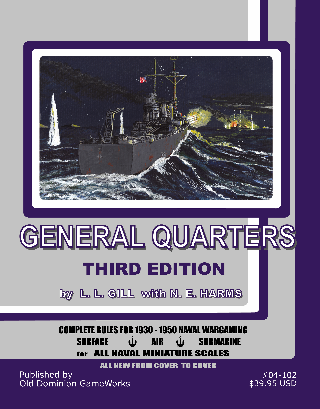
With the pricey GQ3's increased complexity departing from the cheap abstract simplicity of the old GQ1 and 2 booklets, there is definitely a place on the shelf for Battlestations!
TL:DR
The game sets out with a clear design aim, which it successfully accomplishes. Faster and slicker than the "old" GQ 1 & 2, it does away with book-keeping entirely in favour of tabletop markers.

A myriad of hitboxes and criticals are eschewed in favour of four generic damage levels. The ability to repair multiple levels within a turn was a bit jarring but it balances out with regards to gameplay.

Battlestations! is very simple, but still takes into consideration concepts covered in more complex games, simply in a more streamlined way, sans the math and book-keeping.  Using a d20 allows combat to be resolved with a single roll, streamlining the old GQ "fire-by-battery" process still further; light years from the dice chugging of Naval Thunder or GQ3, which fire individual mounts.

Traditional naval gaming "rivet counters" may find Battlestations! bland, but if you want to use more than a half dozen ships (and want to finish in a reasonable amount of time) then this may just be the ruleset you are looking for. The focus is on streamlined play, tactics and maneuver, not record keeping.  However, the "broad brush" approach to damage means you won't know if that 3" shell knocked over the captain's coffee pot, or if the left bridge wing Oerlikon is knocked out.

Due to GQ3 becoming more complex, Battlestations! fast play focus makes it more a complementary rather than a competing ruleset.

Recomended: Definitely. I can see it won't be to everyone's taste - but not only is it the only naval game I know that actually is aimed at allowing 20+ ships per side, but it would naturally handle a "typical" game of 8-12 ships per side a lot smoother and faster than its rivals. I can see myself adapting the d20 4-tier damage system for big VSF aeronef battles, to boot.

Saturday, 9 February 2013

Cyprian Rifts - Just another spaceship game

 I thought I would review these rules, but then I thought - "why bother?" and simply posted the ship data card, which I think reveals all you need to know.

 
The ship data card speaks for itself.

I'm not attacking Cyprian Rifts in particular (I love the idea of indie game and miniatures designers - as an aside, the miniatures look pretty good); but rather the lack of innovation in space games in general.  Every space game is either trying to remake Starfleet Battles or Full Thrust.  I'm simply using Cyprian Rifts as an example - it shows even indie developers are "stuck in the rut."

Cyprian Rifts leans towards the SFB-style of complexity, as you can see from the data card. For example, it has crewmembers (of different skill levels) who can be killed as certain bits of the ship are destroyed.  In a nutshell - it is a fairly complex game, aimed at about 2-4 ships per side. It uses a 2d10 + stats (similar to the 2d6+ stats in Warmachine) and it has a deck/hand of "event/special action cards" (like Firestorm Armada); cinematic movement (like 90% of space games); damage types which take different sized chunks from hitboxes (like Renegade Legion) but brings nothing particularly new or compelling to the table, besides rather thorough terrain rules.

Whilst it is not a bad game, like very other space game to come out in the last few years, there is absolutely no reason to switch across to it from whatever other system you are using.

The Cyprian Rift cruisers look like....

GZG ESU ships

...and the point I'm making...
While ground combat games like Bushido, MAYHEM, Infinity, Malifaux, Ambush Alley experiment with resource management, card-based gameplay, risk vs reward mechanics, dice-pools, reaction systems; or even dispense with measuring altogether (Crossfire); space games are notable solely for their lack of originality.

Grab any space rulebook of the shelf.
Does it have rows of hitboxes?  Lots of "system hits" or "criticals" to record?
Does it use a cinematic or pseudo-vector movement? Does it rely on hexes?
Is activation IGOUGO? Does attacking involve buckets of dice? 

 However the smaller Rifts ships are more interesting... I'm rather tempted to grab a few...

 Personally, it bothers me to:
Spend more time recording and writing that actually moving ships and making decisions
Have ships "teleport" past each other without a chance to fight
Have small ships always take massive casualties (most die within the first 2-3 turns)
Have battles devolve into a dice-rolling contest in the middle of the table
Have ships without clearly defined roles or jobs (carriers excepted)

Am I the only one?  Is everyone perfectly content with playing Full Thrust, Starmada and Starfleet Battles? It says in Ecclesiastes "there is nothing new under the sun" but do space game designs have to remake the same game so diligently?

I'd argue that Battlefleet Gothic with it's "Orders" and "Blast Markers" has contained the only real "innovations" in the genre in 20 years. And that was very "WW1-in-space", firmly wedded to its 40K background and gigantic baroque ship models...


Tuesday, 29 January 2013

CROM - Fantasy Skirmish Rules Review (Starring Conan)

Matakishi's Tea House is one of my favourite wargaming blogs - a combination of inspirational terrain ideas and interesting articles. As I am interested in "Dice Pool" mechanics (Bushido, Confrontation v3) I thought the Conan-esque rules for CROM were worth a look.

The Shiny
The 61-page $8 pdf had plenty of colour pictures and (my favourite) miniatures in action. The rules are rather simple and easy to read with generous sized font.  Usually I insist on a "Quick Reference Sheet" or a index but CROM doesn't need them - you can quickly flick through to find anything you need  - without your glasses! (Note: Rules are free on the website but the pdf saves a lot of mucking around). There is even a free supplement available.

The Mechanics
This is the primary reason this game interested me.  Heroes have a "dice pool" which represents their life or strength.  These dice can be assigned to "movement"  "combat" or "special".

Dice are rolled and totalled - or (and this is an interesting risk vs reward/resource management) they can be "burned". You can pick a dice to be an automatic '6' but it is permanently lost from your "dice pool" - due to the hero over-exerting himself to perform the amazing feat...  Dice can be used in any order - or even kept for later (for example, retaining combat dice to defend against an opponent).

This unit card shows a very Frazetta-looking Death Dealer, from Bronze Age Miniatures

Whilst Heroes have a dice pool which can be assigned any way they wish, Minions have "set" dice (e.g. 2 movement, 2 combat, 0 special). They activate in groups of 3-5 and are basically cannon-fodder (like they are in the movies).

Movement is up to the total rolled by movement dice. Rules include jumping, climbing (and falling, naturally; and horses (which add movement dice).

Bronze Age Miniatures are a good source of Conan miniatures

In combat players allocate dice to attack or defence.  They compare totals, with the highest succeeding.  An successful attacker gets 2 hits, +1 hit each '6' rolled; a successful defender gets 1 hit,with +1 for every '6'.  Hits are removed from the loser's die pool.

Special actions are kinda a catch all for stuff like magic, initiative and shooting.   

Initiative is card-based, but players who have allocated dice to initiative may roll to go first or "jump the queue".  Shooting is just like combat, only there is no extra +1 hits for '6's.  Magic focusses on Conan-esque spells.

Another Bronze Age miniature - used to good effect in the scenario photo below...

Magicians "burn" their dice until they have filled the dice pool of the Summoned creature.  Good wizards might get a better conversion rate - 1 dice spent gets you 2 dice worth of summoned monsters. Poor ones might require a human sacrifice as well...  Once summoned, entities must be controlled with magic rolls. A failure means the entity is out of the player's control - and probably hungry.  There are other forms of more "direct" magic such as fireballs, healing and shielding. Attacking another wizard with magic is quite risky - a magical "wiz vs wiz" duel works rather like combat.

I love the equipment cards used in scenarios... the art is simple and quirky throughout

In addition, there are rules for fire, poison, and example campaigns which showcase Matakishi's lovely terrain boards and miniatures. Fighting slavers in the market, making a prison break, raiding tombs, rescuing a scantily clad maiden from a dark jungle citadel fighting snake men, skeletons and giant grave worms - it's all in a day's work for Conan. And it's all in the pdf as scenarios - accompanied with inspirational photos of miniatures and scenery.

Will Conan interrupt the ritual in time?  
(Photo from Matakishi's Teahouse - a great wargaming resource - check it out)

TL:DR
Simple, innovative and fun rules that use the "dice pool" to incorporate interesting resource management (assigning and 'burning' dice).

I wouldn't say these rules are terribly "deep" (they lean towards the "Song of Blades and Heroes" end of the simplicity spectrum) which may hurt their replayability - but as an excuse to get some awesome Conan minis on the table they can't be beat.

The scenarios are fun and the scenery is inspirational. You can even read the rules without squinting!

Pretty much all the rules content is available for free here - along with scenarios, unit cards, play examples - and even a "how-to" guide to make some of the great scenery shown.

Recommended: $8 to a good cause? Cheap as a meal at MacDonalds. And the rules are interesting and fun. What are you waiting for - get your Conan on!

Saturday, 26 January 2013

5150 Star Navy Spaceship Wargame Rules Review

Back last year I interviewed one of the game designers on 5150: Wing Leader - a dogfighting game in the beta stage (EDIT: It will be released as 5150: Fighter Command).  

Star Navy, although also by 2HW, is a different game altogether, more of a squadron and fleet-level game for big ship actions.  I believe there are other upcoming space titles - including the more detailed 5150: Fringe Space.

5150 Star Navy is the first of a "trinity" of space games.

The Shiny
I'm looking at the $17 pdf, which has a colour cover and a plain text B&W interior with no illustrations. The $20 softcover rulebook, based on previous purchases, I expect to be similar. Early 2HW rulebooks were rather poor with regards to clarity.  Kinda like house rules where the author and his mates already know the rules and expects others to instinctively grasp it. This has improved with newer publications.  This time they take an interesting approach with a "Stop" section - a pop-quiz to check you have read the key rules.  It kinda works, as it forces you to go and re-read the rules.  That said, rules should be clear enough at first glance not to need a "cram" paper...

Game Mechanics
Central to the 2HW approach is Passing dice- an iconic 2HW mechanic - 2 d6 are rolled against a target number.  Each dice that equals the target is a success. Results from roll can be: both rolls pass (complete success)  one roll passes (partial success) and no rolls pass (failure.)  Example: A Rep 5 crew roll to see if they hit a target. They roll a 2 and a 5 - one (a partial) success. Only half its guns will hit.   The other main method is  Counting success. This is quite a common mechanic -  multiple d6s are thrown - any score of 4, 5 or 6 is a success.

Unlike many space games, crew quality is important and ranges from REP 3 (unreliable rookies) to REP 5 (elite crew).  There are 4 ship size classes - destroyer, cruiser, battleship and the rare dreadnought. Unlike many space games, hull points are manageable - 18 for the biggest dreadnought - and only 4 or 8 for more common destroyers and cruisers. You could track this using different coloured d6.  Systems are pretty straightforward - bridge, life support and engines are integral to all ships; hangars, shields, AA batteries, missiles and guns can be added.

Star Trek vs Stars Wars? Which is better?
Gameplay
Game start begins with both sides rolling a "Long Range Scan" - (scoring more successes than your opponent means a more advantageous setup) and deciding their starting velocities.  The long range scan results also impact your chances of getting the initiative first turn.

Ships may change velocity based on their thrust. Destroyers and cruisers can make 2 turns - battleships and larger get only one. There are rules for asteroids but most planets are "off table".

Combat
Combat is a bit grainy - roll 2 dice vs the ships' REP (crew skill) either all, half or no shots from guns hit.  Shields then reduce any hits.  Guns have a 360 firing arc and unlimited range (but with penalties at extreme range). Guns are generic and identical to each other.

Missiles also test against REP - they either hit or miss but are subject to AA fire  - or the target can attempt to evade them. They have only 12" range and a more limited arc.

Hits are allocated on a chart. If the firer is larger than the target, damage is equal to ship class (a class 4 cruiser does 4 hits); if the firer is equal or smaller only one hit is scored.  Damage can be repaired between missions but not during a battle.  There are rules for boarding and capturing enemy ships.


Reactions
Every time a ship takes damage of any sort, it rolls a reaction test with 2 d6. It takes only one test after all damage is resolved. Hits may result in the ship dropping to a lower REP (crew skill) level or breaking off the fight.  Bridges, engines and life support have their own special test.

Fighters
These move differently than other ships - they can move 24" in any direction and do not track velocity.  They carry out either CAP, Fighter Intercept or Attack missions. Squadrons are paired off and combat can result in them being driven off or remaining on the battlefield. Fighters on CAP duty are placed beside the ship they guard and intercept incoming attackers. Any attackers who make it past enemy fighter must face AA before attacking the ships.

Campaign
There is a section for who fights whom using the 5150 background which you may or may not want to use. As you succeed at missions your forces' morale will fluctuate. There is a campaign map and ship activation and movement on the map is largely dependent on the ship commnanders' REP.

There are a range of missions - attack, defend, patrol, hunt and convoy.  The likelihood of receiving a particular mission is dependent on the type, success or failure of your previous mission. "Blips" or "blinds" called PEFS (Possible Enemy Forces) are generated and are swapped for enemy ships when they come into range.  The enemy forces can be randomized and can be controlled by the game mechanics - as usual, 2HW campaigns are very useful for a solo gamer.

After a mission each force's morale is adjusted. Ships may increase or decrease their REP as well. This gives good flavour and adds a storytelling aspect to gameplay. You may also gain or lose ships.

Once a force's campaign morale is reduce to zero it vacates the system; in the next campaign overall morale is reduced by one.  Oh, by the way - you can even play as a pirate and spend your time raiding merchant ships...

Points Systems & Fleet Lists
Although most 2HW games are scenario/campaign driven, there is a simple points system for balancing pick-up games. Ship creation is pretty basic - systems cost 1-2 hull points and I doubt it is balanced for competitive games (but I can't think of any space games that are...). There are comprehensive fleet lists for the 5150 universe, but I suspect most players, like myself, will be more keen to adapt Star Navy to existing movie and TV sci fi settings.


TL:DR
Whilst they have improved, 2HW are still not my favourite rulebooks for layout and "readability."

The rules are simple and will handle large numbers of ships. I'm not totally sold on the "unlimited range 360d firing arc" guns, nor the fact all guns are identical.  The "all guns hit/half guns hit/no guns hit" is also a bit off-putting but I suppose you can think of them as firing in salvoes.  Missiles and fighters are also "one size fits all."  Perhaps that is a sacrifice they made in order to speed play, but surely adding a bit more variety within the three weapon types (such as kinetic and laser guns, torpedoes, missiles and mines, fighters and bombers) would not be game-breaking. 

I do like how crew skill (or "REP") is very important to the battle - something ignored in 90% of space games.  The campaign systems are rather good - they are both simple (low record keeping) and entertaining and as usual any 2HW product is very solo-gamer friendly.  You can even play co-operatively with a friend.

I'd also like to note that 2HW have an active Yahoo group and blog and have a helpful, energetic community spirit so you will get good "after market" support.

Recommended?  A little ambivalent here.  There has been very little innovation in space gaming so 5150 Star Navy is a breath of fresh air in a stale genre.  That said, Star Navy has a few contentious design choices and generalisations; and the 2HW system tends to polarise opinion.  As space gamers are rare where I live, I welcome the chance to play through a solo campaign in a game that is not a Full Thrust clone - so I'm going with a yes.

Friday, 25 January 2013

Gruntz 15mm Sci Fi Wargames Rules Review

I'm sure you're familiar with the format of this meme. Here's my version:

1. Take Warmachine rulebook
2. Replace "Warjacks" with "Vehicles." Remove "Warcasters" and related feats.
3. Replace steampunk terminology with sci fi terminology and rename stat lines.
4. ??????
5. Profit!

15mm armies are easy to store and very affordable.  This GZG UNSC force cost about $70...

Gruntz 15mm sticks so close to its source, it is more the sort of thing I'd expect to see as a set of house rules in a Warmachine yahoo group then a published set of rules in its own right.  I know you can't patent game mechanics (try tell GW that, though), but... it feels kinda dirty, like respraying a car and claiming it's a different make and model.  The author could at least have thanked Privateer Press in the acknowledgements....

Now given my somewhat scathing opening, and the fact I have a well-known aversion to the CCG-with-minis-so-unbalanced-it-appears-balanced Warmachine, you can tell where this is review is heading, right?

Actually, no.  Gruntz 15mm is a good game.

The Shiny
I have the pdf, and it stands alongside the "Battlefield: Modern Miniature Warfare" as one of the nicest pdf rulesets I own.  It has absolutely truckloads of quality pictures of miniatures in action from
Old Crow, Khurasan and GZG. There are plentiful gameplay diagrams and examples, and flowcharts which make game sequences clear.  There is even a FAQ of common questions.  This is a set of rules obviously built for gamers, by a gamer. I like it so well I'm considering grabbing a print copy.  Ironically, I wish more companies would copy this guy!  A+

The rules are well presented and obviously made by a gamer, for gamers. Plentiful examples, diagrams, and pictures of minis...

Mechanics
Basically, it's Warmachine with the casters and feats stripped out.   The stats pretty much directly correspond:
Gruntz  vs Warmachine
Move = SPD
Shoot = RAT
Assault = MAT
Guard = DEF
Soak = ARM
Mental = CMD
Gruntz also has "Skill" for making vehicle piloting rolls.  Units even have similar "stat cards."  

Gameplay is IGOUGO and like Warmachine most rolls are 2 x d6 added together to beat a target score.  You roll 2d6 plus your RAT oops I mean "Shoot" score and try to beat their DEF Guard score to hit.  If a hit is scored, the weapons POW Damage + 2d6 is compared to the target's ARM Soak and any amount in excess of this applied as casualties/daamge. Melee works the same way.

Squads (usually of 6, coincidentally) stay within 3" of each other. Units can make 2 actions including shooting, running, assaulting, overwatch (I always like this in a rule-set), going prone, removing suppression etc.  I liked "Interdiction fire" where a unit marks an area of effect in which it gives supporting fire - used by weapons like squad machine guns, although this too is replicated from WM. 

The rules are clear, easy to read and well laid out.

Commanders have "special abilities" which are more sensible then some of the game-changing "Feats" in WM; they including removing suppression and extra movement for friendlies in range, extra wounds, and being able to fire an extra shot.

If casualties are taken, a unit must take a morale check or be suppressed. They need to use an action to remove their suppression which will reduce their options next turn.  If a squad takes over half casualties they must check for "Condition Brown" (yes, direct quote from rules!) and if they fail the test they run away from the enemy.

Vehicle rules are quite comprehensive and well explained.  Vehicles have a Full-Thrust style damage track with quite a lot of hitboxes (ironic "yaaaay" from me). Criticals (which work similarly to FT) can damage Armour (-4 soak), Engine (restricts speed) or Tek (-3 to ranged attacks.)  There are rules for embarking and disembarking, assaulting vehicles with foot troops, airborne assaults and artillery.

There are digital warfare rules where vehicles and units can be suppressed or disabled by being "hacked" which adds an interesting dimension to combat.

All up, about 40 pages of gameplay rules is pretty par for the course, and presentation and ease of use is well above average.

TL:DR  Gruntz strips the more annoying cheese from Warmachine, adds a few sci fi flourishes and gameplay tweaks, and emerges as a rather solid ruleset, with gameplay quite different to its parent


Terrain for 15mm is also cheap, and easy to store. A simple 4x3 sand table is surprisingly easy to make and maintain.
Optional Rules
There are rules for card activation or alternate activation which break out of the IGOUGO mould. The card system in particular looks interesting and has a few interesting quirks but I'd probably avoid it for really large games as it could slow things down.

Build Your Own
One of the features of Gruntz is its unit construction rules.  You are encouraged to make armies from different 15mm manufacturers and are given a solid set of tools for "making your own."  The unit creation is pretty straightforward and being able to build a custom army from your favourite models from different manufacturers is very appealing.  Infantry squads are based around groups of 6 with up to 2 special "attachments."  There are rules for making monsters and vehicles (air. hover, tracked, etc)

There is a template with about 40 generic infantry and support weapons which cover pretty much any TV show or movie, and a similar range of vehicle weaponry.  There are also "Perkz" which allow you to customise units with skills ranging from "Bullet time" to "Telepathy" and "Infected" (turn your opponents into friendly zombies).

The building rules are clear, well laid out and take up a large chunk of the rules (about 40 pages).

EDIT: I'd like to add the proviso that although fun for mates and good for "pick up" games the points system is far from power-gamer proof.  Weapons are worth the same no matter who is wielding them, and improving key stats is comparatively cheap.   Min-maxing units would be quite easy - this is not a super-tight "competition" rule set.

In addition, in the pipeline is a Barracks army-builder program ($14?) which will take all the work out of unit creation - simply choose your unit stats and weapons from a drop down box, then print out the cards.  The author seems to be an active hobbyist and supports the game really well. The Gruntz site is worth a visit.

For some reason, all 15mm companies seem to have impeccable customer service. Blue Moon, Micro Panzer, Khurasan, GZG, Rebel, CMG - all have impressed me with their pricing, communication, and response times.  (Micropanzer troops and GZG vehicles pictured)

TL:DR
A attractively packaged and very well presented ruleset, it's sci-fi Warmachine rules without the cheese.  Removing the caster-warjack synergy and feats gives a very different (and far better) flavour of game, and as a bonus WM players will find it very easy to pick up.

The unit builder section is a gem and Gruntz 15mm seems to be (directly or indirectly) supported by most of the biggest 15mm manufacturers.  You can truly make your army out of any miniatures you want, quickly and easily. Constructing your custom army can be a fun activity in itself!

The range of about 50 "Perks" allows a lot of easy customisation of your troops. Together with the unit builder, this is the most convincing argument to put Gruntz ahead of the other major 15mm commercial ruleset, Tomorrow's War.

Recommended? Yes.  Easy to learn, accessible, very customisable. A very solid set of rules that seems surprisingly polished for a private venture. Provides a great entry point into 15mm sci fi gaming. 

Some other options:
My current favourite sci fi rules is the less conventional ruleset "Tomorrow's War" which has superior tactics and strategy. The mechanics are simpler (and owe a bit to the free Stargrunt by GZG) although the reaction system makes gameplay more complex. That said, it is more generic and grainy, and it is better for human near-future sci fi rather than exotic aliens. There are only 4 "levels" of troops with little differentiation between races.  Of the few weapon classes (energy, kinetic, railgun, etc) special weapons simply add firepower dice rather than having special attributes.  The "build system" is very primitive compared to Gruntz (more guesswork than anything).  That disclaimer aside, Tomorrow's War is unparalleled for forcing commanders to make realistic decisions, and remains my #1 choice.  I'd recommend TW for scenarios, and Gruntz is better for pick-up games at the club. Both are worthwhile games.

FUBAR is a good simple free ruleset, and the "not-40K" spin-off In the Emperor's Name allows you to get use out of those 40k models that have been sitting in the cupboard...

Alternate Aeronef VSF Rules: Coaling Stations Mod

I found a lot of interesting ideas in the pre-dreadnought game Coaling Stations and I think the core rules would transplant well to VSF, giving us better rules than the current contenders (Aeronef and Airships & Sky Pirates). Whilst trying to keep additions to a minimum, here are the changes I would add:

Orders
Added to the current orders are
"Dive" - reduce altitude by 1 level
"Climb" increase altitude by 1 level

Visibility
Cloud is treated as "heavy fog" to see into/out of at a particular level.

Movement
The maximum air crew can operate without oxygen is about 12,000 feet (2 nautical miles) and it was the average WW1 Zeppelin's ceiling. The Germans found operating over 15,000 feet for long periods caused nausea and blackouts. As WW1 went on Zepplins improved their ceilings to 18,000 and even 24,000 feet and started using compressed oxygen.  Diving helmets and rubber suits were invented in 1837 so you could arguably use higher altitudes.  Airships could move at 100-120kph (60 knots) so you could simply double (or even triple) usual ship class speeds.

Altitude is divided into 6 bands with a micro d6.  If we assume say a 18,000 ft ceiling, each band would be 3,000 feet (half a mile) or 2.5cm/1" in game terms.  This means if a ship is firing at a target 2 levels below it, 5cm is added to the horizontal range.  Climbing or diving one level would not impact speed. 

 I mostly have "digs" or dirgibles which I wanted for a sky pirate game.  On order are 2 fleets of nefs...


Ships that are crippled have their maximum altitude reduced to level 4; sinking ships have a maximum altitude of level 2. Ships who are higher than the maximum will sink each turn until they reach their permitted level.  A crippled or sinking ship cannot climb but can maintain altitude or dive.


Shooting
I'm not a fan of the Coaling Stations shooting mechanic - which makes bigger guns more likely to hit, but do the same damage as rapid fire small guns.  This would make big 12"+ guns the best weapons for taking out destroyers when in reality they are too slow to traverse and unable to fire rapidly enough at a fast moving, small target.   I've banned heavy batteries from firing at destroyers at all; with light calibre hand-loaded "quickfirers" having the best chance to hit and damage.

With regards to "3D' aerial combat, there would be a "dead zone" above and below ships where the guns cannot elevate or depress far enough.  Pre-dreadnought weapons had about +/- 13-17 degrees, which had improved to +/- 40 degrees by the end of WW1. If you assume +/- 22.5 degrees, then each level below adds 5cm (1 nm) to the "dead zone."  So a ship who wants to fire at another ship 3 levels below must be at least 3nm (15cm) away or its guns cannot depress far enough to hit....

I've ordered some Austrian warships to stand in as my "Germans"

..as the official "German" nefs look the the bastard offspring of a landing barge, a river dredge and a paddle wheeler...
Shooting Modifiers
+1 if firing into/out of cloud (as per smoke)
+1 Any gun over 4.1" firing at destroyer or torpedo-boat sized vessel*
*Only secondary batteries and primary batteries under 6" can engage destroyers. Only quickfiring guns of 4.1" or less can engage them without penalty
Modify rule:  "Evasive Action" - +1 to enemy (and own) firing if protected cruiser or smaller, 4+ save against torpedo hits
I've tried to make destroyers and torpedo boats a little more survivable... For example at one stage in Jutland 12 destroyers closed to point blank (under 3000m) of 10-20 battleships and battlecruisers and only 2 were sunk - due to secondary battery fire. Under most modern rules, you'd be lucky to have two destroyers survive...

Sunday, 20 January 2013

Coaling Stations Pre-dreadnought Game Review

Every now and then a game comes along and impresses the heck out of you, with innovative gameplay or different ideas.  Games like this, for me include DBA, General Quarters, Infinity, Tomorrow's War, Song of Blades and Heroes, Malifaux, Battlefield Modern Warfare and Havoc. I add a new one to the list - a game called Coaling Stations.  Couldn't find a review on the net anywhere, so here goes.

The Shiny
It's a $6 plain text pdf, with a single picture on the cover.  In fact the rules are quite hard to follow and I had to re-read them multiple times to puzzle them out.  They kinda read like house rules - i.e. the author and his mates understand them and they assume everyone else knows them to. There seems to be bits missing as well.  The play examples at the back of the rules were pretty much essential to make sense of the rules.

HMS Hood. No, it's not that Hood. 

Command Rules
These are similar to Battlefleet Gothic/Epic/Hail Caesar where you roll 2d6 to pass a Command roll.  However the difference between your command rating and the dice roll determines how many orders you can give. The list of orders can include choosing speed, turns, evasive action, changing squadron formations, making repairs and firing gun batteries or torpedoes.  If the roll is over the Command level the ship simply cruises straight forward at half speed.  Example: A squadron of battleships (lead by average level 8 commander) decides he will attempt to increase to flank speed, turn 90d, fire main batteries then secondary batteries.  He rolls a '6' (2 lower) so he can carry out the first two orders but fails the last two so he does not open fire....

There are cards with the orders printed on them which you could use to record the order sequence.  I think this whole command sequence is a very clever idea and intend to "port" the command system into other games I have such as the WW1 game General Quarters 2. 

There are also visibility rules which are reasonably detailed and weather conditions can change during the game.  Many WW1 battles I have read about emphasized the role of poor/miscommunication, leadership choices and visibility in deciding battles and I presume pre-dreadnought battles would be similar - in which case Coaling Stations is hitting the nail right on the head.

This video clip is, I think, from a Japanese mini series... Awesome CGI

Firing & Damage
This is done by different sized dice - d4 (12"+ guns) down to d12 (under 4" guns).  Lower scores are better.  Any firing that results in three or more 1's means you roll on the catastrophic damage chart. This solid, but nothing out of the box. I am also dubious about the historical "accuracy" of the dice percentages and damage.

However the idea for recording torpedoes interested me a lot - you mark the target with dice - as many dice as there were torpedoes fired.  The dice face records the range - so two torpedoes fired at range 3 would be shown by two dice with the '3' face up.  The "to hit" dice is determined by the range - as the gameplay example is 3 range, you'd use a d4, if under 6 range, use a d6 - 8 range would use a d8.

Damage is also interesting. It has "hitboxes" of sorts, but it is recorded using micro d6 of different colours.  White dice = damaged, Yellow dice = crippled; Red dice = sinking. Ships are rated for how many hitpoints per dice colour. I.e. 5/5/5 = 5 hitpoints per dice colour. 

After a ship takes xy amount of hits, it moves to the next colour dice. I.e. a 4/4/4 armoured cruiser takes 2 hits.  This is shown by a '2' on a white d6. The white d6 shows it is damaged. Effectively the hitpoints are now 2/4/4.  Next turn it takes 3 hits. This means it loses the last two "white" hit points and takes a red hitpoint.  So it's like 0/3/4 which is shown by a '3' on a yellow dice. The ship is crippled.

Hits can also be blocked by 40K style "armour saves" on a d6 - light cruisers get a 6+ save, battleships get a 4+ save...

There's almost no paper record keeping - you could even use a d12 to show "Castastrophic" hits.

Ship data is simple and easy to remember:
 Battleship 
Speed 18kts
Armour Save 4+
Main Guns 2 batteries (x2) 12"
Sec Guns 7 batteries (x1) 6"
Torpedo tubes 2x Port & Starboard
Hits per Dice 5/5/5

Given the examples and fairly generic template, adding in your own ships would be quite easy.

There are rules for collisions, ramming, laying smoke, and ship repairs.  I'm still a little confused with this one:
"In order for a ship to repair damage a 1,2 on a d6 needs to be rolled which is modified by the crew training of -1 for good training to + for poor training, a roll for each repair may be rolled however no rolls are allowed to repair damaged hits or items marked destroyed."   Umm - so what CAN I repair?

There are fleet lists with ships stats for the Russo-Japanese wars (Tsushima & Yellow Sea)  and examples of play which are pretty much required reading due to the patchy and unclear nature of the rules.

The USS Missouri... again, not the one you were thinking of....  The secondary turrets look great even if they are a bit limited...

TL:DR
The command system is clever and seems perfectly suited to an eras where command and control are problematic. For me it was worth the price of the pdf alone and I intend to graft the rules onto my WW1 GQ games. It makes crew quality and commander skill a very important factor in the battle.

I'm not 100% sold on the "different damage dice" gun method - if after modifiers you need a 4 or less on a d4 - that means you have a guaranteed hit? I don't really mind (I intend to adapt the rules for Victorian Sci fi) but I doubt the historical accuracy.  The 4+ saves seem a tad '40k' but I do like the torpedo tracking rules and the three colours of "damage dice" replacing hitboxes and ships SSDs.
Ship stats are easy to use and remember and there is little to no record keeping which is always pleasant. 

The ruleset has some interesting concepts, but it is let down by being somewhat poorly explained and laid out.


Recommend? I am no pre-dreadnaught expert (my naval gaming experience is WW1-onwards with General Quarters and Shipwreck!) but I suspect these rules lean more towards Battlefleet Gothic rather than Harpoon.  I certainly like them, but mostly because I think with a few house rules they could make an awesome Aeronef/flying battleship game - i.e. I am more interested in the game mechanisms than historical accuracy.

Other options: The WTJ have the free rules Quickfire which looks to be pretty straightforward, and Those Damn Battleships Again uses the simple DBA engine and is also free. Perfidious Albion (which has an interesting damage grid) and Fire When Ready by A&A Games are very affordable.  You could own all these (and Coaling Stations) for under $30.

EDIT: Thanks to Dave, whose "Fawcett Avenue Conscripts" have a well-illustrated battle report here