Showing posts with label Micro Scale (1:300-1:4800). Show all posts

Saturday, 16 February 2019

"Adequate" Cheap+Fast 1:300 Terrain with Dieselpunk Tanks

Blog regulars will know I subscribe to the "cheap and nasty" school of painting and terrain - i.e. my theory is it is better to have purpose-built terrain that is made quickly and casually rather than rely on printed paper cutouts, tissue boxes and books under a sheet. Likewise, my painting standard is also pretty poor but I think fielding unpainted or only basecoated minis is a sign of laziness and disrespect for your opponent.  In short: "barely adequate" effort is better than no effort at all.

Here's an example of my terrain for my new dieselpunk tank game  which I whipped up this morning:

French forces approach a stranded landship, intent on capturing it or salvaging it for parts.  

You can see my as-yet-incomplete landship (it's a 1:700 Japanese CV flipped upside down) which obviously needs some turrets and perhaps a control tower (yet to be sourced) and, of course, a paint job.  (My no-unpainted-minis rule does not apply in the privacy of my own solo playtesting sessions!)

From the other direction, Imperial Russian forces have also dispatched a squadron to investigate the stranded landship.

Building the hills took about an hour. With a Stanley knife, I sliced up some of that foam sheeting you get from a camping store (the sort placed under mattresses or tents). I think it cost $10. 

I then coated the top in a mix of water and PVA glue. I sprinkled sand on top (the kids' sandpit comes in handy).

I then sprayed it, using up a $4 can of black spraypaint. Finally, I brushed some el cheapo $2 brown craft paint over the top. 

Whilst it is not amazing, I feel it is very reasonable, for $16 and an hour's effort, and is much better than using paper terrain or books under a sheet or similar.

Russian forces continue to advance on their objective.

As usual, my aim is to show there is a "minimum standard" that is easily achievable, as so much terrain on blogs are amazing masterworks that takes hours and hours for a single piece, that are so detailed that I find them discouraging (I know I can never measure up).  My terrain posts are to encourage the rest of us - the time-poor, money-poor dads who just want to get reasonable-looking stuff on the table, those aiming for adequacy rather than mastery.

A supporting force moves up onto a nearby hill to provide overwatch fire.


The Russians prepare to unload engineers to inspect the landship, but French forces have crested the hill and prepare to engage.

I chose the "flat wedding cake" style layout for my hills to simplify the rules for cover/hulldown/line of sight. It also means the models sit flat on the terrain and don't slide around. 

I may create a matching terrain board (simply a sheet of MDF similarly coated in PVA, sand and painted) to replace the sheet if I have an hour free next weekend.

....Anyway, the kids are clamouring for attention so I'll sign off.  Have fun - and remember, in terrain making there's a broad range between exceptional and awful. There's no shame in inhabiting the "adequate" part of this spectrum.....

Friday, 1 February 2019

Dieselpunk Tankmunda - Arrival

Modern MBTs are boring. It's pretty hard to tell one from the other, and they tend to use very similar weapons and equipment.  The "MBT" has been a staple since late WW2.

But back in the 1930s.... tanks were different.  It's a transitional era of warfare, where designers were trying out radical concepts, rather than merely refining the "meta."

Watching Mortal Engines has fired my interest in wacky dieselpunk vehicles, and a trip to Heroics and Ros quickly secured some 1:300s pre-war/early WW2 vehicles.

I'm going to use out-of-scale tanks to be the "landship carrier" motherships for squadrons of smaller tanks. This is a 15mm Landcruiser Ratte but I'll probably use 1:48 tanks with multiple turrets like the T-35.

Mordhiem/Necromunda-with-Tanks "Tankmunda"
I've always been interested in a tank-centric game; most times tanks are either in small numbers supporting a platoon-level game (Bolt Action) or can be present en-masse (division-level Cold War games) or merely are too generic (FoW).

I want a set of rules where tanks are the stars, where individual tank crews can "level up" and have unique special rules and character, and play linked games like a campaign.

This is a typical "squadron" carried by a mothership tank.  Two light tank troops (cavalry and infantry) as well as medium and heavy troop and logistics support.

I've discussed the idea here but by deciding to go dieselpunk sci-fi, I can use handwavium where needed. I want it to "feel" like a tank game but design-wise it will owe much to a RPG/MMO - i.e. tanks are classes with paper-scissors-rock distinct balance, almost like the mage-tank-dps from fantasy genres.

Basically, my rules will not attempt to be a sim, but merely a warband/Mordhiem-style game which (hopefully) "feels" like tank combat rather than infantry.

I've already started this in 15mm and have workable rules, (playtest here) but I simply cannot afford 15mm models like I could in the era BC (Before Children), so I have turned to 1:300 to allow myself to experiment with different tanks eras in an affordable way.

Some T-35 heavies escort some half-track cargo carriers.

Heroics & Ros 1:300
They are perfectly serviceable, affordable gaming pieces but are not particularly inspiring.  With the exception of some AMC.35s (which were rather nasty) they were reasonably free of annoying bits to trim off. I can certainly recommend Heroics and Ros if you want to explore 1:300 cheaply. (Yes, GHQ are much nicer but are 4x the price - almost as much as 15mm!)


 The AMCs I wasn't impressed with, seen escorting some S.35 mediums.  You can see a counter denoting an in-game status effect (mobility, crew, or weapon damage).


Given the low cost, I'll probably use H&R for two more projects: I want to do a dune-buggy game using modern wheeled LAVs (because I think up-gunned armoured cars are cool!) inspired by the Deserts of Kharak. I've already made a scratch-built land-carrier (using an upside-down 1:700 CV model with tracks added).

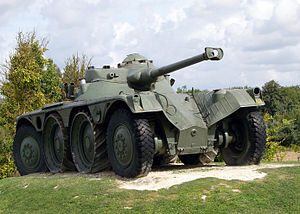
I like armoured cars. They just look awesome. And the French seem to be the most energetic proponents of them.

 I may also do a 1950s-70s set of rules where mercenary tank companies fight in Africa starring T55s, Centurions etc (i.e. Arab-Israeli/Indo-Pakistan War tech along with cobbled-together WW2 upgrades, without having to follow historical OoBs) or or possibly a WW2-in-1947 set where I can use Centurions & AMXs against King Tigers and weird what-if tanks.  I'll consider any era when I'm not refighting Normandy, Kursk or Cold War Fulda Gap which seems so beloved of every other tank gamer.

Anyway, more info to follow as I modify my existing rules and redefine the philosophy I want the rules to espouse.

Sunday, 18 December 2016

Affordable Mechs and Mech Game Essentials

I'm tossing up whether to go 15mm or 6mm for my homebrew tanks rules.  With a very tight hobby budget, 15mm look better, but 600% more expensive.  6mm...  nnngh, they look so dinky...  they're so cheap, but would I actually use them?

As I mull this over, I dug around in my 6mm sci fi, and to be honest there's nothing that makes me like that scale. Perhaps because my 6mm is mostly Brigade, not exactly known for their compelling sculpts (their idea of a sci fi tank is a cardboard box with a turret on top).

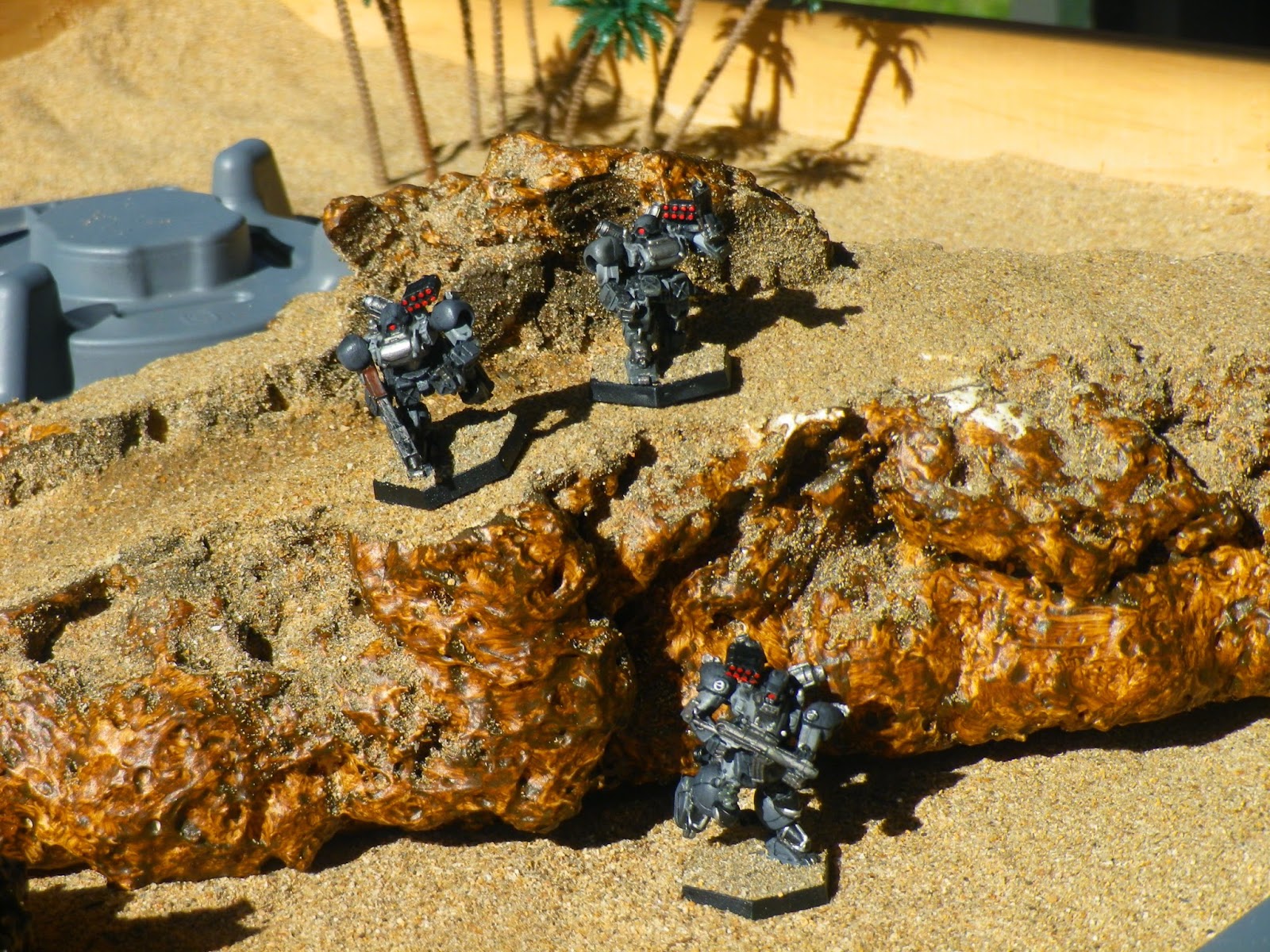
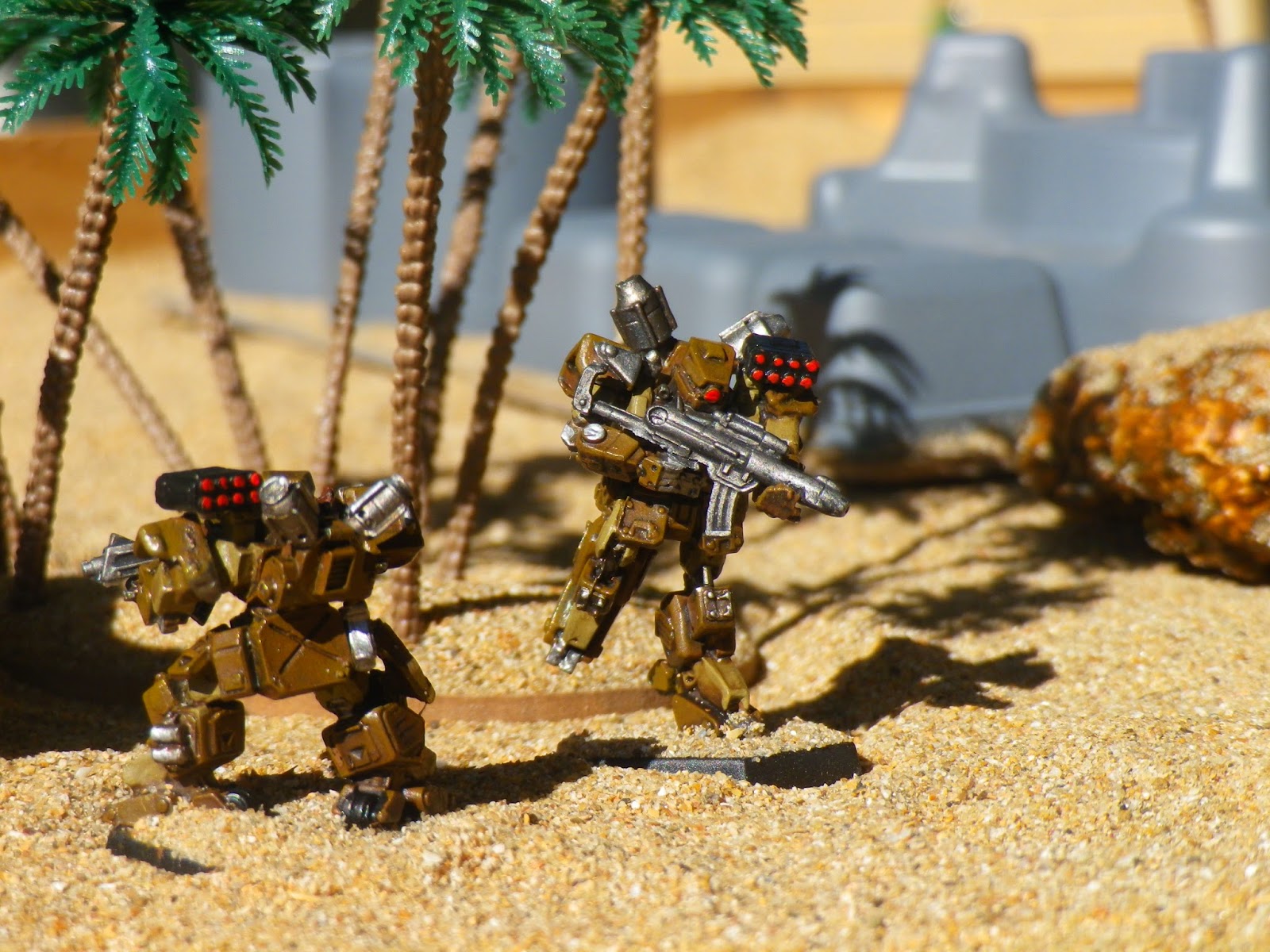
Anyway, while rabbiting around I found a bunch of Iron Winds battle armour.  They are about the size of  a 15mm infantrymen and would make good "big" mechs in 6mm scale. Jury is still out - I mean, would you play a skirmish game with individually based 15mm? I decided to paint them up and see.  Voila!

Yesterday's painting efforts... I realise why I have almost no backlog in 16mm/6mm scales - it's so freaking easy and quick.

Word of Blake demon series battle armours. I kept the paint scheme consistent in case I want to make it an "army" later.


Some 6mm tanks, infantry and buildings for scale.


The buildings are Brigade and were both cheap and (I think) effective for sci fi.

"The smaller it is, the brighter you paint it"

Anyway, as I'm painting, I'm now thinking about mech rules. I was unimpressed by Alpha Strike - in attempting to simplify the gluggy Battletech rules, they removed things like heat sinks and limb damage - things that make Battletech "Battletech" - whilst keeping a lot of unnecessary mechanics from the old game.  What makes a mech game a "mech" game?  I've already discussed this a bit in the google group, but I'll lay out some key points here:

When is a mech, a mech?
I'll divide them into three sizes
1. The fckhuge = Several stories high, range into hundreds of tons (Gundam, Battletech, Titans)
2. Could transform into a jet = about the size/weight of a modern AFV (Macross, Heavy Gear). Think an Apache gunship on legs.
3. Battle/Power Armour/Exo-suit = a humanoid-size suit that is "worn" (Appleseed, 40K Terminator, BT Elemental)

For the sake of this article I'm confining myself to the first two types.

 The far back/right minis are PAL suits - the smallest BT battle armour.

There Has to be a Sense of scale
Combined arms - tiny infantry scurrying around, normally impressive MBTs to be "stood over."
Tiny houses at waist (or ankle!) height.  The modern PC game MW:O makes the mistake of making buildings so tall the mech does not seem big in comparison. When mechs only fight mechs, it's hard to realise how big they are.

I think it's important to differentiate mechs from human infantry. Many indie mech games are just reskinned 40K.  What makes it a game "mech?"

Heat Management/Energy Management/Travel Modes
This not universal, and is very "Battletech" - but why not a nod to the elephant in the room?  If it can be done simply it does provide a nice differentiation point making mechs more "vehicle" and less "infantry."  I might also include Heavy Gear movement modes (also seen in VOTOMS) where wheels can be used as well to "skate" The mech might even transform - if you have suitable models for both forms.

Electronic Warfare
Some sort of sensor mechanic - to jam incoming missiles, "spot" for indirect fire, or detect mechs out of line-of-sight.  Stealth coatings and chameleon thermal+optic camouflage. Agile scout mechs with sensors who perform recon.

Detachable Limbs
It's always cool when a limb gets blown off.  Or you rip off another mech's arm and beat him around the head with it.   Again, this makes the game more "mech-like" (though there are some cave trolls in fantasy who would debate this...)

Upgrades, Heroes & Levelling
Nearly all mech genres have featured highly customizable mechs - from the special "hero" mechs of Gundam and Macross to the "build points" of Battletech.  Most mech franchises also feature "ace" pilots capable of mowing down hordes of regular grunts, so I think the game should allow pilots to progress from "raw-teenager-who-is-the-Chosen-one" to combat veteran. In other words, a campaign system and a unit builder. 

Due to the scale of the vehicles, infantry and buildings, the power armour have become "big" mechs.

How simple?
Although Battletech has a fervent fan-base and has certainly stood the test of time, I feel the record keeping and gluggy rules are not for everyone.  On the other end of the scale, most simple indie mech games are simply reskinned 40K or are pretty much indistinguishable from most WW2-on infantry games.  I guess it depends on the scale - how many mechs are you trying to get on the table?  However at what point does it cease to become a mech game and simply become an infantry game?

Friday, 23 January 2015

Robotech RPG Tactics: Miniatures Review

For those surprised by my somewhat benign review of the Robotech RPG Tactics rules (verdict: unnecessary hitpoints but mostly fine), you may be asking - is it worth diving into this game?

My response:
Do you enjoy doing 1000-piece jigsaw puzzles?
Would you enjoy doing that same puzzle a dozen times in a row?
Do you enjoy doing Tamiya model kits without instructions?
Do you find having missing/poorly sized pieces a "fun challenge"?
Do you enjoy using tweezers? Were you a legend at playing "Operation?"
Do you like the texture of copious dried superglue encrusting your fingers?


If your answers to all of the above is "Yes!" then you will enjoy the Robotech RPG Tactics models.

Basically, the miniatures are all like mini 1:300 versions of 1:48 Revell kits rather than wargaming pieces.  It's like they have no idea who their target audience is:
Hobbyists - who enjoy assembling stuff are better off with large, detailed kits?
Wargamers - tend to view models as playing pieces, and don't want to spend 12 hours assembling?
Boardgame/RPGers - who tend to have even less patience for assembly than wargamers?

Basically, they've made a product that combines the worst of all worlds.  It's too tiny to be a good display model, and too hideously complicated for a gamer.

There is a ridiculous amount of parts for such tiny models - a Valkyrie battleroid (the same size as a 28mm mini) comes in 16 pieces.  Heck, I've seen 1:300 jet models that had similar detail - cast in ONE piece.

*The sprues are not numbered, and they really, really need to be
*Many fine details (antennae, guns) were damaged on the sprue due to their layout
*The instructions are vague and do not cover all layouts clearly; there's a lot missing
*Some weapons/arms must be assembled in a particular way (this is NOT explained)
*Most of the multi-part pieces are completely unecessary. They split things into 3 bits where one would do. It's a 1:48 model shrunk to a super-fiddly 1:300 scale
*It's obvious the parts were designed by computer software, by someone who has never played wargames (or even assembled a model)

These dozen miniatures took about 5 hours to assemble....  
I'm not a talented modeller, but reasonably experienced.  That said, I could probably work a bit faster with proper instructions

I calculate the models take ~20 minutes each to build (and I'm not very pedantic/particular) - which means I have another 10+ hours to simply assemble the rest of the starter set.  The fact each Veritech comes in 3 "modes" means you have to assemble 3 models for one playing piece simply compounds the issue.   The only upside to the models is they look about right to go with Battletech models from pictures I've seen around (I only have converted clix at the moment so I can't post a scale photo sorry).

The dice, unit cards, and counters (there isn't enough for the UEDF who need more than 10) are pretty mediocore quality so don't add a lot of value to the box. 

Although value wise, it isn't that bad.  My starter box cost $110.  If we subtract the quite decent rulebook ($30 is about usual) and the rather poorly made dice and cards ($10 is very charitable) - we are left with $70 for 34 models - about $2 each which is very good, actually.    Ignoring the rules and stuff makes the pieces worth $3 each which is still good, although expansion boxes seem priced much higher at 4 for $35 ($9 ea mini) which would make adding to your army a tad pricey.

TL:DR
Whilst the value in the starter box is quite solid, whoever designed the minis deserves to be locked in a cell, and forced to assemble them for the rest of his life.

Thursday, 22 January 2015

Robotech RPG Tactics: Rules Review (+starter box pics)

My starter box set arrived today in an impressively large box, and I was very excited to open it. I'll spare you a traditional "unboxing" YouTube video* (*I'd find it too tricky to narrate it in the self-important yet monotone American accent usual in such things) and instead focus on the rules. (I'll include a few photos though).

I'm a bit worried my nostalgia goggles will make me kinder than usual, but on to the rules review (bear in mind this is only playtested at a very rudimentary level.)

The Shiny
The book is a 112-page glossy softcover with art and illustrations throughout.  Whilst not in the Infinity category of "shiny" it is nonetheless a pleasant addition to the collection on a par with the better softcover productions. It actually has an index (which seems unusual these days) but lacks a quick reference page.  Only 28 pages are rules - the rest is stats, paint schemes and fluff. 

The rules are not in the "Infinity" level top tier, but are colourful, glossy and pleasant, with lots of nostalgia-inspiring Robotech/Macross pictures.
Stats
These are in the ~4 stat "sweet spot" for skirmish games:

Speed = duh
Piloting = how well it handles, dodges, and can melee
Gunnery = shooting accuracy
Defence = how tough/hard to hit

In addition, the 28 generic special rules for weapons and vehicles are straightforward enough and well within the norm, and compare favourably with the 50-100 in most indie rulesets.  However most mechs have quite a few of these special rules each (especially the Veritech fighters which have 3 "modes" as they can transform from mech to jet.)

There was plenty of plastic sprues in the box....
Activation & Initiative
Players roll 2d6 to see who goes first then alternate moving "squadrons" (groups 2-4 mecha) which don't have to be close together (but weaker pilots can benefit from staying in close formation).  Pretty much a standard alternate move.

However it gets interesting with Command Points - you get one per mecha, plus extras for leadership bonuses. These are a resource which you can "spend" in a range of ways - to try to "steal"an activation (i.e. activate 2 units in a row); boost speed (double movement); make extra melee attacks or or fire extra weapons, dodge attacks, shoot down missiles or mitigate damage.

These do not automatically succeed, but better pilots are advantaged - for example to boost speed players add their Piloting skill + d6 together - they need 6+ to succeed.

I do like the Command Points system - they adds depth to an otherwise pretty generic game.

..which looked impressive spread out...
Combat
This is pretty simple.  Players roll Gunnery + D6 vs the target's Defence.  If the score is equal or above it hits.  However targets can spend Command Points to attempt to dodge - they roll a d6 + Piloting to see if they beat the attack roll.  Damage can further be halved by spending a Command Point - which as you can see are an important "currency" to manage in the game. There are a few modifiers for cover and bonuses for flying in close formation. 

Damage is inflicted as "hitpoints" - which regular blog readers will realize is not my favourite means of damage resolution (I belong to the "no record keeping, removes model with lots of lots of pew pew and explosion noises" philosophy).  However the game does come with nifty Warmachine-style cards which mitigates my annoyance a little.

Melee is done a little differently - both sides make an opposed roll - they add a d6 to their Piloting stat.  There are a few special moves (body block/shove, grab, kick, power punch, stomp) which allow for some cinematic action and reminds me pleasantly of the criminally unsupported Lightning Strike rules. (Curse you, DP9)

Movement
These are pretty usual, except you can destroy buildings (essential in a mech game!) and there are some good special rules that pertain to it:  Aircraft can turn 90d at the start of their move, and must then only move straight (for at least half speed.)  Jets with afterburners must make a second movement at the end of their activation after any gunnery/attacks.

Again, this simple but effective differentiation reminds me of Lightning Strike, and makes a clear distinction between Veritech fighters in mech, hover and full-jet mode.

...however my excitement faded when I realised how fiddly they are to assemble - and how you have to assemble and paint 3 models for each Veritech you want in your army (for battleroid, gerwalk and jet modes)
Other Stuff
Lots of stats of the different mechs, with some rather nice art that made me quite nostalgic (and also recall jealously Mitchell from my Year 2 class, who had all the mechs) along with a character section with their own special rules (i.e. Rick Hunter, Roy Fokker, and the dude with glasses who hooked up with the Zentraedi chick, among others)

There is also an very extensive paint guide with all the colour schemes from the TV show (I might add the starter box comes with lots of decals with emblems/squadron markings.)

A 28mm Mantic ghoul for scale. The mechs were smaller than I expected...

Scenarios, Campaigns & Advancement
There are 4 beginner scenarios that gradually increase in size/complexity, and an army builder of sorts (pretty simple; you must have at least one 'core' unit per 150 points; with a minimum of two).

The seven standard scenarios allow you to dice for the type of deployment allowed, and there are six special rules to add spice (orbital bombardment, space battles, unusual gravity, airborne assault etc).

There are also campaign rules, but they are more examples/suggestions/guidelines on the types (map, tree, narrative) you can do, rather than thorough "Necromunda" style rules.  There are optional rules for advancement but the EXP you earn unlocks skills that last for only one game - it'd keep armies from getting unbalanced, but I reckon it's a little lame.

However there is a  detailed point-system that links to the Robotech RPG. This could be easily jerry-rigged for a more Necromunda-style experience.   The tools are there - with a few house rules you could make a reasonably detailed and interesting campaign system.

The paint scheme guide is handy for those who don't have the time to rewatch Robotech/Macross for
"research purposes."
TL:DR
+ Simple, cinematic combat rules
+ Movement differentiates simply but clearly between mechs and jets
+Activation system has resource management (command points) which adds decisions
+Just enough tools to make your own campaigns

-Most mechs have multiple special rules (though they are simple and generic)
-Hitpoints/record keeping (though offset by nice Warmachine-style cards)
-Not really a  'mass battle' ruleset - it's a skirmish game, which will handle ~12 a side
-Rules are pretty generic - nothing that exciting to be honest
-Assembling the models will be a b***h (not really rules-related, but...)

Whilst I'm not super-excited about the rules, they are a sensible mix of familiar mechanics; and I like the resource/activation system.  They're definitely good enough and I won't be trying to jerry-rig another rules set for this genre (like I do for Battletech, Aeronef, and most space games).  A little off-topic, but I'd add the value/content ratio of the $100 starter box, whilst not "great" value, seemed reasonable enough.

Recommended: Yes.  Whilst I'm not keen on hitpoints, it has solid activation and sensible combat and movement.  And bits of it reminds me pleasantly of Lightning Strike, which tops my underrated-game list.

Friday, 19 December 2014

Battletech: Alpha Strike Rules Review

"Alpha Strike" stems from the realisation that the way to make money is to sell lots of miniatures.  When a complete traditional Battletech "force" can be made up  a lance of four $10 minis, I can't see truckloads of minis being sold. 

Alpha Strike simplifies Battletech in order to cram more models on the tabletop. It even has its own new scale (cue groaning from Battletech fans who have already undergone several scale changes) which is half the size of the traditional mechs.  Since it is half the price ($5ea vs $10ea) but only uses 1/8th the volume of the metal, that's good business sense right there.  The same pewter is worth 400% more. 

However - and this is a big plus - mecha are roughly 1:285 scale which mean they should fit perfectly with any 6mm sci fi you might already have - like those from GZG/Brigade etc.  This is a major, major selling point for me as infantry and auxiliary vehicles are not available yet anyway.  It deviates from the usual Battletech hex grid and jumps firmly aboard the tabletop gaming wagon.

EDIT: Comparison pics suggest they look more like 1:700. They are half the height of regular minis, so maybe the regular size is 1:285? (I got rid of my BT minis but they were older ones so my scales might be out of whack?) 

The jump to 1:285 allows compatibility with the generic 6mm ranges which gives you great flexibility in making combined-arms forces. Minis are online only at Iron Wind Metals.

The super detailed mecha profiles from traditional Battletech (I think the latest iteration is called "Total War") are replaced by a fairly simple unit card.

Size
Move (in inches)
Skill (this is pilot skill and shows the "to hit number")
Damage (the damage in each range bracket - short, medium and long - depends on the weapons fit)
Overheat (this is how much extra damage a mech can do, in exchange for heat)
Armour (armour hitpoints total - there are no individual hit locations)
Structure (internal hitpoints - again, there are no individual hit locations)
Heat Scale (this only has 4 levels - 1,2,3, and Shutdown)
Special Abilities

Gameplay & Rules
Activation is done alternately, like traditional BT.  Mecha can move or jump.  Movement has typical modifiers for smooth or difficult terrain. Attacks and movement can be made underwater, in snow and ice, hazardous acid pools and industrial zones, jungle, magma, and mud.  There are advanced rules to leap, sprint, climb and evade attacks.   There are advanced environmental rules for wind (even tornadoes), earthquakes, gravity, darkness, and atmospheres ranked from very thick to vacuum. 

They can fire at any enemies within their arc.  They check range and roll to hit.  Ranges are short (0-6") medium (6-24") and long (24-42").  The "to hit" number is the pilots' skill - so if the firer's Skill level is 4 he needs a 4 or better on 2d6.  However there is likely to be modifiers for target speed, cover etc.  Purists will be pleased you can still perform charge and death-from-above (jumping) attacks. 

If damage from an attack goes into structure, a critical hit is rolled for.  Criticals are much simpler than original BT as they are for the entire mech rather than individual components such as arms, legs or torso. Hits to the rear add +1 damage.

Players can choose to "overheat" their mech before they attack, exchanging extra damage for heat.  Each extra damage adds one heat.  Heat levels remain the same - heat can only be reduced by not firing or standing in water. Units which use so much heat they "shutdown" cannot do anything for a full turn, after which their heat resets to 0.

Units can have "special abilities" such as CASE (can ignore ammo critical hits) or melee weapons (adds +1 damage to melee attacks), anti-missile systems (-1 to damage from attacks including missiles), HEAT (weapon applies heat to target as well as damage).

Aerospace rules are abstracted and movement occurs in four "zones" in a separate aerospace map. Aerospace craft can interact with ground targets, strafing and bombing them with a range of attack types. However there are also "concrete" rules to allow aerospace units to land and liftoff on the tabletop during missions. Troops can also be dropped from high or low altitudes.

There are rules for on and off-board artillery, as well as a range of artillery, bombs and autocannon rounds such as flak and tracer shells, NARC and TAG pods. There are also capital-class weapons that can be used at airborne and orbital targets.  ECM can be used to create a "bubble" to defeat enemy probes and command networks. Mines can be used to ambush enemy troops.

Battlefield intelligence allows hidden deployment, intitative bonuses and pre-plotted artillery.  There are building rules allowing them to be sued as cover - or reduced to rubble.  I particularly like the use of "blip" counters - units can be represented by blips until they are in line-of-sight and visual range.  There are extra rules for fire and smoke - weapon attacks can start fires which damage and heat up mechs, and smoke interferes with weapon fire. You can even field mega-size units like dropships on the battlefield.

As you can see, the rules are very comprehensive - they cover around ~100 pages.

Battletech mech design has always been very "hit-and-miss." For every good mech, there are some who look just plain uninspired.  Meet "Slenderman."
Campaign System
Players are either attacker or defender and their is a flowchart campaign, with who wins determining the next mission.  Each mission (there are 6) shows the % of your total force you can use and amount relative to opponent.  Players have a "Warchest"which acts like XP or influence in other games - you use it to measure victories and buy new toys.  Re-arm, repair and (yay) salvage are all included.

Fluff & Unit Cards
A considerable amount of page space is devoted to fluff (as expected with Battletech); with plenty of unit profiles and quick reference pages and charts making up the remainder of the rules.

TL:DR
An attempt to speed up and simplify BT to allow large forces on the table, for me, the best thing that came out of this was the 1:285 scale change which means it is compatible with many other sci fi lines.  On the other hand, the mech range is rather limited (about ~30 compared to the 100s from the usual catalogue) and to be honest, most mech designs from BT are rather crap, to be frank.

The rules themselves get rid off much of the book keeping that bogs down Battletech, but also remove all of its charm.  I want to blow off arms or legs in a mech game, dammit!  Weapons types are so abstract as to be meaningless. Battletech Alpha does achieve its goal - to allow us to use more models on the table - but could have been so much more.  It's still got too much record keeping to be a good mass battle game, and it has lost the classic Battletech gameplay depth.  If only they had more adventurous designers - who were willing to tear up the old mechanics.   At the very least, it would have been much more sensible to convert from a existing mass battle ruleset rather than trying to turn skirmish rules (meant for 4 mechs a side) into a strategic-level wargame.   However Battletech is a game all about tradition, with a very loyal, established fanbase, so I can see why they went the route they did.

Recommended:  Not really.  It is very comprehensive, and I admit it does its job - allows you to push more mechs around the table.  It speeds  things up, but loses its soul. More boldness in games design could have made this idea work, with more gameplay depth and a true "Battletech" feel.  As it is, it removes much record keeping, but also all the worthwhile features that would make me want to play it.

Thursday, 3 July 2014

Heavy Gear Miniatures - the ultimate DIY metal minis?

RANT WARNING:  The reason I say it is the ultimate DIY kit is because there is a LOT of "do it yourself." In fact, the models require so much "prep" work you might as well carve the robot yourself out of a chunk of pewter ore. 

I took less time building the entire game table than I did some of the models!

I recently bought some Heavy Gear models at half price (i.e. "somewhat acceptable" instead of their usual "laugh out loud ridiculous/Games Workshop" level) - but I still feel a bit ripped off.  With all the prep work to get the model to a reasonable standard, they should be paying ME. After all, I am doing most of their job for them. 

Considering each metal 28mm miniature costs RRP $12+, I think the miniatures are squarely in the "boutique" range for pricing.  But they certainly are not "boutique" quality. 

Here are a few issues I have encountered:

Mold lines
On 2/3rds the models. Difficult to remove. Can't think of any good reason why the mold lines should exist.  It's not as if the models are dynamic, intricate sculpts like Infinity the Game. They are pretty simple, staid sculpts, in multiple parts.

These are "general purpose" Jager/Hunter squads and required a fair bit of trimming and drilling.  The fire support mechs were much harder to put together but the recon boxes were not too bad. 

Tags of metal/bits of sprue miscast on model
Some are very large and chunky (i.e. so big they require tin-snips - you can't simply file them off.)
                            
Sprue > Limbs/Weapons
Arms/weapons are flimsy compared to the uber-thick sprue they are irrevocably wielded to. Removing them from the sprue invariably leaves chunks of sprue on the arm/weapon, requiring more filing and unsightly marks.

 They look so innocent now....
Arm joints/sockets are terrible
The arm sockets are never drilled out properly - you'll need to drill out each and every one yourself.   In addition, the "plugs" that are supposed to fit into the socket always outsized and have to be laboriously filed down.

Lack of Instructions
A few times I had to go online to identify what a part did or how to put it on.  If instructions like this are needed, it should probably come in the box.  For $12+ a mini, I'd expect a full-colour data card. In the very least, the ability to put it together.

Distinctly Underwhelmed
Each 28mm miniature took significant prep work.  I'd estimate at least 20-30 minutes to get each model to "acceptable" level. Every model needed lots of drilling, filing and trimming.  Imagine the outcry if each GW Imperial Guardsman was so full of molding faults it took 30 minutes to assemble.  If Dream Pod 9 advertise "made in Canada" as meaning better quality - then all I can say is no wonder Canadians are lampooned on American TV.

These are literally some of the worse models I've had to assemble (except perhaps for the miscast Firestorm Armada resins) and certainly #1 for poor price/quality ratio.  When I compare the quality of a $12 "Gear" to say a Red Star/Empress 28mm modern trooper (~$3ea) - the discrepancy is glaringly obvious.

I've teetered on the brink of "getting into" Heavy Gear for years - lured by the interesting setting but put off by the price. If you are in a similar situation, I'd now say "don't bother."

You may recognise the "buildings" - they are mostly the plastic packaging from the models themselves!
TL:DR
If you are the sort of person who would happily whittle a perfect 1:1000 scale model of the titanic out of a log of firewood, or you are an advanced modeller who doesn't mind paying boutique prices for a incomplete product, then I can recommend the Heavy Gear models with good conscience.  Otherwise, save your money and avoid the frustration.

Friday, 7 February 2014

1:300/6mm Mecha - Brigade, GZG and Iron Wind Metals

I did my usual prevarication over whether or not to invest in "Heavy Gear" and as usual concluded they are ridiculously overpriced. So instead I resorted to 6mm to get my mecha fix.

Iron Wind Metals are a great source of 6mm mecha. Their "Battle armour" for their 10mm Battletech line are a perfect fit.  Just look in their Online Exclusives section.  The range is huge and has more options than pretty much all the 6mm manufacturers combined.

Left to Right: Brigade tank, GZG Fatboy, Brigade infantry, IWM Asura, Sei'irim, Nephilim and Shedu battle armours. The small power armour suits are Brigade.

I found the prices (50c-$1ea) good, but postage to Australia was steep - $17+ $9 packing fee meant that the postage added 50% to the cost of the mechs.  As you can see the 10mm "battle armour" make perfect 6mm mecha.
The GZG "Fatboys" have a definite VOTOMS vibe. If you haven't watched it already, VOTOMS is a very "realistic" and gritty military mecha series from the 1980s.

These are all Demon series battle armours from the Word of Blake "Shadow Division" from Battletech lore.

Another comparison shot that shows how well the IWM battle armour matches up. This time a GZG "Hound Dog" is shown in comparison.


More Hound Dogs as part of the OpFor.

I also really like the Brigade power armour. It has a real MaK vibe.

The infantry is also quite good, and is well-priced. 

A decent-sized 1:300 force will cost around $30 - 20-30 vehicles for about the cost of 2-3 10mm Heavy Gear models or Battletech mechs.

The buildings are also Brigade models. They are also quite well-priced.

Even a small 4x4ft table leaves plenty of room to maneuver in 1:300 scale....

I'm also working on a way to abstract the zillions of hitboxes in Battletech using the bell-curve percentages of 2d6 (the possibilities are quite interesting - I might do a separate post on this). I've tried the new Battletech fast-play rules "Alpha Strike" and found it too simplistic.  I still want to know if individual arms and legs are blown off - but I don't want to have to "scrub off" say all 40 hitboxes of leg armour before I can actually damage the mech's legs. It's kinda silly really - in reality shots either penetrate armour or they don't - they don't have to remove every last bit of armour before they can start to do internal damage.  I'm also experimenting with using the Fistful of TOWs modern rules system (it has vehicle design rules that I can stretch to cover mecha).
Stay tuned for more mech action...

Sunday, 12 January 2014

Eylau Sequence: Micro Tank battles in 20:1 scale

Every now and then something comes along that surprises you in a good way.

The Eylau Sequence is a wargaming universe that does just that.  It focuses on combat between MGVs - Miniature Ground Vehicles - tiny tanks that are only millimetres long. The miniatures are larger than life at 20:1 scale, which is certainly novel.  The MGVs are basically tiny drones - difficult to spot, and capable of intel gathering, sabotage and combat. The best way to hunt down the enemy MGVs is to field your own.

Terrain can include dead insects, oil patches, fungus and other objects which are "supersize" compared to the tiny MGVs.  This would make for some fascinating tabletop setups and allow for a fair bit of imagination. 

 The "upsized" 20:1 minis allow for some fascinating terrain ideas. The pebbles could be liquid such as "oil drops" and I can see MGVs navigating a dead ant. (All photos linked from the WTJ Gallery)

 The MGV designs are quite unique. They might make for interesting 6mm sci fi hovertanks or even spacecraft. They even have a paint guide.

The "factions" do not involve sci fi elves or an Empire of Mankind - nor the thinly disguised WW2/Cold War factions beloved of "hard" sci fi games  i.e. the neo-Germans, neo-Russians etc.  No, instead we have Selangor (a Southeast asian alliance) and Australia as the primary players in the "war", with Australia's ally the Medditeranean states (capital city: Malta!). California, and Japan (with super-powered MGVs) are neutral but protect their own interests.

The MGVs have active camoflage and are equipped with with a primary and secondary weapon - which could be kinetic cannon, energy weapons or missiles.

I'm not going to review the rules as they are free here - in fact they come in two levels - one "skirmish" level which might have half a dozen or so units per side generally in hunter-killer
pairs; and an "operational" level  game where there could be dozens of MGVs on each side in large "formations".
After whinging a lot about "generic" games the Eylau Sequence is a breath of fresh air.

The miniatures came about based on an e-book of the same name, by the founder of the War Times Journal.  Annoyingly I don't have a Kindle but at $1 it would be worth it for the "fluff"factor, which DOES interest me.

Anyway, check them out at the War Times Journal site.  I already have a million incomplete projects but these minis are tempting me a lot - and have a unique universe I am actually interested in learning more about.  I don't usually promote miniatures or a game I haven't tried myself, but this sort of creativity deserves recognition. 

Wednesday, 18 December 2013

Bulldogs Away! Naval Rules Review (Modern Fast Attack Craft)

Modern naval wargames bore me.  Not that they are all overcomplicated - for example "Shipwreck" is a pretty good game that covers all the key areas without tedious rivet counting.

But it's the scale and speeds involved that turns me off.  The vast ranges involved make maneuver almost redundant. I could pretty much play a modern naval game without miniatures at all.  When your 30-knot destroyer is pretty much motionless relative to a 450-knot missile, which can accurately range beyond 60 miles, it's evident that "maneuver" very much takes a back seat to spotting and shooting. Most of the time a player's most exciting decision is "do I turn on my active radar or not."

However fast attack craft are a different story.  They tend to be employed in coastal waters where over-the-horizon attacks are uncommon.  They also tend to be often in action - small patrol boats and fast attack craft are involved in the majority of post-WW2 surface actions - numerous North/South Korean gunboat clashes (1st Battle of Yeonpyeong, 2nd Battle of Yeonpyeong, )
the Iran-Iraq war, the Indo-Pakistan Wars (Operation Trident, and Operation Python) and the Middle Easy (Latakia and Baltim) as well as China vs North Korea's corvette gun battle in the 1974 Battle of Hoang Sa)

I noticed that very few involved aircraft, and all FAC battles were in visual range (The 1st Battle of Yeonpyeong started with gunboats "bumping" each other!) with maximum ranges of 15-20 miles for missile fire. In most cases,  close range automatic gunfire was the main weapon. Very few post-WW2 surface battles involved more than one or two small corvettes or frigates - in fact the majority of combatants were usually - you guessed it - fast attack craft under 250 tons.  And interestingly enough, there is a set of rules aimed specifically at these modern fast attack craft.


 The "Osa" class and its variants have probably seen more action than any other post-war vessel.  The Indian variants sank most of the Pakistani navy...  ..and the Israelis sank a bunch of them in the Middle East...

Bulldogs Away 

...is a 38-page black and white pdf. The rules themselves are only 21 pages. The other 17 is a rather thorough list of various missiles, bombs, guns, helicopters, aircraft and ships. There is a thorough index but no "quick reference" sheet. The pdf is plain text throughout - no "bells and whistles" here.

Stats & Ship Data Cards
Ships can have different crew quality - and each side has an overall command quality - which modifies dice rolls.  Ship "data" is not too complicated...

Size - Damage Modifier (hull toughness) - Speed - Maneuverability

Fire Control - Electro Optics - ESM - ECM - Decoys - Weapons (usually only 3-4 systems)

...and can be recorded rather easily compared to most naval games.  


Initiative/Play Sequence
Ships roll a d6 (adjusted for command quality) and leave it beside the model. This determines the order for moving and firing.   The sequence of play goes:

Aircraft
Ships
Torpedoes
Aircraft (2nd move)
Spotting
Launch flares/chaff
Launch SAMS
Snap fire missiles and torpedoes
Fire guns
Resolve missiles and guns fired the previous turn
Launch missiles and torpedoes (normal)
Damage Control

A "Sa'ar" missile boat firing a Gabriel 
(source: Zahal.org)
Movement
Vessels can travel at speeds from creep (5cm) to very fast (30cm) - which is 40kts+. Speeds can only be changed by 2 levels per turn so you'll need someway to record this. Turning is similar to many aircraft games - you must move x amount of distance before you can perform a 60d turn.  There are rules for collisions, drifting, running aground and towing.

Detection
Undetected ships can be replaced with two counters ("blips") - one can be a dummy.  Blips can only make spotting attempts if they are revealed to be a real ship, at which point they are replaced with a different marker and become a "contact."  One other dummy counter must be removed. Contacts may make spotting attempts, but may not fire.  In order to fire, the contact must be replaced by a model on the table (thus becoming a target itself.)  Blips and contacts can move like the ships they represent.

Extreme radar detection range is about 110cm for a "Osa" in normal circumstances.  This can increase or decrease significantly based on circumstances.  At up to half range, detection is automatic - beyond that, a dice roll must be made.   Ships using passive ESM can detect ships using active radar at greater distances, but may not attack unless they have very advanced radar.  Visual spotting is much closer - about 60cm but can be drastically modified by weather or darkness.

Countermeasures & Decoys
These offer a d6 "saving throw" against missile types they are designed to defeat.  

Weapons Fire
These must exceed a "target number" on a d20. There is quite a lot of modifiers for both guns and missiles - you'd need the chart to remember them all. "Snap fire" allows missiles to be fired earlier in the turn sequence but they have a significant negative modifier.

Torpedoes and missile fire are resolved in the following turn (torpedoes can "run" for several turns) which necessitates recording their targets in some way. Usually ships can only fire one at a time which means the board should not get too cluttered.

With an average 40-57mm automatic gun reaching to 30cm,  and missiles having a minimum range (30-75cm for a Styx SS-N-2, for example) maneuver is quite important, and with most boats having a 25cm+ top speed it is quite easy to close or open the range. Yay!

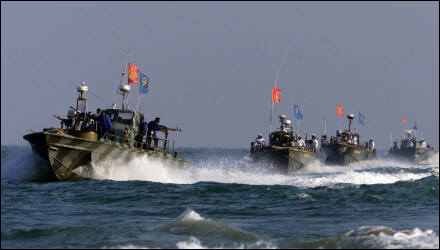
Sea Tiger insurgents - fought against the Sri Lankan navy in armed speedboats.
"Bulldogs Away" allows even small armed whalers and jetskis to be included

Damage
Hits roll 2 d10 - one for the "damage level" (or structural integrity) which ranges from intact, to damaged-heavily damaged-wrecked-sunk. Each level impacts on speed and maneuverability.
Damaging hits cause a roll to be made for each ship system to see if it is knocked out.  The other d10 shows "special hits" or "criticals" such as power loss or fires.

This is a pretty restrained system compared to the usual naval wargames rivet-counting and works fine given the small number of ships (no more than a dozen) involved in the "average" fight.

Aircraft & Helicopters
These get two "movement phases" although aircraft maneuver is pretty limited on the battlefield and there are rules for air to surface and surface to air combat. 

Miscellaneous Rules
There are rules for more unconventional craft such as hovercraft, hydrofoils and "ground effect" craft.  Others include mines and minesweeping as well as landing forces and shore bombardment - both of which would come in handy for scenarios. Since FAC doctrine emphasizes combat amongst islands and cluttered terrain, there is a random "terrain generator" for those who need inspiration in setting up a table.

 The Italian "Sparviero" hydrofoils seem ridiculously heavily armed for their size. Can't help imagining what would happen if they took a hit and "crashed" off their foils at high speed. Well, Bulldogs Away covers that eventuality....

TL:DR
+ Has all important details, but avoids the heavy rivet-counting that plagues many naval games
+ Maneuver, firing and spotting is "balanced" and fun compared to "normal" modern naval games
+ Focus on ships that actually fought numerous post-War battles as opposed to Cold War "what ifs"
+ Extensive ship and equipment lists
+ Straightforward detection rules allow for a bit of "hide and seek"

- quite a few modifiers, no QRS (perhaps one is available on a yahoo group?)
- need to track speed, missiles & torpedoes fired, and each ship's initiative either clutters the board or is annoying to have to record

Bear in mind this is a largely "unplaytested" review (except for pushing a bunch of WW2 E-boat "proxies" around briefly to experiment with some rules mechanisms)

Recommended?: Well, the rules themselves, yes.
My main issue personally, is that modern naval FAC miniatures are a niche within a niche, so you have limited choice within scales. At 1:700 you have PT Dockyard and Skytrex but I object to paying $8+ for single small model, for a game where I know I'll have to buy both forces.   At smaller scales you have  1:1200 North Head (Shapeways, and as expensive as 1:700), 1:3000 Denian (there is no website but you can see the catalogue via yahoo groups) and 1:2400 Viking Forge (no option for online payment - send a cheque? Really?) There are various Shapeways options if you hunt around, but none are reasonably priced. All the ranges are rather sketchy and incomplete - and the one range that is likely to expand - PT Dockyard - lacks modern support ships (merchants, etc) in 1:700.

In short - good rules, cool battles - but limited model choices are a major drawback.