Friday, 9 November 2012

A Fistful of TOWS 3 Review (1915-2015 Micro Armour)

As I continue to "down scale" I am venturing into 6mm.  I remembered trying A Fistful of Tows maybe 10 years ago - a demo ruleset with a strong design philosophy with a commitment to balancing playability with realism, and allowing fast turns with lots of units. Troop quality was important. Apparently there was a new version, so out came the credit card....

FFT3 is a mammoth tome. Choosing the spiral-bound version was a good choice.

The Shiny
The format is B&W with a colour cover. I picked a spiral-bound layout ($67 delivered from Lulu) due to the hefty size (also - spiral bound is great for laying rulebooks open or photocopying stuff).  At a jaw dropping 454 pages the size and cost are the two things that instantly stand out. However it is not a complicated game at all.  The actual core rules are 112 pages (or 25% of the book) with an additional 44 pages which are optional (combat engineering, choppers, airstrikes, airborne, amphibious, chemical and nuclear attacks).  The bulk of the book is from the 263 pages of "army lists" - orders of battle for pretty much every country's forces at brigade/regiment scale from 1915 to the present along with vehicles, infantry and weapon details for those forces, as well as detailed rules for designing your own.  This hefty tome is probably the most comprehensive resource of its kind I have come across and would be very useful for other WW2-modern games besides FFT3. There is a detailed appendix and a handy quick-reference sheet that helps keeps things manageable.

Britain always has quirky and cool armour
An impressive resource
It has stats on every significant weapon; from a Pak88 to a Hellfire missile; from a Messerschmidt Bf109 to a F-22 Raptor.  Tiger tanks are included as well as T80Us.  Soviet Tank Regiments from 1943 are detailed along with modern Stryker brigades; with troop types and quality. There are also rules to design your own, if somehow you find something not included. When you realise you are getting a set of rules as well as a 260-page reference book, in one, the $67 seems more reasonable. There is a cheaper $40 (!) pdf option (maybe for an iPad? - I can't imagine printing it out yourself...)

Core Mechanics
Do not confuse the size of the rules with complexity.  Whilst the most detailed FFT set yet, the game is eminently playable. Indeed, the core rules could be condensed from 118 to 30-40 pages easily as the authors tend to spell things out rather "wordily".  In fact, the earlier free "demo" version of FFT2 (an earlier edition) is 43 pages. The game plays fast and each side's movement can be completed in under 5 minutes.  Note: Each vehicle stands for a group of 3-6, and individual infantry elements are platoons; although the game can be played at 1:1 i.e. each element is a squad/vehicle, simply by adjusting cohesion distances and ranges. Activation is "attacker" then "defender" as per the scenario (or basically IGOUGO, which I am not a fan of) but the "overwatch/shoot-and-scoot" abilities allow some interaction in the opponents' turn. Wargames Vault has free demo rules of FFTW3, including enough to play WW2 or late 1980s NATO-Warsaw Pact.   In summary - it's actually pretty fast and simple to play.

The StuG wanted his cover save...
Movement & Terrain
 Troop quality is all-important. There are 7 levels:  Poor-Marginal-Fair-Average-Good-Excellent-Superb - which is surprisingly precise for a game using d6.  The game uses a Warhammer 40K "cohesion" range which varies from 2" (poor) to 8" (superb).  Terrain rules are quite comprehensive, but like FoW, vehicles must make a terrain-saving throw (say 4+ for average troops) if in difficult terrain or they can only pivot in place.

Detection references a simple chart that considers if the target is in cover or stationary, and if the target is a vehicle or infantry unit.

Infantry tend to dominate in built up areas and can be deadly in close quarters against unsupported vehicles
Combat
Units without stabilised guns or early 1st gen missiles may not move and fire; units that do not fire in their turn may go on "overwatch" and interrupt and fire in an opponents' move, or "shoot-and-scoot" - i.e. interrupt, fire, then retreat half a move.

Most weapons need a 3+ at close range, 4+ at effective range, and 5+ at long range, modified by the firing unit's troop quality. Rate of fire is likewise affected - poor troops fire more slowly, superb troops can pour in extra rounds.   Units in cover get a "cover save" against any hits - say 4+ if in a town.

Vehicles have two arcs - front and flank - and different armour values against kinetic or HEAT rounds.  For each shot that hits, roll 1d6 equal to the weapon penetration - target armour. Close or long range modifies penetration by +2 or -2.  I.e. a KV-1 (Pen 5) vs a Pz.III (Armour 4) at close range gets 3 dice.  If any 4 or 5 is rolled on the d6, a quality check is made (only 1 maximum, no matter how many 4 or 5s are rolled).  A '6' on any die destroys the target.
 Say for the 3 dice rolled, the KV-1 gets a 2, 4 and 5. It forces the Pz.III to make a single Crew Quality check. Units who fail a CQ check are destroyed.  Superb troops need only a 2+ to pass; average troops need a 5+. Better troops are much, much tougher and more resilient to incoming fire.

Most units have both anti-vehicle and anti-infantry firepower.  Anti-infantry firepower works the same way as vehicle combat, but each extra hit modifies any quality check by -1.  Even an infantry unit passes the quality check, it is suppressed which means it will have a negative modifier when it fires next.

Infantry units can get into close combat - withe the non-moving player firing first; sides alternate firing until one side is destroyed. Infantry tend to maul unsupported vehicles in close combat as they always count as having a flank shot.

Artillery rules are quite slick and fast - barrage markers are placed in 2" cohesion. Scout units can place 2 markers, and normal units one.  A dice is rolled for accuracy (modified by observer skill) - if it passes, the barrage has full effectiveness. If not, it has reduced effectiveness.  An "area fire problems" roll is made which could result in the barrage marker "scattering", a fire mission being cancelled or counter-battery fire hitting the artillery unit. Rolls are then made for units under artillery markers, modified by the number and size of guns involved in the barrage.
Summary: Pretty simple, consistent mechanisms. Troop quality matters. A lot. 

 Combat Engineering rules are an interesting inclusion.
[Picture: Sgt Rupert Frere RLC, Crown Copyright/MOD 2010]
Other Stuff
FFT3 is very comprehensive. Besides the "basics" there are rules for helicopters, airstrikes and AA.  Combat engineering (mine clearing, bridgelaying, demolition) is also covered, as well as amphibious and airborne assaults, chemical warfare, and the limited use of small tactical nukes. 

There are scenario generation and campaign design ideas and tips, as well as a "battle generator" that allows you to roll random battles on a chart that considers the last battle you fought. For example if your last battle was an "encounter" you are more likely to fight a "hasty battle" next; if the last fight was an "encirclement" you are more likely to roll a "breakout" scenario next time.  I think this is a great feature - I wish more games had it. Missions are random, but are likely to progress logically from the previous mission.

There is a comprehensive section for designing and point costing vehicles. I am toying with making some "mechs" and using FFT3 for near-future sci fi (although I believe the authors are working on an official sci fi variant and have indeed previously made the free game Railgun 2100 based on the older FFT2.

I also like how the game isn't too heavy on chits or markers; - "suppressed"  "overwatch" "quality check" and barrage markers could be easily made; I intend to use the cheap coloured tiddlywinks supplied by EM4.
Summary: Great campaign and scenario ideas - a broad toolbox all aspects of modern warfare from chemical weapons and engineering to gunships

At $1.50 for 50, I don't know why you'd bother to make your own counters, ever.

Army & Equipment Lists
As I said before, this is huge, and very detailed. I like how all stats for a weapon or vehicle fit on a single line of text.  I can't vouch for the accuracy of them - but vehicle stats can easily be altered to reflect your opinion using their build-it-yourself rules.  I'm considering using it for near-future sci fi and making up hover vehicles and walkers.

In the army lists, I like how at the bottom of the regiment details, it shows how many "stands" or individual troops you need; allowing you to easily know how many minis you need to buy for that particular combat formation, making it easy to plan your purchases, i.e.
British Armoured Infantry Battalion 1980s+:  2 Scorpion, 2 FV432 Mortars, 2 Spartan w Milan OR 2 FV432 + Milan teams, 9 IFV, 9 infantry stands

TL:DR
A huge (450+ pages), expensive ($67) rulebook; but its exhaustive orders of battle covering pretty much every army, weapon, troop and system information WW2-2015 would be of value to most modern gamers regardless of the rules themselves. The rules are simple and play quickly despite their wide scope.  I think the main issue with FFT3 is that the rulebook is a significant investment, not really a casual purchase, and $40 seems frankly ridiculous for a pdf. However the plethora of demo rules available means you can decide if the gameplay is for you before investing.

+ Fast turns, playable - get lots of models on the table, finish in a reasonable amount of time
+FoW-ish level of complexity, whilst delivering a deeper, more tactical game
+Points system allows some balancing to be done for "pickup" games
+Sensible cohesion/command rules
+Emphasis on troop quality
+ Immense 260+ page resource for orders of battle and weapon and vehicle stats, WW2-present
+ Design and modify equipment and vehicles
+Comprehensive "toolbox" for WW2-modern wargaming
+Campaigns, scenarios well catered for. I like the "battle generator" for campaigns
+Try before you buy - WW2 and Modern demos

Recommended? Quite impressed - admittedly I only have the rather bland Cold War Commander (a ripoff of GW's Warmaster/Epic rules) and the turgid 1980s-billions-of-charts WRG rules to compare with (I haven't tried Spearhead). Don't be put off by the size of the book - it is 75% army and equipment lists - FFT3 has quick, intuitive gameplay, allowing heaps of models to be handled relatively easily; and has a focus on troop quality. Recommended.

Saturday, 3 November 2012

SAGA 28mm Dark Ages Rulebook Review

I've had my eye on this for a while but had been put off by the "buy in".  I know the Gripping Beast minis cost pale in comparison to GW fare, but two small starter warbands combined with the "specialty" dice ($84 x 2) and the rulebook ($35) are a significant investment when no one locally plays it.

My starter minis have been caught up in the Maelstrom Games mysterious "stock reduction/move" (which is looking more and more like a Ponzi scheme) so my playtesting has been limited to proxying some LOTR minis.

 A slim but well-produced and very practical rules set, with lots of examples and summaries

The Shiny
I was a little surprised how thin the rulebook was - when I initially ripped open the packet I thought it was only the battleboards (of which 4 were included). Softcover, it actually weighs in at 75 pages - full colour throughout.

This is evidently a set of rules that has been carefully playtested, and created by gamers, for gamers.  It is easy to read, and includes not only a quick reference page, and photocopyable measuring sticks and tokens, but lists a section on "often overlooked rules", has a solid index, and plentiful examples of gameplay.  In fact rules are summarised at the end of each chapter making this rulebook very easy to read and use. One of the best laid out, user-friendly rulebooks I have come across in a long time.

Army Building
This is dead simple - for 1pt you get 4 Hearthguard (elites); 8 Warriors; or 12 rather rubbish Levies (the horde option). Most armies are 4-6pts and range from 20-70 miniatures. This applies to each faction. Factional differences are shown due to different options in battleboards.

Whilst the battleboard mechanic is a great idea, I disliked the $18 custom dice, especially since a normal d6 would have done the job just as well...

The Battleboard (Orders Phase)
SAGA is a game, not a simulation.  Whilst without the ridiculous rules cheese of say Malifaux or Warmachine, the game hinges on good management of the "battleboard" to enable heroic actions from myth and legend. Each unit generates a "SAGA dice". These are rolled at the start of your turn. Various dice combinations can be used to activate SAGA abilities.  SAGA abilities differ between factions - some can be activated more than once - and SAGA powers can be combined to create powerful effects.

Managing SAGA dice and your battle-board is a mini-game in itself. The rulebook provides good examples of how this works.

Activation Phase
Units can be activated by spending SAGA dice.  Elite troops are easier to activate, ill-disciplined levies are the hardest.   An activated unit may move, shoot or rest. Resting gets rid of a fatigue token.
Units can be activated repeatedly in a turn, as long as there are SAGA dice available to do so.

Movement
This is very standard. Troops move a standard range and stay within cohesion range rather like 40K.  Uneven and impassable ground have typical events. Units that move or activate more than once accumulate Fatigue.  


 This Breton starter warband is $118 including SAGA dice - expensive for a "historical" game - the buy-in is disturbingly similar to GW products
Shooting & Melee
Ranged units can engage others within range and LoS.   Levies & Warriors get 1 dice per 2 models; Hearthguard get 1 dice per model.  Attackers and Defenders can use battleboard abilities. Attackers check their rolls - each roll that scores above the enemy "Armour" level scores a hit.  Defenders then can roll a dice each hit. A 4+ cancels the hit.  Cover cancels hits on 3+.  Melee works in a similar manner - however elite troops and warriors have even stronger advantages over levies and combat is more lethal. Units who take the most casualties in melee will retreat. Each unit in melee gains Fatigue.  As units are lost, so too are their accompanying SAGA dice, reducing the capabilities of your warband.

Fatigue
Besides the battleboards, I found this mechanic the most interesting.  Units may accumulate fatigue - levies and warriors may accumulate 3 whilst elite hearthguard can accumulate 4.  Once a unit reaches its limit it may not be activated except to "Rest" and fights with only half the usual dice in melee.

But this isn't that bit that interested me - it was the ability to "spend" an opponent's fatigue points!
If fighting a fatigued opponent, you can "spend" one of their fatigue tokens in order to increase your armour; or you could use an opponent's fatigue to reduce their movement distance. The fatigue system provides a simple but interesting risk-v-reward resource that adds depth to SAGA. Fatigue tokens are the only tokens used in the game (a nice change - most new games have a million tokens and unit cards cluttering up the table).

Other Stuff
The core rules encompass 35 pages - the remaining 40 include miscellaneous rules such as your Warlord (a heroic character who generates extra SAGA dice and is very powerful in combat); faction rules for Vikings, Normans, Danes and Welsh; stats for "named" heroes like Harald Hardrada or William Duke of Normandy; a list of all SAGA abilities, six standard scenarios as well as a scenario for a 3 or 4 player battles. 

Armies with more elite troops are cheaper - this Anglo-Danish force costs $50 - without the $18 SAGA dice

TL:DR
SAGA is simple game, with two clever mechanisms tacked on - the use of the "battleboard" and "fatigue" introduces another level of tactics and resource management, whilst not complicating matters - always a good design point.  A game for heroic actions rather than a strict historical simulation, SAGA lacks a morale system and as the game is scenario-based, there is no reason not to suicidally sacrifice your units to accomplish objectives.  The faction-specific battleboards provide the ability for some fun meta-gaming and heroic actions without the over-the-top cheesiness or "he who knows the most rules wins" of Warmachine or Malifaux.   The rulebook is nicely presented and very gamer-friendly - one of the best I have come across lately.  I'm not a fan of having "special dice" (especially at $18 a set) and although you can convert your own it seems more trouble than it is worth. I also found the cost a little daunting - one 28-man starter army was $100 which is much steeper than the usual cost to try a skirmish wargame*

The game seems to cry out for a campaign system where warbands can battle for land and renown, and perhaps gain "experience" and abilities - I notice there are quite a few home-grown campaign systems springing up on the net.  An "official" campaign is possible, as  Gripping Beast have already published two supplements, each introducing 4 new warbands, so the game seems solidly supported.  Dark Age raids are ideally suited to skirmish gaming but it is rumoured that Arthurian and Crusades versions in pipeline.  SAGA seems a solid club game and a good introduction to historical gaming, and I can see it attracting new players to historical gaming a la Flames of War.

Recommended?: Certainly.  The battleboard and fatigue mechanics are great, and I think both historical and non-historical gamers will enjoy this one. I'd like to see a campaign system supplement; but all in all, a good intro to Ancients/Dark Ages gaming.

*Bulk plastics: If you used Wargames Factory plastics and did a bit of creative kit-bashing you could make warbands for much cheaper.  At 32 minis for $20, if you shared buying 3 boxes of say Fyrd, Thegns, Bondi or Huscarls with a mate, and mix and match body parts a bit, you could both end up with 48 minis for $30 - a much cheaper proposition.

Tuesday, 16 October 2012

Game of Thrones/A Song of Ice & Fire Review: Not the Best Anymore?

Since the well-made HBO show a lot of people are "discovering" the books* and how awesome they are.

However I'd suggest these are NOT in fact the best fantasy books currently around. 

(Interesting fact: before the movie "Troy" the archeological dig received only a trickle of visitors a year - after the movie, millions - such is the power of the big screen)

Game of Thrones
Without a doubt, George R R Martin is a talented author.  Both smug critics and the general public agree. Whilst he is a pioneer, to say he "invented" gritty dark fantasy might also be a exaggeration. The "Black Company" series by Glen Cook certainly predates it and J V Jones "Baker's Boy" (1995) and Robin Hobb (Assassin's Apprentice) 1995 have grim themes and far from infallible heroes. There are arguments for Michael Moorcock's work.

However GRRM is painfully slow, producing books with all the speed and enthusiasm of a dog pooping razor blades.  He went years over deadline. He also seems more interested in editing anthologies such as the little-known Wild Cards series than finishing Game of Thrones books. Though I suspect the shed-loads of money he will now be making may smartly re-focus his priorities.

Five novels since 1996 is hardly prolific and you can't say it's due to the editing process - his prose, whilst good, can be rather long winded. A six year wait between books 4 and 5 (which shared a concurrent time-line!) has me doubting he'll ever finish with this cash cow in his lifetime (*cough* Robert Jordan *cough*)  Despite the long incubation the latest book "A Dance with Dragons" is certainly the worst in the series and for the first time ever (I started the series back in 1996) I found myself skipping pages, bored - a criminal offence from any author. Whilst not as misogynistic as feminists will make out, he does seem a bit preoccupied with teen sex and rape.

Tell me that the idea of this guy writing about forced teen sex doesn't make you feel a tad uneasy...

Don't get me wrong. These are good books. Game of Thrones was a breath of fresh air, and we have GRRM's success to thank for the burgeoning "gritty fantasy" movement, which exchanged nauseatingly heroic characters and sickly sweet coming-of-age stories for believable, fallible multi-faceted characters with realistic motivations.

...but.... despite the hype, I'd steer a friend elsewhere.  My advice: Enjoy the TV series (which is remarkably faithful to the books) and move on. (I have similar thoughts on Lord of the Rings which is an over-indulgent exercise in world building with mediocore characters and plot development - but that may be dangerously close to heresy...)

So...  who would I recommend?

Joe Abercrombie
I think this guy has inherited GRRM's mantle as the "cutting edge" of gritty fantasy. He took the format laid out in GRRM's work and refined it.  Like tuning up an old V8; stripping it of excess weight, and adding new brakes and a supercharger.  His books stand out from the new wave of "gritty fantasy" practitioners even as Game of Thrones first stood out amongst other fantasy books.

Why do I make this bold claim?

The Heroes: Axe-wielding norsemen fight to themes of Band of Brothers and Killer Angels

His novels keep getting better. His latest work, The Heroes is brilliant and the writing style has dramatically improved from his debut in The Last Argument of Kings.

Less main character points of view than the dizzying array in Game of Thrones means a story that is easier to follow.

His writing style is leaner and less indulgent, yet no less intelligent. His dialogue is snappy and and a twisted sense of humour pervades throughout.  To call him the Tarantino of fantasy would be lazy and inaccurate - Abercrombie is much superior.

 What does a war movie, a Western and a Shakespearan revenge drama have in common? They all provide themes to Abercrombie's stand alone books...

The book favours entertainment over complexity - whilst cleverly written, plots are simple, but showcase a wide repertoire. The Heroes is a war story which shares themes with books like Band of Brothers and Killer Angels. Red Country (yet to be released) apparently has echoes of the western True Grit. Best Served Cold is a Shakespearan revenge play.

If you like your fantasy gritty, Abercrombie sets the bar.  Game of Thrones is a struggle for a kingdom - the First Law trilogy is a squabble between sorcerers that has become a continent-spanning Cold War that has lasted centuries. Abercrombie sets fantasy conventions on their heads with a infectious enjoyment. GRRM changes perceptions of characters of the course of the series - Abercrombie can do it within the span of a book. 

My only complaint - ramping up the violence and "gritty scale" may have lead to an "unrealistic" level of grittyness where pretty much everyone is a bastard.Game of Thrones has a more balanced character selection.

Finally - his stories actually END.  This is a vanishingly rare virtue nowdays. Remember when 300 pages was a big book? Remember when a trilogy was only three books (not a dozen)?
 I blame the editors.  Every fantasy author seems to think you need a dozen 700-page tomes to tell a story and no one seems to reign them in. It's like most 22-episode TV series. Half the episodes are "padding" and irrelevant to the plot arc. The same can be said of most chapters in your average fantasy book. Heck, God only needed 1200 pages or so for the Bible.

TL:DR
Abercrombie ramps it up a level to stand above his peers.  Faster, leaner, tighter, grittier.  Commit to a book, not a six year wait.   Snappy dialogue and a sense of humour prevail throughout.  Abercrombie pushes the envelope that George R R Martin defined. Recommended.


Tuesday, 18 September 2012

LOTR: Battle Companies AAR - $12 of fun

I am intending to playtest a series of small games with the LOTR:SBG and the skirmish campaign spin-off  "Battle Companies". This game is remarkable in needing only a few plastic miniatures. Both warbands in the game cost under $6 each (including a metal "major hero" for each) - this is off ebay of course - where LOTR minis are currently both plentiful and cheap.

The original rules are here as found in White Dwarf 297.  They were tweaked in White Dwarf  311 and it is this latter version I am using as it allows three heroes to start, not just one; it has more skill "upgrade" choices, and it a little better balanced.  

There are 5 Good warband choices: Dol Amroth, Dwarf, Gondor, Rivendell, Rohan
and 7 Evil warband choices: Easterlings, Haradrim, Isengard, Khand, Mordor, Moria, Wargs

PREGAME
Selecting Forces:
I chose an Isengard warband: 3 scouts with hand weapons, and 3 scout archers. 
The wife goes with Gondor: 3 "standard" troops with hand weapons, 2 archers and 2 spearmen.

I assign my major hero and one of my minor heroes as standard scouts. The other minor hero is an archer.  My wife chooses a major hero to be a swordsman, with spearman and archer as her minor heroes.

Selecting Missions:
I am actually using a deck of cards and the Malifaux: Rising Powers rulebook* (p.42-43) as they offer a myriad of mission choices including "hidden" missions which your opponent does not know about.

In an amazing fluke, we both got the same mission: "Slaughter." So much for special missions. Another straight up fight then. 

This whole pregame process took 10 minutes.
(*Before you rush out and buy it, can I say the mission tables are only good use for this rulebook besides as a door-stop)

BATTLE REPORT
The wife won deployment. She had secretly chosen a scheme "have more figures in enemy deployment at end of game" from the Malifaux scenarios (which I was unaware of) so she quickly advanced down the side of the board to accomplish this.


The men of Gondor charge down the side of the board to achieve their secret "breakthrough" scheme to control my deployment. I angle my archers towards the wall for a free potshot.


I attempt to control the top of the steps whilst peppering the enemy with fire but the men of Gondor duck out of sight on their way to my deployment zone.


As they run around through the building they are fired upon by one of my archers. Archer #1 claims his first victim of the game - an enemy bowman. They get into cover but their reprieve is short lived.  


As they charge up the steps they are met with a volley of exceptionally aimed arrows.  I concentrate my fire on the spearmen to avoid their "supporting bonus."  Archer #1 causes a wound on a heroic Gondor spearmen. He uses his "Fate" to cheat death.  Archer #2 kills another spearmen with a "6" to the head.


Archer #1 kills the last bowmen (his third wound of the game - remarkable with the weak orc bows) as the forces come together at the top of the steps. Battle is joined in a fierce melee.  Our captains meet in battle and with both rolling "2"s my superior fight value wins the day. However the Gondor captain cheats "Fate" and is merely pushed back down the steps.  In a last desparate fight, the two orcs take on a Gondor swordsman supported by the heroic spearmen. They kill him, at which point (with a 0-4 kill/death ratio) and unable to complete her objective, my wife withdraws. Playing time: 30 minutes.

POSTGAME
Experience Gained & Wounds:
Isengard
Orc archer #1 5XP (level up -> crossbow) - 3 wounds
Orc archer #2 3XP - 1 wound
Orc archer minor hero 2XP

Orc scout + shield major hero = 3XP - 1 wound
Orc scout + shield minor hero = 3XP - 1 wound
Orc scout + shield - 2XP

Gondor
Bowmen minor hero  1 XP - (INJ) miss a game, wounded
Bowmen 1XP - (INJ) miss a game, wounded

Spearmen minor hero - (INJ) dead
Spearmen - 1XP

Gondor std #1 - 1XP  (INJ) wounded but complete recovery
Gondor std #2 -1XP
Gondor major hero - 1XP

Influence:
Isengard got 2+2 for win (4 influence). As it has 3 points it can roll on the Influence table. The roll of "4" gains an extra scout uruk-hai with a hand weapon (and no shield). It has 1 influence left over.

Gondor got 2 for participating (2 influence). it can only by wargear as there is not enough (3pts) needed for an Influence roll. While it could buy equipment or weapons upgrades, Gondor decides to save all its influence for next round to replace the dead spearman.

The postgame check took 10 minutes - so 50 minutes to play the game from start to finish although I could trim this to 30-40 minutes with practice.

THOUGHTS
Only one guy (my orc archer who scored an improbable 3 wounds with a series of sixes) got to "level up"; which was a bit disappointing. However the 30-minute game time would allow 3-4 games to be played in an evening allowing a satisfying "narrative" to be developed.  Having to ebay a metal $3 crossbowmen mini brought my total to $9 for Isengard whilst Gondor stayed at $6.  Definitely an affordable way to play! The softcover "Mine of Moria" A5 rules can be picked up on ebay for $10-15 if you don't have the rules (and, like me, don't fancy shelling out $50+ for a fancy hardbacked tome.)

The small model count made every shot or melee a matter of vital interest - the sharpshooter orc scout practically won the game causing 3 wounds.   On the downside, having less units and limited unit types to work with made the game a little bit more bland and less tactical than the other bigger LOTR games I've played - I felt I won largely due to my (unusually) excellent archery die rolling. Also, the relatively low-power Battle Companies heroes lead to less opportunities for "resource management" with Might Will and Fate, which is where LOTR gets a lot of its flavour. This may improve as the heroes "level up" though. 

I'll be interested to see how warbands develop - compared to Mordhiem which could become "broken" with certain combinations of units and equipment. The Battle Companies options are a lot simpler though so should be less "bugged." I have my suspicions about high-defence dwarves and sharpshooter elves being possibly OP over a long campaign.

TL:DR
Blander gameplay than larger LOTR:SBG games, but quick (30 minutes); simple, cheap, and most of all, fun. It would be very easy to develop a "narrative" with a sequence of battles.  The tiny amount of minis and low, low cost  ($6 per warband) makes this easy to recommend - I'd be surprised if most gamers couldn't lay their hands on 10-15 LOTR plastics which they or a gaming partner already has.  The typical GW rules style makes them easy to learn and the campaign system, where individual minis gain new equipment, skills and traits over games (or even acquire injuries or die) is always  fun.


Recommended: Certainly. Vanishingly cheap, simple - a very accessible entry to the addictive world of campaign gaming.

Wednesday, 5 September 2012

LOTR Batrep + Terraclips Preprinted Card Terrain

Finally I remembered my camera. 

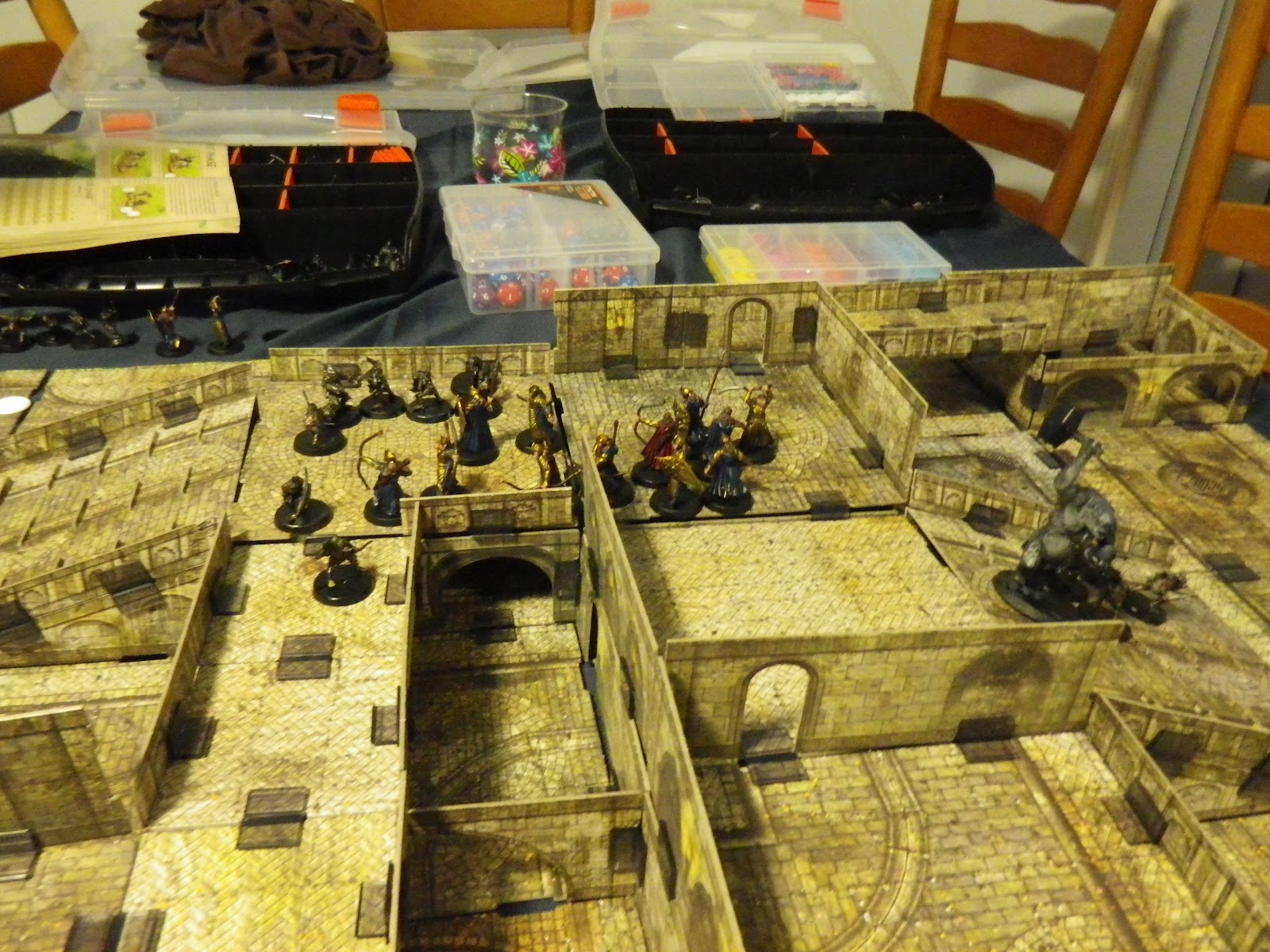
This was a 200pt game - armoured high elves, lead by Haldir, against a troll, goblin captain, and a swarm of perfidious goblin underlings.  As I was too sick to go to my regular game, the wife filled in, and did well in her first outing.

Terraclips Terrain
I have reviewed them here but it is worth re-emphasizing two things (a) how easy it is to store them flat and (b) the ridiculous amount of time needed to assemble it.  Kinda counter-intuitive.  Technically, it is very transportable - but in practice I would never use it at my local club as it takes an hour to assemble a decent board.  That said, my opponents always enjoy playing on its detailed, multi-leveled surface, and the cardboard is surprisingly tough and forgiving. A quality product, but one that lacks a clear role.  In the game pictured I used about one and a half packs of the Streets of Malifaux set.

Disclaimer: all my minis are basecoated only - as I refuse to play with unpainted minis but didn't have time to detail and base both sides. 

Set-up
As usual I split my force in three - the cave troll seemed to attract a lot of attention, so I used only a few goblins to support it in the centre, sending the bulk with my goblin captain on the right flank, and a band of 4 archers around the left.  As usual my opponent responded to my three-pronged attack by splitting the force into two - the bulk of the archers facing my small goblin force, and the rest with Haldir up the centre.

Early Game
I moved my troll up the middle to get attention and snuck my main horde around to the right (they are out of sight at the top of the board) - I planned to use their climbing to assail my foes from the flank and rear like last game. The wife started to move her forces together which was what I did NOT want.

All eyes on the troll - while the sucker punch comes around from the right....
There are also a handful of goblin archers hiding behind the doorway at the bottom of the map.

I had to try to get some separation between her forces so I did my now-standard "feigned retreat" - as anticipated she chased the troll up the middle; firing at its leathery hide with no effect.

I retreat to buy the flanking force time to get in position....
Middle Game
I spring my trap. There is the usual "wtf" moment as the goblins scurry over the walls.  I spend a might point to seize the initiative. After being peppered with elf arrows, the goblin archers on the left also climb over from the other side and join in.

The trap is sprung! Goblins climb over the wall to the top of the map and engage the elf rearguard

 With superior numbers, they quickly force the pointy-ears back

End Game
I force the elves back, but my feigned retreat with the troll meant it took too long to get my heavy hitter into combat. Meanwhile, my puny gobbos proved a bit too easily carved up by those shiny elf blades.  After Evil initially holding the advantage, both of us reached the "Break Test" on the same turn. That said, the"troll decoy" did keep the enemy broken up into two bite-sized forces so perhaps it was a fair trade.

Both sides lost heavily - here the troll finally gets into combat and breaks through

There was a last fight, with the goblin captain breaking and fleeing but the troll and a few others proving surprisingly resilient despite their courage of 2.  Haldir used his might to inflict two wounds on the troll, which passed several break tests along with a companion goblin who was eventually hacked down.  Running out of might, Haldir finally fell to the troll, in a literal fight to "the last man standing."

The fight lasted surprisingly long - after a few goblins bolted off, both sides passing their break tests with amazing valour

A good game - my wife easily grasped the basics after a few turns; arguably she missed victory due to my superior die rolling in the endgame - those goblins just refused to flee! (Which, gracious loser as she is, she reckoned was due to loaded dice or some sort of craps-style "blanket roll" trickery on my behalf).

Thoughts
There was less maneuver in this game as my wife nervously kept her forces close together and wouldn't be lured too far apart.  Again LOTR is so simple - and the activation mechanic, use of Might, Fate and Will for resource management (to win fights, and alter the activation sequence) makes this far superior to the cheesy codex list-mongering of 40K. 

The goblins are quite powerful - they have access to hordes of cheap troops for outnumbering purposes, and a few troll heavy hitters. Both times I have used the goblin agility to climb vertical terrain and swing the tide of battle - so despite their rather bland "special power" it has been used effectively.   The built-up terrain hindered the elf archers. I'd be interested to see how dwarves would go, but sadly I can't get them on ebay for love or money (and strangely, buying them new at $70 for 2 sets of 12 plastics doesn't appeal).

I'll do almost anything to get some cheap dwarves - including waxing my legs, as you can see

Monday, 3 September 2012

Infinity: Skirmish Wargame Paradise?

The skirmish campaign was popularized by Mordhiem and Necromunda.  The ability to gain experience and upgrade your heroes lead to an attachment to your warband and a "storytelling" feel you just can't get in a one-off scenario or fight to the death. 

Even now, unbalanced as they are, Mordhiem and Necromunda tend to elicit positive nostalgia.  There have been several attempts to capitalise on this, most recently through Empire of the Dead (itself a thinly disguised imitation of the Legends of the Old West rules which in turn were based on Mordhiem et al); I have personally revived Battle Companies for my LOTR forces.

But the best skirmish game of recent times is, arguably, Infinity.  If the "Big Three" are Warhammer, Warmachine and Flames of War, then Infinity is part of the "next three" alongside games like Malifaux and those by Spartan Games. 
 
Ariadna: low-tech Russian-Scottish faction; they have werewolves and heavy weaponry

Excellent Sculpts
Beautiful detailed models, with fluid, dynamic poses and crisp casting, Corvus Belli have set the benchmark for all other sci fi models. That said - not every sculpt will be loved by everyone - their newer models are noticeably better than their old ones - which are still not bad - but the difference is appreciable. Putting them together can be fiddly. Some factions have an anime aesthetic which does not appeal to everyone, but a sci fi game devoid of both skullz, scrollz and spiky bitz AND grimy post-apocalyptic wastelands gets the thumbs up from me.  A starter box (with 6-7 models) is $40 and since teams seldom exceed 10 minis per side, you can expect to pay under $70 for a well-equipped "army." Seriously. Have a look at their website. If you don't find something you like, I'll refund the time you spent reading this paragraph.

 PanO: a Appleseed anime-style mashup with armoured space knights - a hi tech shooty faction. This is a new release for this month

Very Shiny Rules
As the rules are free, there is no need to buy the rulebook.  But most do anyway - as this is one of the most beautiful hardbacked rulebooks I have come across. Fantastic original art, beautiful photos - it's a coffee table book as much as it is a rules reference.  Yes, it can be a bit hard to read at times, needs a better index system, has fluff mixed in with the rules, and sometimes stuff has been "lost in translation" (you're better off using the pdf simplified Starter Rules, mixed with the online wiki to begin with) but if you're not enjoying the fluff and shiny stuff, you're doing it wrong.  The Human Sphere add-on is also well worth it. You don't need the rulebook - but you should get it anyway...  

Infinity even has fluff videos! Production values, even in videos, are high

If the anime aesthetic isn't your thing, that's fine - only applies to 3 or 4 of the 7 factions

Excellent Rules
 But the most revolutionary thing about the game is the rules. Whereas most sci fi game mechanics don't deviate far from 40K, Infinity tips them on their head.  The first major change is the "order pool".  In most games, each model gets one activation or "order." This is true of Infinity - but you can spend them however you like - activating the same model repeatedly if you wish.  For example, seven models generates seven orders.  However instead of activating each model once each, instead you could activate the same model seven times in a row. Or activate one model four times, and another model three times - you get the idea. Once your orders are all used up, it is your opponent's turn.

 Yu Jing: Asian hi-tech conglomerate with lots of power-armour and, of course, ninjas, good in melee

The second major change is use of reactions or AROs.  Every time a model activates every opponent in line of sight can react to him (usually by firing at him or dodging behind cover). This ensures the gameplay is non-stop. Both players roll a d20 in a "face to face" roll and the winner (who also must roll under his relevant stat - be it physical or shooting) gets to act first.

It's a little hard to get your head around the mechanics but Corvus Belli have made a series of great Utube videos which should help any newbie. The rules are actually quite simple - its more that they are so very different to the "norm."

There is a great series of tutorial videos explaining how the unusual mechanics work

Combat is very lethal; weapons fire 3-4 shot bursts and even a single shot is likely to kill. Heavy weapons can fire across the board. Good use of cover is critical to survive. Close combat is possible but unlikely - in sharp contrast to 40K where  using the bolter rifle as a club is usually more effective than actually firing it.

There is a good choice of weapons but they share similar stats (i.e. a AP rifle, Multi-rifle, Viral rifle, and Combi-rifle all use the "rifle" range bands and rate of fire but simply differ in the type of ammo used) There are drones and robots, which act as both "pets" or can be autonomous; hackers who can seize control of power armour or mechs and turn their weapons on their allies - even redirecting guided missiles in flight: grenade launchers with superadhesive to stop foes "in their tracks"; tissue-shredding monofilament mines, chain rifles, cut-down MGs "spitfires", shotguns and flamethrowers as well as a range of exotic weaponry such as EMP devices, flash and electrical weapons.

 Nomads: rebels of space, with lots of hackers, mutants and gun-toting space nuns.

Now with a Campaign System (Campaign Paradiso)
There are lots of fan-made scenarios but Infinity has been until now been more officially geared around the kill-em-all tournament mentality (in which it is surprisingly balanced).  There has always been a clamour for a Mordhiem-esque system to gain experience and new equipment and skills.  This is arriving in November, along with a complete new alien faction (the mysterious Tohaa) and 16 scenarios.

The new campaign book teaser....

...but not perfect
Infinity is not perfect. I feel that "rules creep" has been slowly bogging the game. More and more special rules, special equipment and "exceptions" proliferate with every new model.  Infinity's boast is "it's not your list - it's you" - inferring that YOUR tactics and in-game choices rather than your army lists determines the victor.  I think it is in danger of becoming "It's not your list - it's your memory" - i.e. inferring that your ability to memorize special rules and their interactions is the key to victory.  The initial learning curve in Infinity is steep - but the proliferation of new rules are making it increasingly vertical. That said, things like camouflage and paratroops allow you to break through enemy defences and add a whole different dimension to the game. Not even your deployment zone is safe!

However if you have an iPad or similar device, the Infinity wiki has all rules cross-referenced in a very user-friendly way.

Haqqislam: Moorish/benevolent Muslim faction with regenerating heavy infantry and assassins

There are no vehicles in the game (although there seem to be placeholders in the rules for them); personally I think this is fine, as having tanks etc seems outside the scope of a game with usually less than 10 men per team.  Instead there are TAGs and REMOTEs - small mechs and robots that wield heavy firepower such as missile launchers, flamethrowers and automatic cannon. 

TAGs are powerful, agile mechs that support the special-forces teams

Finally, if you don't have lots of terrain, you might as well not bother. For me, this is the #1 issue with "getting into" Infinity. Generally, if you can see it, you can shoot it.  There should never be more than a 4 to 8" gap between pieces cover unless you want to see your models die very fast.  Tall buildings allow snipers and machinegunners to dominate. A player with a mentality of 3-6 terrain pieces per table (a la 40K) could see his force shot down from his opponent's deployment zone.
It's not insurmountable though - I made a cheap and cheerful terrain board in a weekend.

Combined Army: a mix of red faced angry warrior space monkeys and seed-spawned vicious shapeshifting alien killers
TL:DR
Brilliant cinematic activation system and ability to react to opponents means it's "always your turn" - your models don't stand around like dummies waiting to be shot.  Combat is lethal, and realistic use of cover is encouraged.  A wide range of weapons and equipment means a huge toolbox of tactical choices.  The game is relatively cheap ($40-70) to start and the rules and all lists are free. The game is well supported with a steady stream of new releases, Youtube guides, and friendly forums. The wiki is very useful if you have a mobile device. This is a game where player skill matters more than your "army list" and you are always involved in the gameplay.

However, remember for Infinity you need LOTS of cover.  In fact, lack of terrain was the reason my Infinity models have sat dormant for so long. Special rules and equipment can be a bit confusing and frustrating (you tend to lose when meeting a new superweapon for the first time). The learning curve is steep, and rules could be better laid out. 

Nonetheless: in-game skill > army list codex warriors; cheap intro cost; free rules and lists; cinematic gameplay; realistic cover and reactions; good support and community, wide range of exotic weapons and equipment, great sculpts, and not a gothic building, skull or scroll in sight.....

Recommended?: Definitely. With a new campaign system, the best skirmish game for sci fi just got soul. Get in now to avoid the rush.

Aleph: a "benevolent" AI that oversees humanity. Cyborgs, robots and sentient body-hopping AI ensure everyone "co operates"....     
...OK, I admit, ever since Number Six from BSG, I've liked my cyborgs female...

Warmachine: Not the Messiah, just a Messy Game

Looking at this post it started out as a LOTR batrep but became a Warmahordes rant. Oh well, I've been sick - allow me this indulgence.

LOTR: A game for the simple-minded amongst us

LOTR: Simple but Subtle
My second game of LOTR (300pts) on the weekend.  The rules for LOTR models are very straightforward and play like a streamlined, less-cheesy version of 40K, with more tactical unit activation, movement and firing choices as well as an element of resource management. 

Most models have no special rules at all to remember (Warmachine and Malifaux, I'm looking at you) and both myself and my opponent commented on how we were concentrating on actual tactics and maneuver rather than referencing special rules.  In fact this time though we only needed to consult the rulebook a few times (each time we used a new troop type) to check basic stats. 

In contrast, listening to the Warhordes games at the tables nearby:

"I pop my feat now"
"Okay - what does that do" (searching in rulebook)

"Okay then I counter with.. wait, does that model have reach?" (goes to nearby table to ask)
(Looks at his cards)
"You can't attach Sorcha as he has fire immunity"
"Oh. In that case I spent a focus to cast Lightning Blast which I channel through this node"

If you paid enough for your model, you don't even need to move minis - you can simply let it sit in your deployment zone and play "cards"


People were checking the rules or unit cards pretty much every time something activated.  Reminds me of a bad CCG or RPG session. In fact I have decided that with Warmachine you might as well do away with models altogether, as maneuver seems mostly concerned with what models you are willing to sacrifice to damage xy model/s of your opponent. E.g. As an extreme example, one game had a giant $100+ pewter warmachine (with 1-2 attendent mechanics clustered against it) fighting off a horde of foes. It was parked static on the table and I was told "he doesn't have to move; there's a lot of strategy in the order you use your abilities."  Mmmm.  So why did we bother with the models, again? 

The locals are saying how awesome Warmachine is compared to 40K/WFB but swapping a game that rewards powergaming, cheesy lists and has ridiculously expensive models for one which openly rewards powergaming, cheesy lists and has ridiculously expensive models AND overly complex rules (which supposedly add "tactics") does not seem like a trade up to me. Although PP hasn't discovered Finecast yet, it's only a matter of time.

 Powergaming, even when overtly encouraged, is still cheese

One guy asked me how I can remember the rules to "all those games"  (I have been seen playing Tomorrow's War, Infinity and LOTR on the same day (yikes!) whilst everyone else relentlessly garners competition points with their unpainted Warmachine metals).  The answer: Probably because the same brain cells that are use to remember a single Warcaster's feats, powers and stats can be used to memorize the base rules and stats for several LOTR factions

/rant off (wipes spittle from around mouth)... back ON Topic..   ...yes, LOTR that was it

..anyway I was saying how subtle LOTR rules are.  "Special rules" are so few, and seem to have so slight an impact, yet add lots of flavour.

Yes, the random LOTR photos means I forgot my camera again. A pity as I'd like to show off the Terraclips terrain in action.

List Building
I simply grabbed two trolls (as they looked cool); a captain to give some Might points, and filled out my goblins as spears, bows and shields in equal number.  My opponent, mindful of weakness of archery, traded in all his 8 or so Gondor archers for 3 Rangers and brought more spears, as well as 3 Fountain Court bodyguards for his leaders.  He had Faramir and a captain to both counter my trolls and have a healthy Might point advantage.

Deployment
I deployed my forces (each to the sides of a bridge that ran across the table from one deployment zone to another) in three forces, each flank lead by a troll with my goblin captain in the centre ready to cross the bridge.

My opponent split up his forces, half spears on the bridge (lead by a captain) whilst his heavy hitters aimed for my weakest flank. He advanced.

Early game
As happened last game; I totally withdrew my weakest flank, leaving some archers to pepper his advancing troops.  I charged both trolls over the bridge, much to my opponents' consternation.  I also sent a mess of goblins round the far undefended flank.  It now looked like a race; who could to the other side's deployment zone first so they could charge up the bridge behind the enemy. My gobbo archers drew first blood by picking off 2 Rangers with the loss of one of their own.

Mid Game
Unfortunately, the "race" was stacked - my goblins simply climbed the side of the bridge. The spear wall, lead by the captain, was quickly pincered by the trolls and the sneaky goblins who took the vertical "shortcut".  Despite heroics by the captain, who hacked down several of the swarming goblins, the spearmen on the bridge were efficiently butchered. Rather improbably, 4 goblins had been lost for 2 rangers and 8 men of Gondor. 

End Game
The hammer (Faramir and his Fountain court) arrived after looping round the end of the bridge but by then my forces had turned to face the threat to their rear. Faramir fought a heroic battle with the horde, killing 6 goblins single-handed, but finally ran out of might and got ripped apart with 7 wounds in a single melee round.  The rest of the Gondor force broke and fled, save for the Fountain Court bodyguards who naturally stayed with Faramir until the bitter end.


Thoughts...
Special Rules
The goblin's climbing ability proved decisive but was by no means "victory by rules" and I liked how my opponent recognized the threat himself "This looks like ring-a-rosey... uh oh hang on goblins can climb walls - crap!" (albeit too late) and the Fountain Court guards stayed to fight, cinematically, to the end due to the "bodyguard" rule.  At no stage did we have to paw through the rulebook to check or justify "special" rules.

My archers are about as deadly as this guy firing suction cup arrows...

Archery
When archery is mostly '6's to wound against armoured targets, quantity > quality.  I think I'm going to concentrate all my archers next time to give a massed volley.  Whilst the 3 Rangers were accurate shots, the simply could not match the rate of fire/wounding capacity of the 9 goblin bowmen.  That said, I can see why my opponent barely bothered - archery is very weak (8% lethality on average).

FACT: Three is better than Two; unless we're talking about haemerrhoids

Three Prong Attack
This worked last game too - I divided my force into three groups; my opponent responded by dividing his force in half (thereby technically out numbering any of my three groups by a 5:3 ratio)

Each time I responded by "withdrawing" one of my flanking groups to lure one of his halves away, then attacking his remaining half with my other two (creating a 7:5 ratio in my favour whilst also having greater maneuverability with 2 groups vs 1)

Again, I really enjoy LOTR as it has simple rules that encourage decisions about maneuver and resource management rather than winning by remembering more combos of rules.